Your weakest link in running mechanics is the point in your stride where your body’s stability or efficiency breaks down first under fatigue or load—often the exact spot where injury develops. This weak point isn’t always obvious because it may not hurt; instead, it shows up as asymmetry in your stride pattern, excessive movement in a joint, or compensation from stronger muscle groups elsewhere in your body. Identifying it requires honest observation of how you run when you’re tired, not how you run when you’re fresh. Most runners have at least one mechanical vulnerability.
A runner with poor hip stability might develop knee pain. Another with limited ankle dorsiflexion might overpronate. A third with tight calves might compensate at the knee or hip, eventually injuring the lower back. The good news is that once you identify your specific weak link, training becomes targeted and effective instead of random.
Table of Contents
- What Creates a Weak Link in Your Running Pattern?
- The Most Common Running Mechanic Weaknesses
- How Weak Links Progress to Injury
- Practical Methods for Identifying Your Weak Link
- Identifying Specific Weak Links in Your Stride Cycle
- Tools and Tests for Detection
- Creating a Training Plan Around Your Weak Link
- Conclusion
- Frequently Asked Questions
What Creates a Weak Link in Your Running Pattern?
A weak link emerges when one part of your kinetic chain lacks the strength, mobility, or control needed to manage the forces of running. Running generates impact forces of two to three times your body weight with each footfall. Your body distributes these forces across joints and muscles in a specific pattern. If one joint or muscle group can’t handle its share, neighboring structures compensate, working harder and tiring faster. This is where breakdown happens. Consider the hips. If your hip abductors and external rotators are weak, your pelvis drops on your non-stance side when you run. Your knee then angles inward to compensate.
Over months, this altered knee alignment causes inflammation in the patellofemoral joint. You might assume the problem is your knee, but the actual weak link was your hips all along. This is why generic knee-pain strengthening programs often fail—they don’t address the source. Environmental and training factors also create weak links. Running exclusively on firm pavement builds strength in straight-line motion but may leave your feet, ankles, and hips unprepared for uneven terrain. Increasing weekly mileage too quickly overwhelms whichever system is least adapted. Poor sleep, inadequate nutrition, or chronic stress reduces your body’s ability to stabilize the most mechanically challenging parts of your stride. The weak link often isn’t a structural problem but a readiness problem.

The Most Common Running Mechanic Weaknesses
Overpronation—excessive inward rolling of the foot and ankle after landing—ranks among the most common weak links. The arch of your foot should act like a spring, absorbing impact and storing energy. If the muscles supporting your arch are weak, your foot collapses inward, and that lost arch function transfers stress to your ankle, knee, and hip. Importantly, mild pronation is normal and necessary; the weakness shows up as excessive or uncontrolled pronation that continues too long into your stride. Limited hip extension is another widespread problem. Many runners spend eight or more hours sitting daily, which tightens the hip flexors and leaves the hip extensors weak and underdeveloped.
When you push off the ground, your back leg should extend fully behind you, powered by your glutes. Without adequate hip extension, your stride shortens, your cadence increases, and your legs work harder for less forward progress. This doesn’t cause immediate pain but leaves you vulnerable to overuse injuries because each stride is mechanically inefficient. Weak ankle stability in the frontal plane—side-to-side—appears in runners who spend little time on uneven surfaces or who have never specifically trained ankle proprioception. Your ankle should lock into a stable position as you land and provide a solid platform to push off from. Ankle instability forces your knee and hip to work harder to manage side-to-side movement they weren’t designed to handle alone. Over time, this contributes to knee and hip injuries.
How Weak Links Progress to Injury
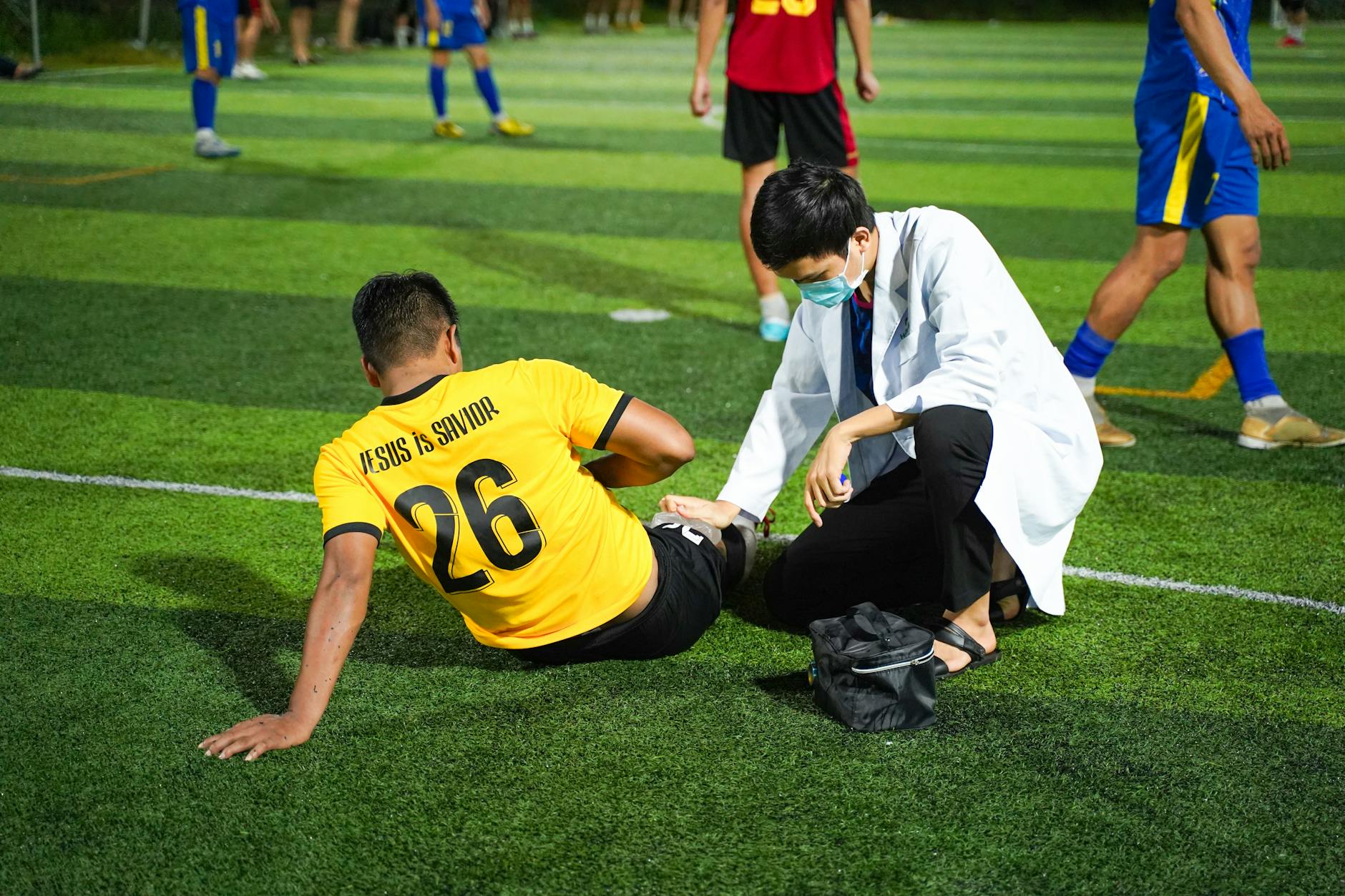
A weak link doesn’t cause injury immediately; it causes compensation. In the early phase, your body’s redundancy covers the problem. Other muscles work overtime, proprioceptive systems compensate, and you run without obvious pain. But compensation is expensive. The muscles doing the extra work accumulate metabolic fatigue faster than they otherwise would, and they’re working at slightly suboptimal angles. After weeks or months of this, inflammation develops, tendon stiffness increases, or muscle imbalances become extreme enough that even the compensatory system fails. Consider a runner with weak glute medius muscles.
At first, the outer hip muscles and lower back muscles compensate for this, controlling pelvis drop. You run fine, maybe even faster than before because you’re training. But by week eight or twelve, the outer hip and lower back tissues are irritated and fatigued from chronic overwork. That’s when pain emerges—and it may appear in the lower back, the outside of the knee, or the upper calf, nowhere near the actual weak link in the glutes. This progression explains why foam rolling, stretching, or icing the site of pain often provides only temporary relief. The tissue that hurts is not the problem; it’s the victim of the weak link upstream. Understanding this reframes your entire approach to injury prevention and training.
Practical Methods for Identifying Your Weak Link
Video analysis of your running form is one of the fastest paths to identifying mechanical weaknesses. Record yourself running from multiple angles: directly from the side at around waist height, from directly behind you, and from the front if possible. Look for these patterns: Does your pelvis shift side to side or drop on one side? Do your feet point straight ahead or angle outward? Do your knees track over your toes or collapse inward? Do your arms cross the midline of your body? Watching yourself run reveals asymmetries and excessive movements that feel invisible when you’re running. Strength testing provides concrete data. Perform these tests: single-leg balance with eyes closed (should exceed 30 seconds easily), single-leg glute bridge (can you hold your hip level for 20 reps on each side, or does one side drop?), calf raises on one leg (do both sides match in strength and height?), and a prone hip extension test (lying on your stomach, can you extend one hip as far as the other?). Asymmetries reveal weak links.
A significant difference between left and right sides points directly to the problem. A running-specific assessment involves self-video at the moment you begin to fatigue. Run at your normal pace for five or ten minutes, then record yourself. You’ll see your form deteriorate in real time. This is your weak link revealing itself. Fatigue unmasks compensation patterns because tired muscles can’t maintain the extra work. The movement that breaks down first is your weak link.
Identifying Specific Weak Links in Your Stride Cycle
Your stride consists of several distinct phases: initial contact (footstrike), loading response (absorbing impact), midstance (supporting your body weight on one leg), terminal stance (pushing off), and swing (bringing your leg forward). A weak link can appear in any phase. A weak calf causes your forefoot to rise too early during terminal stance, cutting off your push-off power. Weak hip flexors prevent your leg from swinging through efficiently, forcing you to rotate your pelvis excessively to get your leg forward. Weak foot intrinsics prevent your arch from stiffening during midstance, collapsing your support structure right when you need it most. One warning: don’t self-diagnose a weak link without at least one form check or strength test.
Runners are prone to confirmation bias. You might believe your hip extensors are weak because you read an article about hip extension, but your actual limiting factor might be ankle mobility or foot strength. Multiple perspectives—video, testing, and ideally feedback from a running coach or physical therapist—create accuracy. Another limitation is that weak links aren’t always about strength in the traditional sense. You might have strong glutes but poor glute activation, meaning your brain doesn’t recruit them effectively during running. This shows up as weak-looking movement even though the muscle is capable. Addressing this requires neuromotor retraining, not just strengthening.

Tools and Tests for Detection
The single-leg squat test reveals lower-body control. Stand on one leg and slowly lower yourself into a shallow squat, around 45 degrees. Ideally, your knee stays directly over your second toe, your torso stays upright, and your pelvis stays level. If your knee collapses inward, your trunk leans, or your pelvis tilts, you’ve identified a weak link in hip control or ankle stability. Perform this on both sides to detect asymmetry. The Trendelenburg test specifically isolates hip stability.
Stand on one leg for 30 seconds while standing in front of a mirror. Watch your pelvis. It should stay level. If the side opposite your standing leg drops, your hip abductors are weak. Most runners with weak hip abductors don’t realize it until they see themselves on video or in a mirror. This single test catches one of the most common running weak links.
Creating a Training Plan Around Your Weak Link
Once identified, your weak link should receive concentrated attention for four to eight weeks before assuming it’s resolved. Rather than general strength training, focus on the specific pattern and range of motion where the weakness showed up. If your weak link is single-leg balance, perform balance exercises on one leg; if it’s hip extension, perform exercises that emphasize full hip extension against resistance. Specificity matters.
Upgrading a general gym routine with compound lifts helps, but direct work on the weak link speeds progress significantly. Forward-looking, the smartest approach is preventing weak links from developing in the first place. Runners who vary their training surface (pavement, track, grass, trails), maintain consistent strength work year-round, prioritize sleep and recovery, and pay attention to asymmetries during video reviews rarely develop serious mechanical weak links. The investment upfront prevents months of compensation and the eventual injury that weak links cause.
Conclusion
Identifying your weakest link in running mechanics requires honest observation, not guessing. Video yourself running, test your strength with focused exercises, and pay attention to how your form changes when you’re tired. Most runners have at least one mechanical vulnerability—overpronation, poor hip stability, limited ankle mobility, or weak glute activation. The vulnerability itself isn’t necessarily a problem; the problem is compensation and the eventual injury that comes from weeks of inefficient movement.
Once you’ve identified your weak link, training becomes intentional. You’re no longer doing generic strength work hoping something helps; you’re addressing the specific point where your body breaks down. This targeted approach speeds progress, reduces injury risk, and actually improves your running efficiency and speed over time. Start with video analysis and simple strength tests this week. What you discover will almost certainly explain some of your current limitations.
Frequently Asked Questions
How do I know if my weak link is strength versus flexibility?
Test both. Perform the movement in a controlled environment without load (flexibility test), then perform it under fatigue (strength test). If you can move through the full range passively or statically but can’t maintain it while running or under load, the problem is strength or activation. If you can’t achieve the range even without load, the problem is primarily flexibility.
Can I have more than one weak link?
Yes. Most runners have two to three areas that need attention. The hierarchy matters—usually one weak link is primary and causes compensation that creates secondary weak links. Address the primary one first for four to eight weeks, then tackle the secondary ones.
How long does it take to fix a weak link?
Four to eight weeks of focused training typically produces noticeable improvement in asymmetry or control. Full adaptation usually takes three to four months of consistent work. Genetics and training history affect the timeline; athletes with athletic backgrounds often progress faster.
Should I stop running while I fix my weak link?
Usually not. Reduce weekly volume slightly if you’re experiencing pain, but continue easy running. The weak link developed during running, so you need running-specific training to fix it. Just reduce load on the injured tissue while building capacity in the weak link.
Can a physical therapist identify my weak link more accurately than self-assessment?
Yes. A PT performs controlled tests, observes compensation patterns you can’t see, and may use equipment like force plates or gait analysis. Self-assessment catches obvious problems and costs nothing; professional assessment catches subtle problems and provides specific correction strategies. If you’re injured or making slow progress, a PT visit is worth the investment.
Is my weak link always related to my injury?
Usually, but not always. Sometimes an acute injury is unrelated to your weak link, though the weak link may have made you vulnerable to that specific injury. For chronic, recurring injuries or pain that doesn’t respond to rest, the weak link is almost always involved. Address it alongside treating the acute issue.