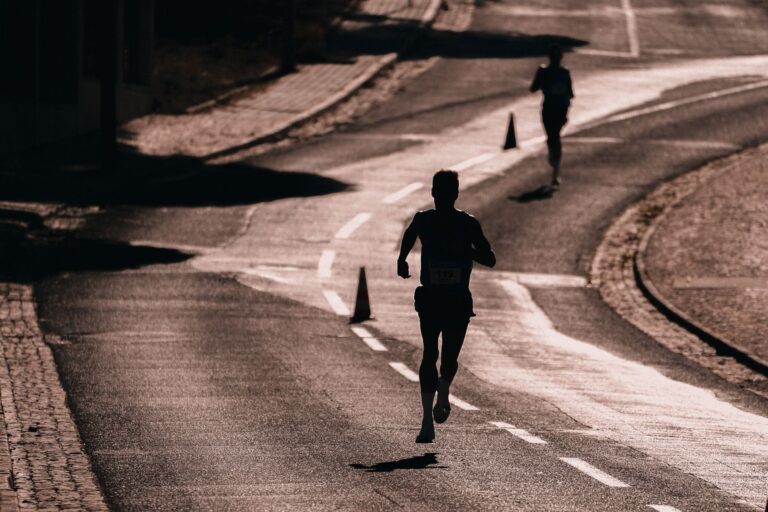
Sabastian Sawe holds the ratified men's marathon world record at 1:59:30, averaging about 2:50 per kilometer or 4:33 per mile. A marathon is exactly 42.195 kilometers, and recovery can take three days to beyond seven even when soreness fades sooner. The women's mixed-race record is Tigst Assefa's 2:11:53, while her separate women-only record is 2:15:41. "Mixed-race" means the women competed in a race that also included men.
Medical information disclaimer: This article is for general educational purposes only and does not provide medical advice, diagnosis, or treatment. Always consult a physician or other qualified health professional about symptoms, medications, tests, or treatment decisions.
Table of Contents
- Who holds the marathon world records?
- What pace does each record require?
- How long is a marathon, exactly?
- How long does marathon recovery take?
- How should runners use the recovery evidence?
Who holds the marathon world records?
Sawe ran 1:59:30 at the London marathon on April 26, 2026. It was the first officially recognized sub-two-hour marathon. World Athletics' ratification notice also lists Assefa's 2:15:41 from London as the women-only record.
Assefa set the women's mixed-race record of 2:11:53 in Berlin on September 24, 2023. World Athletics ratified that performance in 2024. The two women's categories reflect different race settings. The mixed-race mark is the faster overall women's record, while the women-only mark applies when elite women race without male competitors.
What pace does each record require?
Sawe's 1:59:30 works out to approximately: Assefa's 2:11:53 mixed-race record averages approximately: These figures are whole-race averages, not proof that every kilometer or mile was identical. At a perfectly even pace, Sawe would reach halfway in 59:45, while Assefa would reach it in about 1:05:57. Rounded mile and kilometer paces may produce a slightly different projected finish when multiplied across the full distance.
- 2:50 per kilometer
- 4:33 per mile
- 21.19 kilometers per hour
- 13.17 miles per hour
- 3:08 per kilometer
How long is a marathon, exactly?
The official distance is 42.195 kilometers, or 26 miles and 385 yards. The familiar "26.2 miles" is convenient shorthand, not the exact specification. World Athletics rules require a marathon course to be at least the full official distance. Distance alone does not make a course eligible for a world record.
The start and finish cannot be more than half the race distance apart, and the net elevation drop cannot exceed one meter per kilometer. The course also needs an international measurement certificate, according to World Athletics' certified-road-event criteria. For a marathon, those limits mean no more than 21.0975 kilometers between the start and finish and no more than 42.195 meters of net descent. A faster time on a course outside those limits cannot become the official world record.
How long does marathon recovery take?
There is no single recovery time that applies to every runner. In a 2024 study of 20 trained marathoners, oxidative-stress and muscle-damage markers peaked two days after the race. Individual recovery ranged from three days to longer than seven days, as reported in Physiological Reports. A separate randomized study followed 34 experienced marathoners.
Their soreness returned to baseline by day two, but creatine kinase, AST, and C-reactive protein remained elevated. Feeling less sore therefore did not establish that their measured physiological responses had returned to baseline. Both studies involved small groups of trained or experienced runners. They describe recovery patterns, but they do not provide a universal date for resuming hard training.
How should runners use the recovery evidence?
Treat recovery as an individual process rather than a fixed countdown: Anyone facing a medical clearance decision needs individualized guidance; these studies cannot determine readiness for a specific runner.
- Do not use reduced soreness on day two as proof of complete recovery.
- View three to seven-plus days as an observed range, not a guaranteed schedule.
- Remember that findings from trained marathoners may not predict another runner's response.
- Do not turn group averages into personal medical clearance.