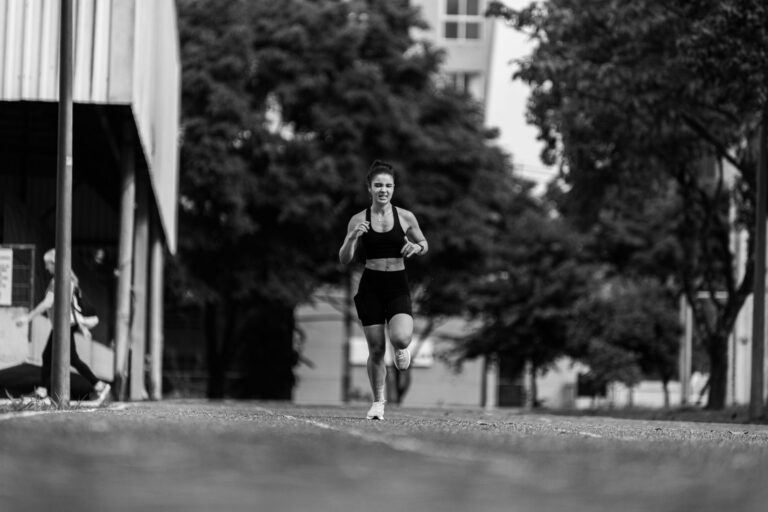
Slow running develops better form than fast running because moving at a controlled pace allows your body to maintain proper biomechanical alignment throughout your stride. When you run slowly, you have the neurological bandwidth to concentrate on foot strike, hip extension, arm swing, and posture—the fundamental mechanics that prevent injury and create efficiency. A runner executing a slow 10-minute-mile pace can actually focus on landing with their center of gravity directly beneath them, maintaining a neutral pelvis, and running quietly; the same runner at a 7-minute-mile pace often defaults to compensatory patterns, overstriding, and excessive vertical oscillation because their central nervous system is simply working too hard to maintain that speed.
The reason this distinction matters is that form issues compound. A runner who logs miles at a pace they cannot control aerobically tends to embed poor movement patterns into muscle memory. These patterns become automatic, feel “normal” by mile four of every run, and persist even when you slow down—a phenomenon runners call “holding onto the pace.” The good news is that deliberate slow running is essentially technical training. Just as a tennis player practices groundstrokes at half-speed to groove technique, a runner who invests in easy miles develops the postural stability and movement economy that actually make faster running safer and more sustainable.
Table of Contents
- HOW FORM IMPROVES WHEN YOU REMOVE THE SPEED CONSTRAINT
- THE UNDERRATED ROLE OF CADENCE IN EASY RUNNING FORM
- NEUROMUSCULAR CONTROL AND STABILIZER MUSCLE ACTIVATION
- BREATHING, RELAXATION, AND FORM QUALITY
- THE DANGER OF SKIPPING EASY MILES AND FORM DECAY
- HOW SLOW FORM WORK PREVENTS INJURY BETTER THAN STRETCHING OR STRENGTHENING ALONE
- BUILDING A SUSTAINABLE RUNNING CAREER THROUGH FORM PRIORITY
- Conclusion
- Frequently Asked Questions
HOW FORM IMPROVES WHEN YOU REMOVE THE SPEED CONSTRAINT
Your body prioritizes different things depending on demand. At high intensity, your autonomic nervous system engages survival systems—your sympathetic nervous system dominates, your proprioception narrows, and your brain allocates attention to power output rather than precision. Slow running reverses this hierarchy. At an easy pace (typically 60–70% of your max heart rate for most runners), your parasympathetic nervous system remains engaged, which means your body can afford to process feedback from your feet, ankles, hips, and core and adjust dynamically. A concrete example: imagine a runner with a subtle anterior pelvic tilt—a forward hip tilt that causes the lower back to arch excessively.
At tempo pace, this runner’s quads fire hard, the lower back compensates further, and the anterior chain dominates the movement. At an easy pace, that same runner might actually feel the anterior tilt, sense the shortage of glute activation, and unconsciously correct toward neutral. Over weeks of easy miles, this pattern shifts. The glutes fire more readily, the lower back relaxes, and the runner builds postural endurance in the correct position. When they return to faster paces, that improved position is now the baseline.
THE UNDERRATED ROLE OF CADENCE IN EASY RUNNING FORM
Cadence—the number of footfalls per minute—is where slow running’s form benefits crystallize most clearly. Elite distance runners typically run 170–180 steps per minute regardless of pace. Recreational runners often run 160–170 steps per minute, but this number drops dangerously at slower paces; a runner doing an easy 12-minute mile might fall to 150 steps per minute, at which point overstriding becomes inevitable. Overstriding, where your foot lands in front of your center of gravity, is the root cause of many injuries: shin splints, knee pain, plantar fasciitis, and stress fractures.
The limitation here is that maintaining high cadence at very slow paces can feel awkward and biomechanically inefficient. A runner holding 175 steps per minute while running a 12-minute mile is taking very short, rapid steps that might feel bouncy or unnatural. This is why the sweet spot for form work is the easy-conversational pace—typically 9–11 minutes per mile for recreational runners—where high cadence feels natural and coordination is easy. Below that, runners should either accept a slightly lower cadence as a tradeoff or incorporate deliberate cadence drills rather than trying to artificially maintain elite-level turnover.
NEUROMUSCULAR CONTROL AND STABILIZER MUSCLE ACTIVATION
Running fast recruits your large prime-mover muscles—quads, glutes, calves—but it does this explosively and repeatedly. Running slow is when stabilizer muscles—the intrinsic foot muscles, the glute medius, the transverse abdominis, the rotator cuff—get the opportunity to engage meaningfully. These smaller muscles are responsible for preventing excessive side-to-side motion, absorbing shock, and maintaining spinal stability.
They don’t fatigue as quickly as prime movers, which means they can actually do their job during an easy run rather than shutting down or delegating their work to larger, less precise muscles. A runner with weak glute medius who does high-mileage fast running will often develop IT band tightness and lateral knee pain because the large abductor muscles can’t stabilize the pelvis against the repeated impact forces. The same runner doing slow, consistent easy miles builds glute medius endurance and proprioceptive awareness, which literally changes how the knee tracks. The injury often resolves not because of anything flashy but because stabilizer muscles finally had a chance to strengthen at a pace that allowed full recruitment.
BREATHING, RELAXATION, AND FORM QUALITY
One of the most underappreciated reasons slow running improves form is that it allows proper breathing without sacrificing posture. When you run fast, breathing becomes rapid and shallow; many runners flare their ribs, tense their shoulders, and lose spinal stability in the effort to get oxygen. Slow running permits nasal breathing or controlled mouth breathing that doesn’t compromise core tension. This seemingly small detail changes everything: a runner who can maintain a calm breathing pattern and a quiet core is a runner whose pelvis stays level, whose torso stays upright, and whose stride stays consistent.
Breathing deeply at easy paces also signals to your nervous system that you’re safe, which relaxes muscles that don’t need to be tense. The jaw, neck, shoulders, and hip flexors all tend to grip during hard running. In an easy run, these structures relax, and the primary movers do the work. Over time, this trains your nervous system to separate effort (necessary) from tension (unnecessary), and that distinction follows you into faster running.
THE DANGER OF SKIPPING EASY MILES AND FORM DECAY
The most common mistake runners make is treating easy miles as filler rather than technical work. They might run easy once a week at an actual easy pace, then do moderate, tempo, and interval work the other days. The consequence is that their nervous system rarely experiences a state where it can groove perfect form; they embed 70% fast-running compensation patterns and 30% easy-running form attempts, and the fast pattern dominates. Warning: this is not a sustainable approach. Runners who do this develop chronic injuries that seem mysterious because the runner feels they’re doing everything right—they’re running, they’re building, they’re training hard.
The problem is that their movement pattern has never developed correctly. Research on motor learning shows that technique must be overlearned at slow, controlled speeds before it can be reliably expressed at speed. In sports like gymnastics or swimming, 50% of training time is often devoted to form work at sub-maximal intensity. Running culture hasn’t fully adopted this principle; most runners do 80% of their mileage in the “aerobic gray zone”—too slow to build speed, too fast to engrain perfect form. The fix requires a training structure where 70–80% of running is genuinely easy (conversational pace), and the remainder is genuinely hard (tempo, intervals, strength). At that ratio, form improves steadily.

HOW SLOW FORM WORK PREVENTS INJURY BETTER THAN STRETCHING OR STRENGTHENING ALONE
A runner with perfect form absorbs impact efficiently and distributes load evenly across joints and muscles. A runner with poor form stresses specific tissues repeatedly: the IT band in someone with poor hip stability, the patella in someone with a quad-dominant stride, the tibial stress in someone who overrides. Strength training and stretching help, but they treat symptoms.
Improving form treats the cause. A runner who corrects overstriding by running easy miles at high cadence will see shin splint pain resolve in 4–6 weeks without any additional intervention because the stress on the tibia simply disappears. Example: a 35-year-old runner who develops medial knee pain might spend months doing clamshells and side-lying leg raises to strengthen the glute medius, which helps but doesn’t fully resolve the issue. The same runner, if they restructure their training to run 80% easy miles with conscious attention to hip stability, will likely see complete pain resolution in 8–10 weeks because they’re addressing the root pattern every single run rather than supplementing with 20 minutes of strength work twice a week.
BUILDING A SUSTAINABLE RUNNING CAREER THROUGH FORM PRIORITY
The long-term running careers that avoid injury and continue to improve belong to runners who invest in form during their easy miles and protect their aerobic capacity with genuine rest and recovery. A 40-year-old runner who has spent 15 years running with attention to form, developing efficiency, and accumulating neuromuscular adaptations can run nearly as fast as a 30-year-old who ignores form and relies on pure work capacity. The efficient runner will also have lower injury rates and a longer career horizon. This isn’t about natural talent; it’s about the cumulative effect of thousands of miles logged with solid biomechanics.
As running science advances and more coaches recognize that pace diversity matters as much as mileage, the expectation in running is shifting toward acknowledging that easy running isn’t wasted running—it’s foundational. Runners who embrace this, who make slow runs the core of their program and treat every step as technique work, consistently outperform runners who default to moderate paces and high intensity. The argument for slow running’s superiority isn’t that you can’t get fit running fast; you obviously can. The argument is that you can’t get *sustainably* fast without building form first.
Conclusion
Slow running builds better form than fast running because it removes the neurological and metabolic constraints that force your body into compensation patterns. At easy paces, you can maintain postural alignment, preserve high cadence, activate stabilizer muscles, and breathe without sacrificing spinal stability. These aren’t small technical details—they’re the foundation of injury prevention and long-term running improvement.
When you prioritize form during easy miles, you’re not wasting time; you’re encoding efficient movement patterns that transfer directly to faster running. The practical implication is simple: the quality of your running career depends more on the quality of your easy miles than on your top-end speed. A runner who logs 80% of volume at a genuinely easy pace, with attention to form, will eventually run faster, stay healthier, and run longer than a runner who treats easy miles as recovery volume and defaults to moderate or hard paces. Slow running isn’t the easiest path to fitness, but it’s the surest path to sustainable running.
Frequently Asked Questions
What pace is “easy” enough to work on form?
Easy running should be at a conversational pace where you could speak in complete sentences. This is typically 60–70% of your maximum heart rate. The exact pace varies by fitness level; for some runners it’s 9-minute miles, for others it’s 12-minute miles. The pace is correct when breathing is controlled and you can focus on posture.
Can I work on form while running fast?
Yes, but it’s harder. Form work is most efficient at slower paces, but you can reinforce good patterns during harder efforts if you’re already familiar with them from easy running. The risk is that fatigue will override your intention, and you’ll revert to compensation patterns.
How long does it take to see form improvements?
Most runners notice better posture, reduced perceived effort, and lower injury rates within 4–6 weeks of shifting toward more easy running with conscious form attention. Neuromuscular adaptations in stabilizer muscles continue improving for 8–12 weeks and beyond.
Is cadence the most important part of form?
Cadence is important and measurable, but it’s not the whole picture. Posture, hip stability, foot strike, and relaxation matter too. High cadence with poor posture is still problematic. Ideally, easy running develops both high cadence and proper alignment.
Should I do form drills in addition to easy running?
Drills like high knees, butt kicks, or bounding can help if they’re specific to your limitation (e.g., improving hip extension). But if your biggest limitation is that you’ve never run at a pace slow enough to practice neutral posture, drills won’t help much. Start with consistent easy miles first.
Can older runners benefit from focusing on form?
Yes. In fact, older runners benefit even more because they often have accumulated compensatory patterns and less tolerance for training mistakes. Rebuilding form at easy paces is one of the most reliable ways for masters runners to reduce injury rates and extend their careers.