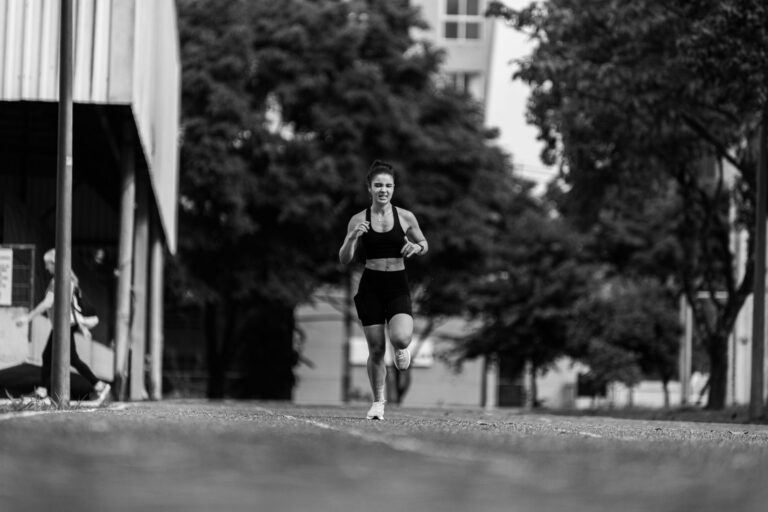
Knee drive is the powerful lifting motion of the knees toward the chest during sprinting, and it’s the primary technique that separates elite sprinters from recreational runners. When Usain Bolt ran his 9.58-second 100-meter world record, his knees rose to hip height or higher with each stride, creating the explosive forward momentum that allowed him to cover ground in fewer steps than competitors. This isn’t just about running faster—it’s about biomechanical efficiency. The higher your knees drive, the greater the force you generate against the ground, and the faster you propel yourself forward.
Most recreational runners have lazy knee drive. Their knees barely lift above hip height, and the lower portion of their legs swing loosely beneath them. This means they’re losing potential energy with every step. Sprinters, by contrast, actively pump their knees upward as if they’re trying to touch their chest with their thighs. This engagement of the hip flexors and quadriceps creates the explosive power that defines sprint performance, whether you’re racing 100 meters or trying to explode off the line in a competitive 5K.
Table of Contents
- How Does Knee Drive Create Speed and Explosive Power?
- The Mechanics of Knee Lift and Hip Flexor Engagement
- Knee Drive Differences Between Sprint Distances and Long-Distance Running
- Training Knee Drive for Your Running Goals
- Common Injury Risks and Limitations of Knee Drive Training
- The Role of Flexibility in Maximizing Knee Drive
- Future Training Trends and Long-Term Development
- Conclusion
- Frequently Asked Questions
How Does Knee Drive Create Speed and Explosive Power?
Knee drive works through a principle called the stretch-shortening cycle. When your hip flexors contract to lift your knee, they’re simultaneously preparing your leg to deliver a forceful push-off into the ground. The higher you lift your knee, the more ground clearance you create for your hamstrings and glutes to extend powerfully during the drive phase. Think of it like loading a spring—the more you compress it, the more energy it releases.
Sprinters who excel at knee drive typically have cadences between 160 and 200 steps per minute, compared to the 150-170 steps that many distance runners maintain. The increased frequency comes directly from faster knee lift and faster knee recovery. A sprinter covering 100 meters in under 10 seconds isn’t taking longer strides—they’re taking more strides with better efficiency. Elite sprinters like Florence Griffith-Joyner achieved their recorded 7.17-meter average stride length not just through leg length, but through explosive knee drive that created optimal ground contact time and push-off force.

The Mechanics of Knee Lift and Hip Flexor Engagement
The primary muscles responsible for knee drive are the iliopsoas (a combination of the iliacus and psoas major muscles) and the rectus femoris of the quadriceps. These muscles need to be strong, flexible, and explosively responsive. When you see a sprinter whose knees aren’t reaching optimal height, it’s often because the hip flexors are either weak or tight. Many runners develop hip flexor tightness from sitting at desks for eight hours a day, which limits their ability to generate powerful knee lift even if they have the muscular strength.
A critical limitation of over-emphasizing knee drive alone is that it can lead to overstriding if not balanced with proper body posture. If your torso leans too far back while you’re driving your knees forward, you’re actually braking yourself with each step rather than propelling forward. Sprinters maintain a slight forward lean from the ankles up, allowing the knee drive to work in concert with hip extension. Distance runners who suddenly try to copy pure sprinting knee drive without adjusting their posture often experience immediate anterior knee pain, which is a warning sign that their movement pattern is misaligned.
Knee Drive Differences Between Sprint Distances and Long-Distance Running
The intensity and focus of knee drive change depending on the race distance. In the 100-meter sprint, knee drive is nearly maximal from the acceleration phase through the finish line, with athletes maintaining explosive hip flexor engagement for all 10 seconds. In the 400 meters, sprinters maintain high knee drive through approximately 250 meters before fatigue causes a slight decline in knee height in the final 150 meters. This is why 400-meter specialists train their hip flexors for both power and muscular endurance.
In distance running, excessive knee drive becomes energetically wasteful. A 5K runner lifting their knees as high as a 100-meter sprinter would expend more oxygen and glycogen per mile, leading to earlier fatigue. The best middle-distance runners (800m-5K) find a middle ground—their knee drive is higher than recreational joggers but lower than pure sprinters. For example, a typical 5K competitor might maintain knee height at about mid-thigh, creating forward momentum without the energy cost of a sprinter’s chest-high knee drive.

Training Knee Drive for Your Running Goals
If you’re a sprinter aiming to improve your speed, high knees drills are foundational. High knees running involves sprinting in place with knees pumping to hip height or higher for 20-30 seconds, repeated with rest intervals. This trains your hip flexors to contract rapidly and explosively. Bounding drills—exaggerated running movements where you emphasize the push-off phase—build the glute and quadriceps strength needed to support powerful knee lift.
Many coaches recommend pairing these with resistance exercises like front squats or explosive step-ups. For distance runners, the trade-off is different. Training excessive knee drive will tire you out in a way that hurts your overall aerobic capacity. Instead, focus on improving your natural cadence through gradual increases of 5-10% over several weeks, which naturally increases knee drive without forcing an unnatural movement pattern. A practical approach is to run short repeats at 5K pace while consciously maintaining a 170-180 cadence, allowing your nervous system to adapt the coordination without overloading your hip flexors.
Common Injury Risks and Limitations of Knee Drive Training
Hip flexor strain is one of the most common injuries sprinters face when ramping up knee drive training too quickly. The hip flexors are small muscles that fatigue easily under explosive loading. If you increase your plyometric volume by more than 10% per week, you risk microtrauma in these muscles that accumulates into chronic inflammation. Warning signs include a pulling sensation at the very top of the thigh near the hip, especially when bringing your knee up, or sharp pain when sprinting at maximum intensity.
Another limitation to understand is that knee drive alone doesn’t create speed if your ground contact time isn’t optimized. A runner with excellent knee drive who has poor plantarflexion (ankle push-off) will still be slow. Some athletes become so focused on lifting their knees high that they neglect the extension phase, leaving power on the track. The most efficient sprinters balance both the lift phase and the push-off phase, creating a complete stride cycle that maximizes speed over each second of contact.
The Role of Flexibility in Maximizing Knee Drive
Tight hip flexors will limit your maximum knee drive height regardless of strength. Many runners have hip flexor tightness from prolonged sitting, tight glutes from weak activation, or both. A simple test: stand upright and try to bring one knee straight up toward your chest.
If you can’t get your thigh parallel to the ground without leaning back, your hip flexors need work. Even sprinters sometimes neglect flexibility work, assuming that strength training alone is sufficient, but several weeks of targeted stretching often yields immediate improvements in knee drive height and power. Dynamic stretching before sprinting—like leg kicks, walking lunges, or inchworms—prepares the hip flexors for explosive work better than static stretching. After your workout, 30-60 seconds of static stretching to the hip flexors, rectus femoris, and glutes helps prevent post-workout tightness that can accumulate over weeks of training.
Future Training Trends and Long-Term Development
Video analysis and biomechanical assessment are becoming increasingly accessible to competitive runners. Using slow-motion video recorded at 120 frames per second or higher, you can observe exactly how high your knees are rising during your hardest sprints. Many elite programs now use this feedback to make small adjustments that prevent the gradual decline in knee drive that typically occurs as runners tire during a race.
As your training evolves, remember that knee drive is a skill that improves with deliberate practice over months, not days. Sprinters who achieve world-class knee drive are typically training at elite levels for 5-10 years, refining the motor pattern through thousands of repetitions. Building your knee drive is a long-term investment in your running economy and sprint speed.
Conclusion
Knee drive is the technique that transforms a runner from moving to sprinting. It’s the active lifting of the knees toward the chest, powered by explosively contracting hip flexors and quadriceps, and it directly determines how fast you can accelerate and maintain high speed.
Whether you’re a sprinter chasing 100-meter times or a distance runner looking to finish strong in a 5K, understanding how to develop and maintain good knee drive matters—though the intensity will differ based on your event. To improve your knee drive, commit to consistent plyometric training like high knees and bounding work, address hip flexor flexibility through dynamic and static stretching, and monitor your form with video when possible. The investment in this one technical element will pay dividends across your entire running performance.
Frequently Asked Questions
Can I improve my knee drive if I don’t have access to a track?
Yes. High knees drills, bounding exercises, and hill sprints can all be performed on grass or pavement. Hill work is especially effective because the incline naturally forces higher knee lift. However, ensure you have at least 20-30 meters of clear, level space to minimize impact stress on joints.
How long does it take to see improvements in knee drive?
Most runners notice improved knee lift and increased running cadence within 3-4 weeks of dedicated training. Significant strength gains in the hip flexors typically take 8-12 weeks of consistent plyometric work. Be patient—forcing aggressive increases in knee drive without adequate conditioning increases injury risk.
Is high knee drive suitable for recovery runs or easy running days?
No. Knee drive work is neuromuscularly demanding and should only be performed when you’re fresh and the nervous system is ready for explosive work. Recovery runs should be done with relaxed, natural strides at easy pace. Reserve high-knee drills and sprint work for days when you have adequate rest and energy.
Should sprinters and distance runners train knee drive the same way?
No. Sprinters should focus on maximum height and explosive speed of knee lift, using high-volume plyometric training. Distance runners should focus on improving cadence and running efficiency without the energy cost of maximal knee drive, using more moderate intensity and volume.