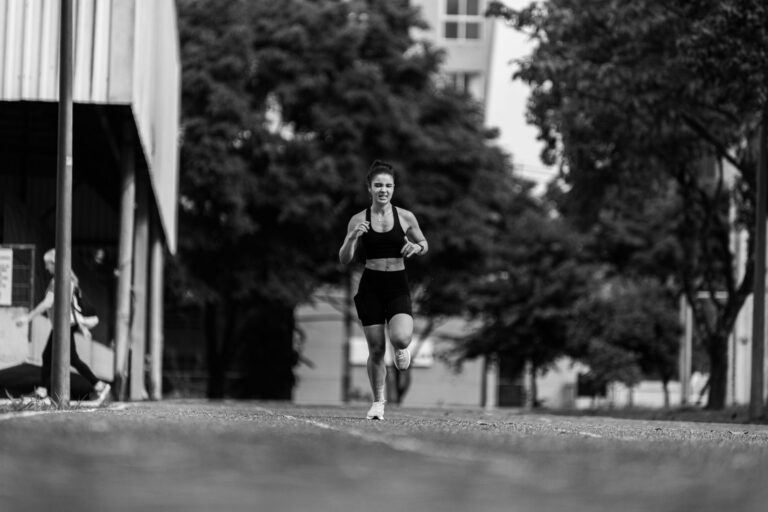
The difference between a 3:2 and 2:2 breathing pattern comes down to how many steps you take during each inhale and exhale. With 3:2 breathing, you inhale for three footfalls and exhale for two, creating a slightly longer intake of oxygen. With 2:2 breathing, you inhale and exhale for an equal two steps each, offering more symmetry and simplicity.
Most runners find that one pattern eventually feels more natural than the other, and that natural rhythm is what matters most—not which one is theoretically “best.” For example, a runner moving at a steady seven-minute-mile pace might naturally fall into a 3:2 pattern because their body spontaneously seeks that oxygen intake-to-output ratio at that speed. But slow that same runner down to a recovery jog, and they might shift into 2:2 without thinking about it. The goal isn’t to force yourself into one pattern, but to recognize which rhythm your body actually prefers at different intensities, and when it’s worth experimenting with alternatives.
Table of Contents
- Why Breathing Rhythm Matters for Running Performance and Comfort
- The Physiology Behind Different Breathing Ratios and Their Limitations
- Discovering Your Natural Breathing Pattern at Different Paces
- Implementing Breathing Patterns Without Overthinking It
- Common Mistakes and Breathing-Related Challenges
- Individual Variation and Customization Based on Running Style
- Evolving Your Breathing as Your Running Improves
- Conclusion
- Frequently Asked Questions
Why Breathing Rhythm Matters for Running Performance and Comfort
Rhythmic breathing serves multiple purposes during a run. It creates a meditative anchor that can reduce anxiety and mental fatigue, it coordinates core engagement with your stride, and it ensures oxygen is being delivered at a pace that matches your effort. When your breathing pattern feels chaotic or forced, it’s often a sign that your pace is unsustainable or that you haven’t yet found the cadence that works for your body at that particular speed. The 3:2 pattern gained popularity in running culture partly because it introduces asymmetry into your breathing and footfall patterns. In theory, alternating which leg you land on during your exhale can promote balanced muscle engagement and reduce repetitive stress injuries.
If you always exhaled on your right foot strike, that side would experience slightly different impact forces over time. However, this benefit is modest, and many runners run injury-free on 2:2 patterns without worrying about it. The 2:2 pattern appeals to runners who prefer simplicity and symmetry. It’s easier to remember, doesn’t require mental math during a hard effort, and provides an equal amount of time for both inhale and exhale. For newer runners or those working at very easy paces, 2:2 often feels more natural because the breathing isn’t lagging behind the intensity of the movement.

The Physiology Behind Different Breathing Ratios and Their Limitations
Your breathing pattern during running is partly determined by your aerobic capacity, partly by your natural cadence, and partly by learned habit. At easy paces, most runners can sustain 2:2 breathing or even longer patterns (like 4:4) without much effort. As intensity increases, the body naturally demands faster breathing to meet oxygen requirements, and patterns often shift toward 3:2 or 2:1 (two steps inhale, one step exhale). One important limitation to understand: prescribed breathing patterns work only if they align with your body’s actual oxygen demands at that moment.
If a coach or app tells you to use 3:2 breathing but your fitness level and current pace actually demand something closer to 2:1, you’ll either force an unsustainable pattern or abandon the technique entirely. This is why many runners find that breathing patterns change not just day-to-day but even within a single run as pace and fatigue shift. There’s also a misconception that rhythmic breathing prevents stitches or side cramps. While some runners report fewer cramps when using deliberate breathing patterns, the research linking specific ratios to cramp prevention is weak. Cramps are more often related to food timing, hydration, and muscle fatigue than to whether you exhaled on your left or right foot.
Discovering Your Natural Breathing Pattern at Different Paces
The most reliable way to find your natural rhythm is to run without thinking about breathing at all. On an easy run where you can hold a conversation, notice how many steps you take between inhales and exhales. Don’t try to match a pattern; just observe what emerges. Most runners find they naturally adopt 3:2 or 4:4 at these easier efforts. During a tempo run or harder effort, check in again and notice if the pattern shifts, and in what direction. A specific example: a runner training for a half-marathon might notice that during her easy recovery run, she naturally falls into a 4:4 rhythm.
But during her weekly tempo run at a significantly faster pace, without any conscious adjustment, she’s automatically breathing in 2:1 (two steps inhale, one step exhale). This isn’t wrong or inefficient—it’s her body responding to the increased oxygen demand. The mistake would be trying to maintain 3:2 breathing during that tempo run when her physiology is asking for something faster. Over several weeks of varied-pace running, patterns emerge. You’ll likely find that you have a preferred “easy” pattern, a preferred “hard” pattern, and maybe a preferred “moderate” pattern. Once you know these, you can use them as touchstones. When a run feels unusually hard or effortful, checking your breathing pattern can reveal whether the pace is actually sustainable for that day.

Implementing Breathing Patterns Without Overthinking It
The most practical approach is to use breathing rhythm as a diagnostic tool rather than a rigid rule. If you’re running at an easy pace and your breathing feels scattered and fast, deliberately shifting into a 3:2 or 4:4 pattern can slow things down and often makes the run feel easier immediately. If you’re in the middle of a tempo run and feel like you’re gasping, trying a 2:1 pattern might feel more natural and sustainable than fighting against 3:2 just because you read it was “optimal.” Here’s a concrete way to experiment: dedicate one week to 2:2 breathing on all your runs, regardless of pace. The next week, let your body choose naturally without thinking about it.
Then try one week of consciously shifting ratios based on effort (4:4 or 3:2 at easy pace, 2:2 or 2:1 at hard pace). By the end of three weeks, you’ll have a much better sense of which approach makes your running feel most stable and efficient. The tradeoff to consider is mental load versus physical benefit. Constantly monitoring and adjusting breathing patterns requires attention, and that attention might be better spent on other aspects of your run like form, pacing, or just enjoying the experience. For most recreational runners, finding one good pattern for easy days and one for hard days, then letting it happen naturally, strikes the right balance.
Common Mistakes and Breathing-Related Challenges
One frequent mistake is trying to breathe exclusively through your nose. While nose breathing has some aerobic benefits, it becomes impractical during harder efforts when oxygen demand spikes. Trying to force nasal breathing while maintaining a tempo pace often leads to anxiety and the sensation of suffocation. For most runners, a combination of nose and mouth breathing during moderate efforts, shifting toward mouth breathing as intensity rises, is most sustainable. Another warning: avoid the trap of thinking your breathing pattern is fixed. If you came back to running after a break, recovered from an illness, or significantly improved your fitness, your breathing patterns will shift.
A pattern that worked last season might feel wrong this season. This doesn’t mean something is broken—it usually means your aerobic fitness has changed and your body is responding differently. Be willing to re-evaluate every few months. Some runners report that wearing a mask during cold weather or air quality events disrupts their breathing rhythm and makes their runs feel harder, which is accurate. Your respiratory system is genuinely dealing with increased resistance. This isn’t a failure of mental toughness; it’s just how physiology works. Plan for slightly shorter or easier runs on days when mask-wearing is necessary.
Individual Variation and Customization Based on Running Style
Different runners have different natural cadences and body mechanics, which means breathing patterns aren’t one-size-fits-all. A runner with a high cadence (fast foot strikes) might naturally fall into a 3:2 or 2:2 pattern because footfalls are already coming quickly. A runner with a slower, more loping cadence might find that even 3:2 feels too fast, and 4:3 feels more natural. Neither is wrong; they’re just responding to their own mechanics.
For example, a trail runner navigating technical terrain might find that rigidly adhering to any breathing pattern is impossible and impractical. The terrain constantly demands different effort levels, and breathing naturally adapts moment-to-moment. In contrast, a track runner doing repeats at a consistent pace might benefit from a stable breathing pattern that serves as a focus point lap after lap. Your running context shapes what breathing strategy makes sense.
Evolving Your Breathing as Your Running Improves
As your aerobic fitness improves, you’ll likely find that you can sustain longer breathing patterns at faster paces. A speed that once demanded 2:1 breathing might eventually become comfortable at 2:2 or even 3:2. This is a positive sign that your aerobic system is adapting.
Rather than clinging to an old pattern, embrace the shift as evidence of improvement. Advanced runners sometimes use breathing pattern changes as a way to modulate effort within a run. Consciously shifting from 3:2 to 2:1 can serve as a mental cue to accelerate, while stretching a 4:4 pattern can signal the beginning of a cooldown. This turns breathing into a tool for pacing strategy, not just oxygen delivery.
Conclusion
There is no universal “best” breathing pattern for running. The 3:2 ratio works beautifully for some runners and feels awkward for others. The 2:2 ratio appeals to those who prefer symmetry and simplicity.
What matters far more than which pattern you use is whether the pattern you’ve chosen actually matches your body’s oxygen demands at that moment and whether it arose from self-observation rather than external prescription. Start by running without any conscious breathing pattern and noticing what emerges naturally. Once you understand your body’s preferences at easy, moderate, and hard efforts, you have the foundation to experiment with adjustments when something feels off. Over time, these patterns become automatic, and breathing becomes what it should be: background support for your running, not a constant mental task demanding attention.
Frequently Asked Questions
Should I breathe through my nose or mouth while running?
Use a combination of both. Many runners breathe in through their nose and out through their mouth, or vice versa, especially at moderate efforts. As intensity increases, shift toward mouth breathing because it allows greater oxygen intake. Trying to breathe exclusively through your nose during hard efforts is impractical and often creates unnecessary anxiety.
Can breathing patterns prevent side cramps?
Not reliably. While some runners report that rhythmic breathing reduces cramps, the research is weak. Side cramps are more commonly caused by dehydration, eating too close to running, or pushing beyond your current fitness. Rhythmic breathing might provide some benefit for certain runners, but it’s not a proven cramp cure.
How long does it take to adapt to a new breathing pattern?
Most runners adapt within 1-2 weeks of consistent practice. However, if a pattern feels fundamentally wrong, it may never feel natural. Rather than forcing an uncomfortable pattern, experiment with alternatives. Your body will tell you what works.
Should I breathe differently on easy runs versus hard runs?
Yes, naturally you will. At easy paces, longer patterns like 4:4 or 3:2 are usually comfortable. At harder efforts, your body will demand faster breathing, often shifting to 2:2 or 2:1. Work with these natural shifts rather than trying to maintain the same pattern across all intensities.
Does breathing rhythm affect running injuries?
Possibly, in theory. Some coaches suggest that alternating which leg you exhale on prevents repetitive stress injuries. However, the evidence is anecdotal. Good running form, appropriate training load, and proper recovery prevent more injuries than breathing patterns ever will.
What should I do if my breathing pattern keeps changing during a run?
This is normal. As fatigue accumulates, your breathing pattern will naturally shift toward faster ratios. As long as you’re not gasping or feeling distressed, these shifts are appropriate responses to changing demands within the run.