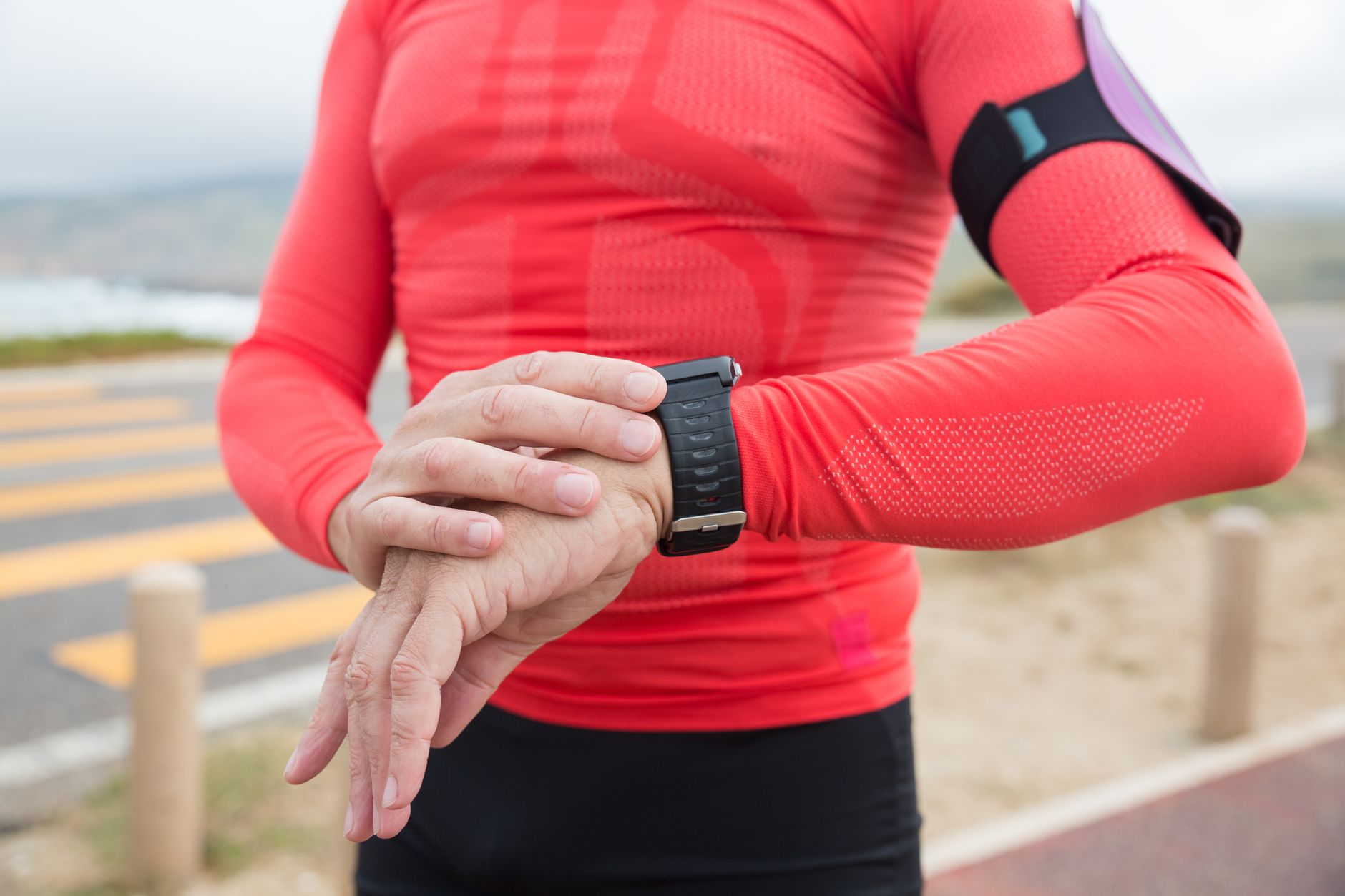
Yes, a running watch will likely overestimate calories burned on hills. Energy expenditure, meaning the calories your body burns to run, is harder to estimate when grade changes quickly. A hilly route raises cost sharply on climbs and lowers it on descents in ways simple pace math misses. Treat the watch number as a high reading that is useful for trends, not exact fuel.
Medical information disclaimer: This article is for general educational purposes only and does not provide medical advice, diagnosis, or treatment. Always consult a physician or other qualified health professional about symptoms, medications, tests, or treatment decisions.
Table of Contents
- How your watch estimates calories
- Why hills make the math worse
- How large is the overestimate?
- What to do on hilly runs
How your watch estimates calories
Running watches do not measure calories directly. TodoMountainBike explains that they estimate them from heart rate, motion, GPS distance and speed, elevation, and personal data such as weight, age, sex, and height in its review of validation research.
That matters because each input can drift during a run. Heart rate can lag behind effort, GPS can wobble under trees, and elevation can jump between readings.
Why hills make the math worse
Uphill running costs much more energy than flat running at the same speed. Cadennce, summarizing Minetti and colleagues, reports that cost rises steeply uphill and falls downhill to a minimum near minus 10 to minus 20 percent grade in its grade-adjusted pace explainer.
So a model built around flat pace will misprice both sides of a hill. It can undervalue a steep climb and still overvalue a descent because downhill running stays costly even when pace feels easy.
How large is the overestimate?
Recent lab comparison found systematic overestimation during exercise of roughly 15 to 25 percent. Neurology Advisor, reporting Kostrna and colleagues, found that result against COSMED K5 indirect calorimetry in its report on the PLOS One study.
For a hilly run, that bias can combine with grade error. A watch showing 600 calories may reflect true use closer to 480 to 520 calories, with wider swings on very steep or rolling routes.
What to do on hilly runs
Use the watch to compare similar routes rather than count exact calories. A higher number on the same hill loop means more work, but the absolute total remains high-biased. Apple says calibration with about 20 minutes of Outdoor Walk or Outdoor Run on flat, open ground with good GPS improves calorie, distance, pace, Move, and Exercise estimates in its calibration guide.
- Calibrate on flat, open ground before trusting hilly data.
- Compare the same route over time instead of chasing single-run totals.
- Fuel long runs by plan and hunger, not by eating back the full display.
- Keep weight, age, and height current in the watch app.