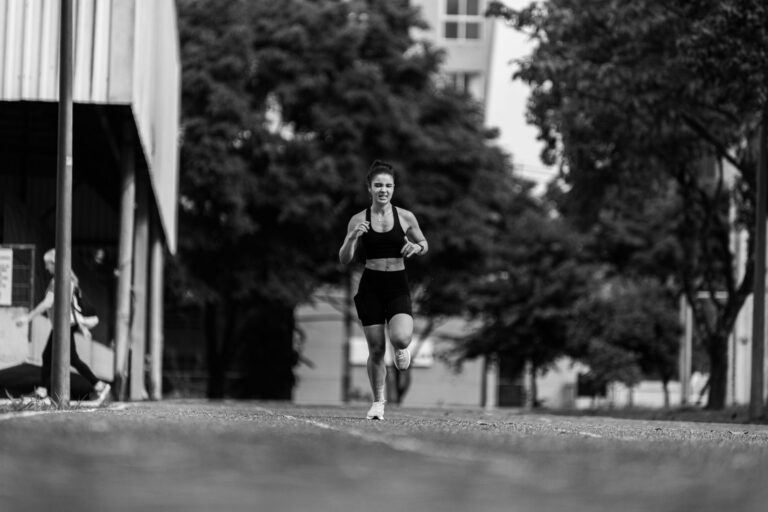
Hip mobility directly determines how far your legs can swing forward and back, which fundamentally controls your stride length as a runner. When your hips have full range of motion, your legs can extend further with each step, allowing you to cover more ground efficiently. Limited hip mobility, on the other hand, restricts how far your leg can swing, forcing you to take shorter, quicker steps to maintain pace—which increases the overall demand on your muscles and cardiovascular system. Consider a runner with tight hip flexors who can only extend their leg to a 160-degree angle behind their body compared to another runner with healthy mobility achieving 180 degrees.
That 20-degree difference translates to noticeably shorter strides, higher cadence, and significantly more strain on the knees and lower back over the course of a 5-mile run. Many runners experiencing knee pain or hitting performance plateaus don’t realize that the problem originates in their hips, not their knees or feet. The relationship between hip mobility and stride length isn’t just biomechanical theory—it’s observable reality. Improving hip mobility can add inches to your stride, reduce impact forces, and improve running economy within weeks. This article explores how hip mobility affects your running stride and why addressing hip tightness should be a priority for any serious runner.
Table of Contents
- How Does Hip Mobility Impact Your Running Stride?
- The Role of Hip Flexors and Glute Activation in Stride Mechanics
- Hip Mobility and Running Economy
- Practical Strategies to Improve Hip Mobility and Stride Length
- Common Hip Mobility Issues That Limit Stride Length
- Hip Mobility Assessments and Measuring Stride Length Improvements
- Looking Forward: Hip Mobility as a Lifelong Running Practice
- Conclusion
How Does Hip Mobility Impact Your Running Stride?
Hip mobility encompasses the range of motion in the hip joint and the flexibility of the muscles and connective tissues surrounding it. The major players include the hip flexors, glute muscles, hip external rotators, and the muscles along the outer hip. When these structures are tight or restricted, your pelvis cannot rotate fully during the running stride, limiting how much your leg can swing. Your stride length is determined by two factors: the angle through which your leg swings and how efficiently that swing translates into forward motion. A runner with restricted hip extension (the backward leg swing) will compensate by leaning their torso forward excessively, creating poor form and increasing strain on the lower back.
A runner with limited hip flexion (the forward leg swing) may overstride unconsciously, landing with their foot too far ahead of their center of gravity. This overstriding increases impact forces by 20-30% compared to a natural stride, according to biomechanics research, and is a leading cause of running injuries. The difference becomes obvious when comparing sprinters to distance runners. Sprinters deliberately work on explosive hip mobility to generate maximum stride length and power for short distances. Distance runners often neglect this mobility work, then wonder why their stride feels choppy and inefficient. A recreational runner who spends forty hours a week sitting at a desk will have significantly less hip mobility than someone with an active lifestyle, even if both run the same three times per week.
The Role of Hip Flexors and Glute Activation in Stride Mechanics
Your hip flexors—primarily the psoas and iliacus muscles—are responsible for driving your knee upward and forward during the running stride. Paradoxically, tight hip flexors are epidemic among runners and desk workers alike, yet they’re rarely the primary focus of training programs. When your hip flexors are tight, they pull your pelvis into an anterior tilt, shortening your stride and forcing your quads to work harder to lift your leg. The glutes perform the opposite function: they extend the hip, propelling your leg backward and providing power for forward motion. Many runners have weak or underactivated glutes despite having tight hip flexors, creating a muscular imbalance that severely restricts stride length.
strengthening the glutes while stretching the hip flexors is the classic prescription, but here’s the limitation: flexibility alone without strength won’t improve stride length. A runner can be extremely flexible but still have a short, inefficient stride if their glutes aren’t activated and strong enough to extend the hip powerfully. This means you can’t simply add daily yoga stretches and expect stride improvements. You need targeted strengthening work—single-leg deadlifts, step-ups, and glute bridges—combined with mobility work to create lasting change. Many runners try stretching alone for weeks and feel frustrated when their stride doesn’t improve, not realizing they’re missing half the equation.
Hip Mobility and Running Economy
Running economy describes how efficiently your body converts oxygen into forward motion. A runner with poor economy requires more oxygen to maintain a given pace, meaning they fatigue faster and can’t run as fast for as long. Hip mobility directly impacts running economy because restricted hip motion forces your muscles to work inefficiently, requiring extra muscular effort for the same speed. When your hip mobility is good, your glutes can generate power smoothly through the push-off phase, and your hip flexors can efficiently pull your leg through the swing phase. This smooth, coordinated movement costs less energy.
When hip mobility is restricted, your body compensates with unnecessary muscle tension in the quads, hip flexors, and lower back to complete each stride. You’re essentially using extra muscles to do the same job, burning more fuel for the same result. Research on biomechanics shows that runners with superior hip mobility typically have oxygen consumption rates 5-10% lower at equivalent speeds compared to runners with restricted hips. This translates to being able to run faster at the same effort level, or maintain the same pace with less fatigue. It’s one of the cleanest interventions available—improving hip mobility costs nothing but time and effort, yet the performance gain is measurable and significant.

Practical Strategies to Improve Hip Mobility and Stride Length
The most effective approach combines dynamic stretching before runs, static stretching after runs, and targeted strengthening work on non-running days. Dynamic stretching activates the muscles and prepares them for the running motion; examples include leg swings, walking lunges, and inchworms. These should be done before every run to prime your hip mobility for that day’s workout. Static stretching—holding stretches for 30 seconds to two minutes—works best after your run when muscles are warm and plastic. Focus on the hip flexors with kneeling hip flexor stretches, the outer hip with figure-four stretches, and the glutes with pigeon pose. Spend 10-15 minutes on stretching three to four times per week.
Strengthening work should include single-leg exercises that force your hips to stabilize while producing power. Single-leg deadlifts, Bulgarian split squats, and single-leg Romanian deadlifts are superior to bilateral movements for building functional hip strength. The tradeoff is time commitment versus results. Effective hip mobility and strengthening work requires 30-45 minutes per week of dedicated effort on top of your regular running training. The alternative is accepting a shorter stride, running less efficiently, and dealing with the injuries that typically accompany poor hip mechanics. Most runners find that once they experience the difference—feeling their stride open up, running feeling easier, paces dropping naturally—the time commitment becomes non-negotiable.
Common Hip Mobility Issues That Limit Stride Length
Anterior pelvic tilt is one of the most common postural issues limiting stride length in modern runners. This occurs when your lower back curves excessively and your pelvis tilts forward, shortening your hip extension range and forcing you into a choppy, quad-dominant running pattern. The condition develops from hours of sitting and tight hip flexors, and it’s insidious because it becomes your new “normal”—you don’t notice your stride has shortened until you compare video of yourself to other runners. Posterior pelvic tilt, the opposite problem, restricts hip flexion and makes your legs feel heavy when running. This pattern is less common than anterior pelvic tilt but can develop from overdoing glute activation drills or from weak hip flexors.
Some runners also develop limitations in hip external rotation—the ability to rotate your thigh outward—which restricts your ability to fully drive your leg forward in the push-off phase. Warning: Attempting to force range of motion in a direction where you have structural limitations, such as a hip labral tear, can worsen the injury. If you have sharp pain in the hip joint during stretching or running, see a physical therapist rather than trying to stretch through it. The limitation here is that not all stride limitations are mobility-based. A runner with poor running form, inadequate aerobic fitness, or biomechanical abnormalities like severe leg-length discrepancies may not see stride improvements from mobility work alone. However, mobility work should always be the foundation, as it’s one of the few interventions that helps nearly all runners.

Hip Mobility Assessments and Measuring Stride Length Improvements
Testing your current hip mobility gives you a baseline to track progress. The standard assessment for hip extension is the Thomas test, performed lying on your back with one leg pulled to your chest while the other leg hangs off the edge of a table. If your hanging leg’s knee bends or your lower back arches, you have restricted hip extension and tight hip flexors. Another simple test: stand with your feet hip-width apart and try to swing one leg forward as high as possible while keeping your pelvis stable. Limited forward swing indicates restricted hip flexion.
Measuring actual stride length changes is straightforward. Mark out a 100-meter distance and count your steps while running at your typical easy pace. Divide the distance by the number of steps to get your stride length. Test this monthly as you work on hip mobility. Many runners see stride length increases of 2-4 inches within 6-12 weeks of consistent mobility and strengthening work, which translates to measurable pace improvements without running faster.
Looking Forward: Hip Mobility as a Lifelong Running Practice
Hip mobility shouldn’t be a temporary intervention you do for a few weeks—it should be a permanent part of your running routine, like running itself. Just as you lose aerobic fitness without continued running, your hip mobility deteriorates without consistent maintenance. Runners in their 40s, 50s, and beyond often experience surprising improvements in stride length and running enjoyment when they commit to consistent hip mobility work, proving it’s never too late to address these limitations.
The future of injury prevention in running is increasingly focused on addressing root causes like hip mobility rather than treating symptoms like knee pain. As more runners understand this connection, the gap will widen between those who prioritize hip health and those who don’t. Your stride length at age 50 is determined partly by your genetics, but largely by the hip mobility work you do in your 20s, 30s, and 40s.
Conclusion
Hip mobility and stride length are inseparably connected. Restricted hip motion limits how far your legs can swing, forcing shorter strides that require higher cadence and increase injury risk. Improving hip mobility through targeted stretching, strengthening, and postural awareness can add inches to your stride, improve running economy, and prevent injuries—all without spending money on new gear or changing your training plan fundamentally.
Start with an honest assessment of your current hip mobility. If you can’t fully extend your leg behind your body without arching your lower back, or if you feel restricted when swinging your leg forward, you have room for improvement. Commit to 30 minutes per week of mobility and strengthening work for the next 8-12 weeks, then reassess. Most runners are surprised by how much freer their stride feels and how naturally their pace improves when hip restrictions are finally addressed.