
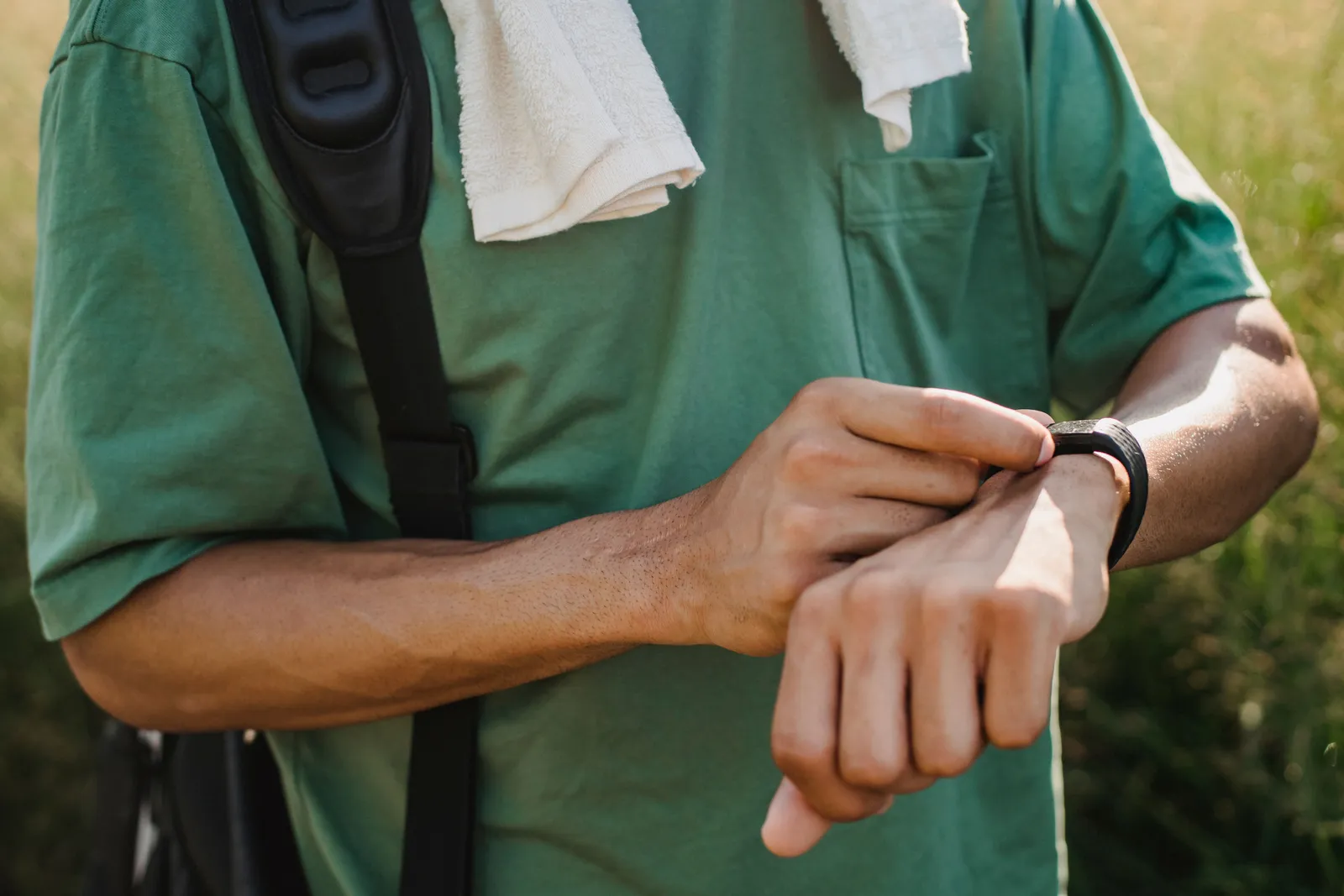
Garmin Body Battery is an estimate of your available energy reserve, scored from 5 to 100. It is not a measurement. Your watch builds it from your heart rate variability, stress level, sleep quality and activity data [1]. Use it as one input on a training day. Alcohol, illness, a loose watch, irregular heart rhythms and heart-rate-altering medications can all move it for reasons unrelated to how rested you are.
What Body Battery is built from
Garmin’s manual compares Body Battery to “a gas gauge on a car,” built from your heart rate variability (HRV), stress level, sleep quality and activity data [1]. In sensor terms, the watch continuously analyzes heart rate, HRV and movement to work out whether you are awake or asleep, when you are active, and how stressed you are while inactive [2].
Garmin splits the scale into four bands [1]:
- 5 to 25: very low reserve energy
- 26 to 50: low reserve energy
- 51 to 75: medium reserve energy
- 76 to 100: high reserve energy
Garmin does not publish the formula or how much weight each input gets. It says the science comes from Firstbeat’s analysis of beat-to-beat changes in your heart, used to infer the balance between the “fight-or-flight” (sympathetic) and “rest-and-digest” (parasympathetic) branches of your nervous system [3].
How it charges and drains
Stress drains it, rest charges it
Garmin’s all-day stress score runs from 0 to 100. The watch calculates it from your HRV while you are inactive [4]. Garmin links that stress score directly to Body Battery [2]:
| Stress level | Body Battery | Nervous system state | Heart rate, typically | HRV, typically |
|---|---|---|---|---|
| 0 to 25 (rest) | Charging | Parasympathetic | Lower | Higher |
| 25 to 100 | Draining | Sympathetic | Higher | Lower |
Garmin says a lower resting heart rate and a higher HRV than your personal baseline are good signs of effective rest. Even a low stress level can still hold back recovery [2]. Positive excitement counts too. Garmin notes that “big-day jitters” drain the battery just as anxiety does [2].
Exercise drains it by intensity and duration
During exercise, the drain depends on how hard and how long you go. Vigorous exercise drains it faster than light effort, and a long, hard workout drains it far more than a short walk [2]. The stress score is not calculated during timed activities [5], so during a run Garmin describes the drain in terms of effort, not stress.
Sleep is the main recharge
Garmin calls a good night’s sleep “the single greatest opportunity to recharge”; naps can also help [2]. Compatible devices also account for sleep pressure, which builds the longer you are awake, so resting during the day does not automatically raise the number, and a short night after a long day leaves a deficit until you catch up [2]. Garmin says you will get more accurate results if you wear the watch while sleeping [1].
Fitness changes how much a workout costs
As your VO2 max improves, Garmin says exercise and stress have a smaller relative effect, so the same run drains less [2]. A brisk walk may barely move the number for a regular exerciser but cause a big drop for someone who has been inactive [3]. See what VO2 max measures and how runners improve it.
Using Body Battery on a training day
Garmin’s own guidance is more relaxed than the number suggests:
- Low does not mean you cannot run. Garmin says being low on energy does not stop you exercising, but it warns that a tough workout on a low battery may be counterproductive in the long term. Training while worn down, short on sleep or under heavy stress means your body likely won’t get the full benefit [2].
- One low day is not a warning sign. Garmin says an occasional low day is no cause for alarm if you know the reason, such as a bad night, a deadline or an oncoming cold. A battery that stays low day after day is the signal to look at your habits [2].
- Don’t try to keep it full. Garmin says the battery is supposed to run down during the day. It also cautions that too many easy days can lead to lower fitness [2][3].
- Check it against how you feel. Early on, Garmin says, it is hard to tell whether a low battery comes from illness or something else. A headache, sore throat or unusual sneezing alongside it makes illness more likely. So does a higher-than-normal heart rate in your usual sessions [6].
So if intervals are planned and the morning number is low, look for the reason (short sleep, a drink, a stressful day, feeling run down) and weigh it against how your warm-up feels. Your resting heart rate trend is a useful cross-check; so is knowing how accurate sleep trackers are for runners.
Where Body Battery misleads
Alcohol
Garmin calls alcohol “a huge stressor” that drains Body Battery faster and degrades the restorative quality of sleep [3]. In an observational study of 4,098 Finnish employees (two authors worked for Firstbeat), nights after drinking were associated with less parasympathetic activity and poorer HRV-based recovery in the first three hours of sleep, in a dose-dependent way, even at low intake [7]. A low score after drinking may reflect a real effect on your nervous system, not how fit or rested your legs are.
Illness and fever
Garmin says illness can disrupt the normal charge-and-drain cycle. That can mean faster draining during the day or slower recharging at night, because the immune response pushes the nervous system toward sympathetic activity and HRV usually falls [6]. Garmin adds that a 1 °C rise in body temperature can raise your average heart rate by more than 7 beats per minute, and that poorly controlled diabetes or an over- or underactive thyroid can show up as higher stress and lower Body Battery values [6].
Watch fit and the wrist sensor itself
Every input comes from the optical sensor on your wrist. Garmin states its wrist heart rate readings can be inaccurate depending on your physical characteristics, the watch’s fit, and the type and intensity of activity, and that its wearables are not medical devices [8]. Garmin’s running-watch manual says to wear the watch above the wrist bone, snug but comfortable, and not shifting while you run. It also says to keep sunscreen, lotion and insect repellent out from under it [9][10].
A review comparing pulse-based (photoplethysmographic) HRV with ECG found accuracy was generally sufficient at rest. Physical activity and some mental stressors worsened agreement, often to an unacceptable degree [11]. In a 2025 study, 13 healthy adults slept in several wearables at once alongside an ECG for a total of 536 nights. The Garmin Fenix 6 showed poor agreement with the ECG for nocturnal HRV (concordance 0.87, mean absolute percentage error about 10.5%) and was left out of the resting heart rate analysis because of methodological inconsistencies [12].
The stress score is not the same as feeling stressed
A 2025 lab study compared a Garmin Vivosmart 4 with a Polar H10 chest strap in 60 participants during rest and mental-stress tasks. Garmin’s stress score differed between rest and stress and tracked heart rate and HRV, but had only marginal value for predicting how stressed people said they felt; plain heart rate showed the strongest link [13].
Irregular heart rhythms
HRV is meant to be calculated from normal heartbeats. Standard HRV methods remove ectopic (extra or early) beats first, because abnormal beats “may reflect cardiac dysfunction or noise that masquerades as HRV.” Even two artifacts in a 5-minute segment can significantly distort common HRV measures [14]. Rhythm problems such as atrial fibrillation can make HRV look higher, and it takes an ECG to tell that apart from genuinely high HRV [14]. Garmin does not publish how Body Battery handles irregular rhythms, so treat the score with extra skepticism if you have atrial fibrillation or frequent extra beats. Our guide to atrial fibrillation in endurance runners covers the symptoms to watch for.
Medications that change heart rate
Garmin publishes no guidance on how beta blockers or other heart-rate-lowering medications affect Body Battery. These drugs can shift HRV itself: in 73 patients with ischemic heart disease and preserved ejection fraction, those taking beta blockers had higher daytime vagal HRV measures than those who were not [15]. That is a small clinical group, not runners, but it shows a medication can move an input the score depends on. Never change a medication or dose because of a watch reading; talk to your prescriber. For training on these drugs, see running on beta blockers.
What Garmin says does not affect it
Garmin’s manual states that food intake and stimulants such as caffeine have “no impact on your Body Battery” [1]. That is Garmin’s description of the model, not a published test of it.
What has not been published
- The Body Battery formula, the weighting of its inputs, and how points are assigned. Garmin describes the inputs and logic but not the math [1][2].
- A peer-reviewed validation of Body Battery itself. A PubMed search in October 2026 found validation studies of Garmin’s HRV and stress score, but none testing Body Battery against a reference measure of energy, recovery or readiness.
- Any Garmin guidance on adjusting the score for beta blockers, other heart medications or arrhythmias.
When to talk to your doctor
Garmin itself says its watches are not designed to diagnose or treat any condition and that you should seek professional advice if you are worried about your health [6]. See a doctor, and do not rely on the score, if you have:
- Chest pain, pressure or tightness, fainting or near-fainting, or unusual shortness of breath during or after a run.
- A racing, pounding or irregular heartbeat, especially if it comes with dizziness.
- Fatigue that lasts for weeks along with a Body Battery that stays low despite normal sleep and easier training.
- A fever, or a resting heart rate that stays well above your usual level for several days.
- A diagnosis of atrial fibrillation, a heart condition, diabetes or a thyroid disorder, or a heart-rate-lowering medication. Ask how to interpret heart-rate-based watch metrics in your case.
Sources
- Garmin. vívoactive 5 Owner’s Manual: Body Battery. https://www8.garmin.com/manuals/webhelp/GUID-5D183A14-BB43-4A9B-B441-5F824214CE40/EN-US/GUID-87E1392B-2C55-40B7-A1FF-3AB9252DA0A0.html
- Garmin. Body Battery Energy Monitoring (Garmin Technology, Health Science). https://www.garmin.com/en-US/garmin-technology/health-science/body-battery/
- Garmin. 5 reasons your Body Battery says you’re running low. Garmin blog, October 15, 2024. https://www.garmin.com/en-US/blog/fitness/5-reasons-your-body-battery-running-low/
- Garmin. vívosmart 5 Owner’s Manual: Heart Rate Variability and Stress Level. https://www8.garmin.com/manuals/webhelp/GUID-8674F17E-62B2-48DE-927A-251611664658/EN-US/GUID-9282196F-D969-404D-B678-F48A13D8D0CB.html
- Garmin. vívosmart 5 Owner’s Manual: My stress level does not appear. https://www8.garmin.com/manuals/webhelp/GUID-8674F17E-62B2-48DE-927A-251611664658/EN-US/GUID-418B6394-73C4-4EA1-A1FF-B3A4147C9578.html
- Garmin. Why your Body Battery may struggle to charge when you start to get sick. Garmin blog, October 15, 2024. https://www.garmin.com/en-US/blog/fitness/why-your-body-battery-may-struggle-to-charge-when-you-start-to-get-sick/
- Pietilä J, Helander E, Korhonen I, Myllymäki T, Kujala UM, Lindholm H. Acute effect of alcohol intake on cardiovascular autonomic regulation during the first hours of sleep in a large real-world sample of Finnish employees: observational study. JMIR Ment Health. 2018;5(1):e23. PMID 29549064.
- Garmin. Activity Tracking and Fitness Metric Accuracy. https://www.garmin.com/en-US/legal/atdisclaimer/
- Garmin. Forerunner 265 Series Owner’s Manual: Wearing the Watch. https://www8.garmin.com/manuals/webhelp/GUID-F41EAFB3-6CC9-42DE-9C6C-9E358DBB0671/EN-US/GUID-F2E7E0A9-FB44-4297-BF4D-D0C31C400C45.html
- Garmin. Forerunner 265 Series Owner’s Manual: Tips for Erratic Heart Rate Data. https://www8.garmin.com/manuals/webhelp/GUID-F41EAFB3-6CC9-42DE-9C6C-9E358DBB0671/EN-US/GUID-08BC6CE7-EB8F-4392-9B7D-714B54D19499.html
- Schäfer A, Vagedes J. How accurate is pulse rate variability as an estimate of heart rate variability? A review on studies comparing photoplethysmographic technology with an electrocardiogram. Int J Cardiol. 2013;166(1):15-29. PMID 22809539.
- Dial MB, Hollander ME, Vatne EA, Emerson AM, Edwards NA, Hagen JA. Validation of nocturnal resting heart rate and heart rate variability in consumer wearables. Physiol Rep. 2025;13(16):e70527. PMID 40834291.
- Rosenbach H, Itzkovitch A, Gidron Y, Schonberg T. Assessing stress level scores against wearables-driven physiological measurements. Stress Health. 2025;41(6):e70125. PMID 41292097.
- Shaffer F, Ginsberg JP. An overview of heart rate variability metrics and norms. Front Public Health. 2017;5:258. PMID 29034226.
- Saleem S, Khandoker AH, Alkhodari M, Hadjileontiadis LJ, Jelinek HF. Investigating the effects of beta-blockers on circadian heart rhythm using heart rate variability in ischemic heart disease with preserved ejection fraction. Sci Rep. 2023;13(1):5828. PMID 37037871.