
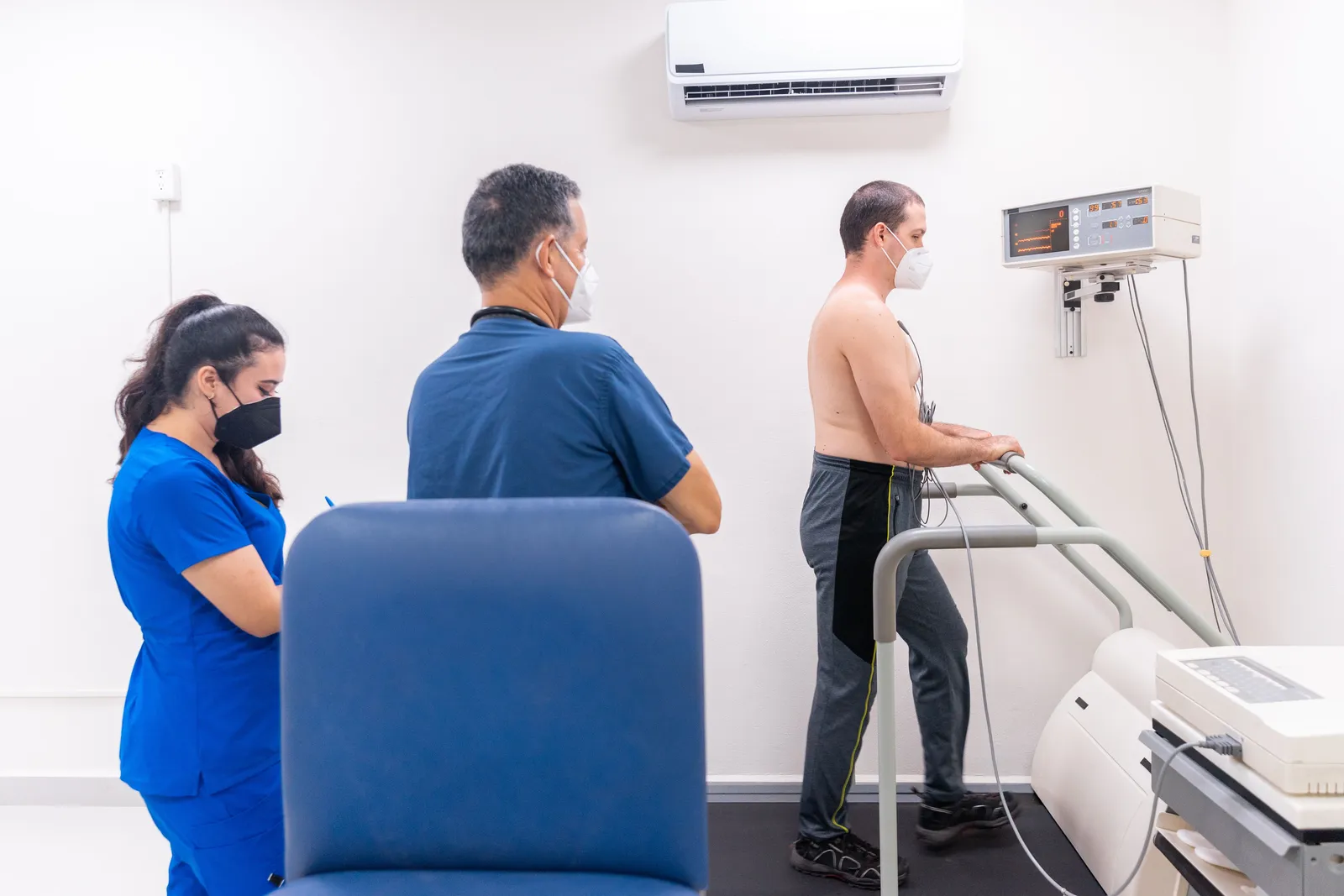
Supervised cardiac rehabilitation is the usual route back to exercise after a heart attack, stent, bypass surgery or heart failure diagnosis. Whether and when you add running is decided with your cardiologist, based on your own exercise test, your medications and how you did in monitored sessions. No official source sets one return-to-running date for everyone, and the National Heart, Lung, and Blood Institute (NHLBI) says the time you spend in rehab itself depends on your condition [1].
What cardiac rehab is
NHLBI describes cardiac rehabilitation as “a medically supervised program for people recovering from heart problems.” It combines exercise training, education about heart-healthy living, and counseling to reduce stress, and it usually takes place in an outpatient clinic or a hospital rehab center [1].
The standard program that Medicare and most insurance plans cover is 36 supervised sessions over 12 weeks [1]. The CDC-led Million Hearts initiative, writing with the American Association of Cardiovascular and Pulmonary Rehabilitation (AACVPR), describes the optimal program as 36 one-hour sessions of team-based supervised exercise, education and skills for heart-healthy living, and counseling on stress and other psychosocial factors [2].
Who qualifies
Million Hearts and AACVPR list strong evidence that rehab benefits people who have [2]:
- Had a heart attack
- Chronic stable angina
- Received a coronary angioplasty or stent (percutaneous coronary intervention, or PCI)
- Chronic heart failure (the Million Hearts website specifies heart failure with reduced ejection fraction [3])
- Undergone coronary bypass surgery, heart valve repair or replacement, or a heart or heart-lung transplant
You need a referral, and insurance coverage varies, so check your own plan [2]. The American College of Cardiology’s patient site notes that rehab usually runs about three months, with sessions two or three times a week [4].
How programs are structured
Rehab often starts in the hospital with education before you go home. Programs commonly call this inpatient stage “Phase I” and label the outpatient and longer-term stages “Phase II” through “Phase IV,” though the numbering varies from one program to the next [2]. The outpatient, supervised stage is the 36-session program described above.
Not every program is center-based. Million Hearts encourages “hybrid” rehab, which delivers sessions both in person and virtually [2]. A 2019 scientific statement from AACVPR, the American Heart Association and the American College of Cardiology found low- to moderate-strength evidence that home-based and center-based rehab achieve similar 3- to 12-month outcomes, and concluded home-based rehab may be a reasonable option for selected clinically stable low- to moderate-risk patients who cannot attend a center [9].
What rehab measures
Rehab is where your heart’s response to exercise gets measured under supervision, which is exactly the information you need before running on your own.
- A starting assessment. An assessment is done to tailor the program to your fitness level, and the type and intensity of activity depend on the severity of your heart condition [4].
- Exercise testing. Before you start exercising after a heart attack, your provider may have you do an exercise test or complete a cardiac rehab program [5]. A stress test monitors your heart with electrodes, checks your blood pressure and the rate and rhythm of your heartbeat, and “can show what level of exercise is safe for you” [6].
- Monitored sessions. During sessions, your therapist may check your blood pressure and oxygen level several times [4]. Exercise usually includes aerobic work plus muscle-strengthening activities such as weights or elastic bands [4].
NHLBI notes that, very rarely, physical activity during rehab can cause serious problems, including muscle and bone injuries or possibly life-threatening heart rhythm problems [1]. Supervision is part of why rehab comes before unsupervised running.
What the evidence says about rehab
The 2021 Cochrane review of exercise-based cardiac rehab for coronary heart disease pooled 85 randomized trials with 23,430 people, mostly after a heart attack or a revascularization procedure, with mean ages from 47 to 77 [7]. Compared with no exercise, at 6 to 12 months of follow-up rehab:
- Produced a large reduction in heart attack (risk ratio 0.72, 95% CI 0.55 to 0.93; high-certainty evidence) [7]
- Produced a large reduction in all-cause hospitalization (risk ratio 0.58, 95% CI 0.43 to 0.77; moderate certainty) [7]
- Likely produced a slight reduction in all-cause death (risk ratio 0.87, 95% CI 0.73 to 1.04; moderate certainty), a range that includes no effect [7]
- Likely made little to no difference in cardiovascular death over that short period (risk ratio 0.88) [7]
Over longer follow-up (more than three years), rehab may produce a large reduction in cardiovascular death (risk ratio 0.58, 95% CI 0.43 to 0.78; 8 trials) and heart attack (risk ratio 0.67) [7]. Two limits matter for readers over 50: trial reporting was often poor, and women made up fewer than 15% of participants overall [7].
Finishing the program appears to matter. In a study of 30,161 Medicare beneficiaries who attended at least one rehab session, those who attended all 36 sessions had a 47% lower risk of death and a 31% lower risk of heart attack at four years than those who attended one session, after adjustment for other factors [8]. That is an observational association, not proof that the extra sessions caused the difference, but it is a reason to complete the program rather than leave early to start running.
Many eligible people never start. Only 29% of eligible Medicare fee-for-service beneficiaries in 2017 attended even one session [2], and Million Hearts has set a national goal of 70% participation [3].
Questions to settle with your cardiologist before running unsupervised
Bring these to the appointment at the end of rehab, or before you add running if you are already exercising on your own:
- What did the exercise test show? Ask what workload and heart rate you reached, whether there were rhythm or blood pressure changes, and what level of exercise the result suggests is safe for you [6].
- What intensity is the upper limit, and how is it measured? Get a specific heart rate range or perceived-effort level, and ask whether it came from your own test rather than an age-based formula.
- Do the medications change heart rate zones? Beta blockers such as metoprolol work partly by slowing your heart rate [10]. Researchers in cardiac rehab note that prescribing exercise intensity as a percentage of peak values has many limitations in patients taking beta blockers, and one randomized trial in beta-blocker users after bypass surgery recommended combining perceived-effort ratings with heart-rate-reserve or workload targets [11]. The site’s guide to running on beta blockers and how heart rate zones change covers this in more detail. Never stop or adjust a medication to reach a training heart rate; that decision belongs to your doctor.
- Is the blood pressure response to exercise acceptable? If high blood pressure is part of your history, ask about the running modifications for high blood pressure that apply to you.
- Does a device or a rhythm problem change the plan? If you have a pacemaker or defibrillator, ask about its settings and limits; see running with a pacemaker after implantation.
- Is a supervised maintenance program worth continuing? Ask whether your program offers continued sessions or a hybrid option [2].
From rehab sessions to running
Walking usually comes first. MedlinePlus, the National Library of Medicine’s consumer health service, gives an example walking progression after a heart attack: about 5 minutes at a time in week 1, adding about 5 minutes each week to reach about 30 minutes by week 6 [5]. That is a walking guide, not a running plan, and your own program may differ.
When your cardiologist clears you to run, keep the intensity your rehab team prescribed rather than the pace you ran before your heart event. Easy, conversational running at a controlled heart rate is the natural starting point; the guide to zone 2 running heart rate and pace explains how that intensity is usually defined. If you take a beta blocker, a watch’s default heart rate zones may not fit you [11], so use the targets from your own test.
No guideline cited here gives a universal number of weeks or months before running is safe. The answer depends on the type of heart event, the results of your testing and how you responded in rehab [1].
Warning symptoms: stop and get help
MedlinePlus advises stopping any activity that causes chest pain, shortness of breath, or any of the symptoms you had before or during your heart attack, and telling your provider [5]. NHLBI lists these heart attack symptoms [12]:
- Chest pain, heaviness or discomfort in the center or left side of the chest
- Pain or discomfort in one or both arms, the back, shoulders, neck, jaw, or above the belly button
- Shortness of breath at rest or with a little physical activity
- Sweating a lot for no reason
- Unusual tiredness for no reason, sometimes for days (more common in women)
- Nausea and vomiting
- Light-headedness or sudden dizziness
- Rapid or irregular heartbeat
A second heart attack may not feel like the first [13]. NHLBI says to call 9-1-1 right away for heart attack symptoms, even if you are not sure, and not to delay the call to try anything else first [12].
When to talk to your doctor
- Before your first run without supervision, even if rehab went well.
- If your angina gets stronger, happens more often, lasts longer, comes on at rest, or does not improve with your medicine [5].
- If you notice chest, arm, neck or jaw pain or pressure, arm numbness, sweating, losing color, or lightheadedness during or after activity [5].
- If your medication or dose is changed, because the heart rate targets set on your old regimen may no longer apply [10][11].
- If your watch shows a heart rate that is unusually high for your effort or an irregular rhythm alert. A watch reading is not a diagnosis, but it is worth reporting; see atrial fibrillation in endurance runners for the symptoms that matter.
Sources
- National Heart, Lung, and Blood Institute. Heart Treatments: Cardiac Rehabilitation. https://www.nhlbi.nih.gov/health-topics/cardiac-rehabilitation
- Centers for Disease Control and Prevention / Million Hearts, with AACVPR. Cardiac Rehabilitation Change Package, Second Edition (August 2023). https://millionhearts.hhs.gov/files/Cardiac_Rehab_Change_Pkg.pdf
- Million Hearts (U.S. Department of Health and Human Services). Cardiac Rehabilitation. https://millionhearts.hhs.gov/about-million-hearts/optimizing-care/cardiac-rehabilitation.html
- American College of Cardiology, CardioSmart. Cardiac Rehabilitation. https://www.cardiosmart.org/topics/cardiac-rehabilitation
- MedlinePlus, U.S. National Library of Medicine. Being active after your heart attack. https://medlineplus.gov/ency/patientinstructions/000093.htm
- MedlinePlus, U.S. National Library of Medicine. Stress Tests. https://medlineplus.gov/lab-tests/stress-tests/
- Dibben G, Faulkner J, Oldridge N, et al. Exercise-based cardiac rehabilitation for coronary heart disease. Cochrane Database Syst Rev. 2021;11:CD001800. PMID: 34741536. https://pubmed.ncbi.nlm.nih.gov/34741536/
- Hammill BG, Curtis LH, Schulman KA, Whellan DJ. Relationship between cardiac rehabilitation and long-term risks of death and myocardial infarction among elderly Medicare beneficiaries. Circulation. 2010;121(1):63-70. PMID: 20026778. https://pubmed.ncbi.nlm.nih.gov/20026778/
- Thomas RJ, Beatty AL, Beckie TM, et al. Home-Based Cardiac Rehabilitation: A Scientific Statement From the American Association of Cardiovascular and Pulmonary Rehabilitation, the American Heart Association, and the American College of Cardiology. Circulation. 2019;140(1):e69-e89. PMID: 31082266. https://pubmed.ncbi.nlm.nih.gov/31082266/
- MedlinePlus, U.S. National Library of Medicine. Metoprolol. https://medlineplus.gov/druginfo/meds/a682864.html
- Zanettini R, Centeleghe P, Ratti F, et al. Training prescription in patients on beta-blockers: percentage peak exercise methods or self-regulation? Eur J Prev Cardiol. 2012;19(2):205-212. PMID: 21450591. https://pubmed.ncbi.nlm.nih.gov/21450591/
- National Heart, Lung, and Blood Institute. Heart Attack: Symptoms. https://www.nhlbi.nih.gov/health/heart-attack/symptoms
- National Heart, Lung, and Blood Institute. Heart Attack: Recovery. https://www.nhlbi.nih.gov/health/heart-attack/recovery