
Yes, you can build muscle with cardio, but with significant limitations. While cardiovascular exercise does stimulate muscle development to some degree—particularly in your legs, core, and upper body for certain cardio modalities—it won’t produce the muscle gains you’d achieve through dedicated resistance training. A runner who logs 40 miles per week will develop stronger leg muscles than a sedentary person, but those gains plateau relatively quickly because steady-state cardio doesn’t provide the mechanical tension and progressive overload that strength training demands.
The amount of muscle you build depends heavily on the type of cardio you do. High-intensity interval training (HIIT) and sprint-based activities trigger greater muscle adaptation than long, slow distance running. Someone doing 30-second sprint repeats on a bike will experience more muscle growth stimulus than someone doing a 5-mile easy run at the same duration. The difference comes down to force production and metabolic demand—your muscles only grow when forced to adapt to significant challenges.
Table of Contents
- What Types of Cardio Actually Build Muscle?
- Why Cardio Alone Won’t Build Significant Muscle Mass
- How Different Running Styles Impact Muscle Development
- Combining Cardio and Strength Training for Optimal Results
- Overtraining and Muscle Loss From Excessive Cardio
- Nutrition and Recovery for Cardio Athletes Building Muscle
- Periodization Strategies for Balancing Cardio and Muscle Building
- Conclusion
- Frequently Asked Questions
What Types of Cardio Actually Build Muscle?
Not all cardio is created equal when it comes to muscle development. Sprint training, hill running, rowing, and HIIT protocols all generate meaningful muscle-building stimulus because they require high force production. When you accelerate hard, push against resistance, or work at near-maximal intensity, your muscles recruit more fibers and experience greater mechanical tension. In contrast, easy jogging at conversational pace primarily relies on aerobic metabolism and uses a smaller percentage of your muscle fibers, limiting growth potential. Rowing provides a particularly good example of cardio-driven muscle building. Rowers develop substantial muscle mass in their legs, back, shoulders, and arms because each stroke demands explosive power generation.
Compare a competitive rower’s physique to a distance runner’s—both do intense cardiovascular training, but the rower looks more muscular because rowing forces your muscles to produce significant force with each repetition. Similarly, steep hill sprints trigger greater quad and glute activation than flat running, creating a stronger growth stimulus. The intensity-to-duration relationship matters significantly. A 10-minute session of all-out sprints will build more muscle than 60 minutes of steady jogging. This is why cyclists doing high-intensity intervals develop visible leg muscle, while ultra-marathoners—despite training 15+ hours per week—often appear lean rather than muscular. The total mechanical work and metabolic stress matter more than total training volume when muscle growth is the goal.

Why Cardio Alone Won’t Build Significant Muscle Mass
The fundamental limitation of cardio for muscle building comes down to progressive overload. Muscle growth requires progressively challenging your muscles with heavier loads or greater volume over time. Weight Loss“>running faster or longer does increase demand, but there’s a ceiling—you can’t run indefinitely at maximal speed. Resistance training removes this ceiling; you can always add more weight. Additionally, steady-state cardio creates a metabolic environment that actually works against muscle growth at scale. Prolonged aerobic exercise elevates cortisol and depletes glycogen stores, potentially triggering muscle catabolism if volume gets excessive.
An athlete doing three hours of slow cardio daily will struggle to build or maintain muscle mass because the recovery demand exceeds the growth stimulus. The body adapts to aerobic training by becoming more efficient—better oxygen utilization, more mitochondria—not necessarily by building larger muscles. Genetics and fiber-type recruitment also limit cardio’s muscle-building potential. Your body’s muscle fibers exist on a spectrum from slow-twitch (endurance-oriented) to fast-twitch (power-oriented). Endurance cardio primarily targets slow-twitch fibers, which don’t grow as robustly as fast-twitch fibers. Sprinting and resistance training preferentially recruit fast-twitch fibers, which have greater growth potential. This is why sprinters look more muscular than marathon runners, despite both being cardiovascular athletes.
How Different Running Styles Impact Muscle Development
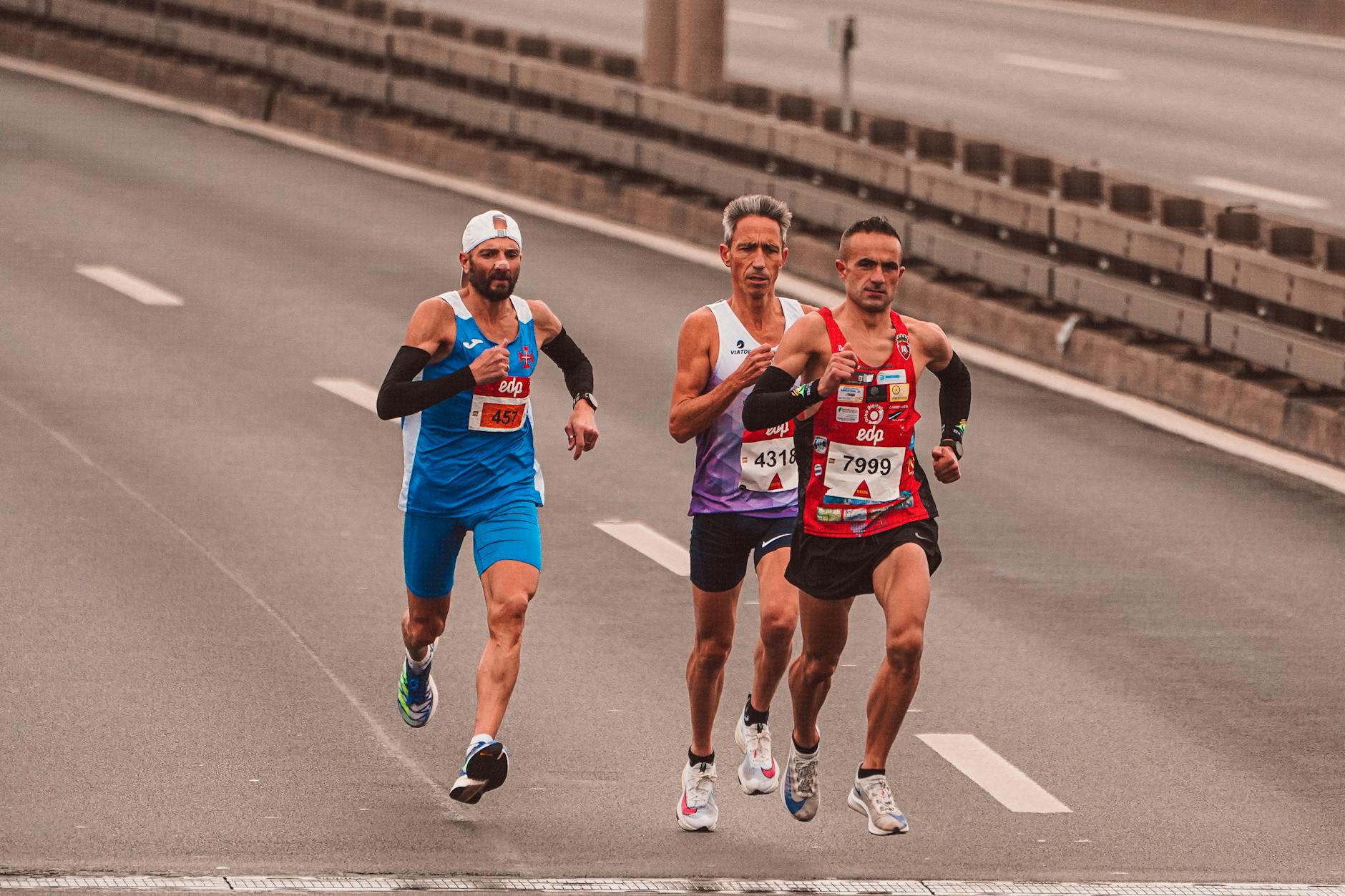
Distance running and sprint training sit on opposite ends of the muscle-building spectrum. A marathon runner performing 80-mile training weeks develops aerobic adaptation, fatigue resistance, and lean muscle, but minimal muscle hypertrophy. Their quadriceps, calves, and glutes become efficient endurance muscles, not large ones. A sprinter running 400-meter repeats once or twice Intensity Minutes Improve Quality of Life”>weekly builds measurably more muscle in the lower body, despite training far less total volume, because the high-force demands trigger fast-twitch recruitment. Trail running occupies a middle ground.
The variable terrain, elevation changes, and frequent deceleration demand greater muscular stabilization and force production than road running. A runner incorporating regular hill repeats and technical descents will develop noticeably more leg muscle than a flat-route road runner doing the same weekly mileage. This is why fell runners—who train on mountainous terrain—typically appear more muscular than road racers of similar fitness levels. Tempo runs and threshold efforts sit between easy jogging and sprint work. These moderate-to-hard efforts do generate more muscle stimulus than easy runs because they require sustained high force production, but they still primarily recruit aerobic pathways and slow-twitch fibers. If muscle building is your priority, threshold work is useful as a supplement to sprinting or strength training, but shouldn’t form the backbone of your program.
Combining Cardio and Strength Training for Optimal Results
Athletes who want both cardiovascular fitness and muscle growth must combine cardio with dedicated resistance training. This is the only approach that optimizes both adaptations. A runner doing three strength sessions weekly plus their running program will develop significantly more muscle than running alone, without sacrificing aerobic capacity if the strength work is programmed correctly. The training order matters. Performing strength work on separate days from hard cardio sessions—or doing strength before easy cardio—minimizes interference between adaptations.
Research shows that high-intensity cardio done on the same day as strength training can blunt muscle protein synthesis and hypertrophy if performed in the wrong sequence or at excessive volume. A practical approach: do lifting sessions on strength-focused days, reserve other days for running, and keep total weekly training volume reasonable to allow recovery. The tradeoff is that building significant muscle requires caloric surplus and strategic nutrition, while maintaining running performance often demands leaner body composition. Many runners find they must choose between optimizing for muscle gains (which favors being slightly overfed) or optimizing for running speed (which favors being lean). A middle ground exists—most runners can build modest muscle while maintaining performance—but the highest levels of both require accepting some compromise.
Overtraining and Muscle Loss From Excessive Cardio
The biggest threat to muscle retention in endurance athletes is chronic overtraining. Doing more than 10-12 hours of moderate-to-hard running weekly without adequate strength training creates a catabolic environment where your body breaks down muscle for fuel. This occurs because the recovery demand exceeds the growth stimulus, cortisol remains chronically elevated, and muscle protein synthesis can’t keep pace with breakdown. Ultra-marathon runners represent an extreme example. Someone training 80+ miles weekly develops exceptional aerobic capacity but often loses considerable muscle mass, particularly in the upper body.
The metabolic stress of sustaining moderate-intensity effort for hours daily, combined with caloric deficit and insufficient strength stimulation, shifts the body toward muscle catabolism. Remarkably, many ultra-runners could improve their performance by reducing volume slightly and adding strength work, which would build resilience and power for the downhill and technical portions of races. Warning: if your primary goal is muscle building, don’t exceed eight hours of running per week without complementary strength training. Even then, monitor your strength levels—if you’re getting weaker despite consistent training, excessive cardio volume is likely the culprit. Scale back running volume or reduce intensity on some sessions, and ensure you’re eating enough protein and total calories to support both adaptation demands.

Nutrition and Recovery for Cardio Athletes Building Muscle
Protein intake becomes critical when pursuing muscle growth alongside cardio. While sedentary individuals need about 0.8 grams per kilogram of body weight daily, cardio athletes attempting to build muscle should target 1.6-2.2 grams per kilogram. This higher intake supports muscle protein synthesis while your training creates constant adaptation demand. A 150-pound runner should aim for 110-150 grams of protein daily, distributed across multiple meals.
Caloric intake also matters substantially. Building muscle requires modest caloric surplus—roughly 300-500 calories above maintenance—while endurance training creates significant energy demand. A runner attempting to build muscle must eat enough to cover the cardiovascular work, fuel the strength training, and provide the surplus for growth. Many runners eating “just enough” to fuel their cardio work make no progress on muscle gains because they’re in caloric balance rather than surplus. This doesn’t mean extreme eating; it means being intentional about caloric intake and tracking progress to ensure you’re supporting both adaptations.
Periodization Strategies for Balancing Cardio and Muscle Building
Strategic periodization allows runners to emphasize different adaptations across training phases. During winter months, you might reduce running volume and emphasize strength and hypertrophy work, building muscle while maintaining fitness. As racing season approaches, shift toward higher running volume with maintained (but reduced-frequency) strength work to preserve muscle while developing race-specific fitness.
This cyclical approach prevents the loss of either adaptation. Many accomplished runners follow a reverse linear periodization strategy: high training volume and lower intensity early in the year (building aerobic base and some muscle with long tempo runs and hill work), then progressively reducing volume while increasing intensity (peak-specific races). This naturally creates space for more strength training early in the cycle when muscle building potential is highest. The approach works because it aligns training emphasis with available recovery capacity rather than trying to maximize everything simultaneously.
Conclusion
You can build muscle with cardio, but the gains remain modest compared to dedicated resistance training. Sprint-based work, hill running, and high-intensity interval training create meaningful muscle stimulus because they demand force production, while steady-state distance cardio builds endurance-adapted muscle that remains relatively lean. The key constraint is mechanical tension—your muscles only grow when forced to overcome significant resistance, something that has a ceiling in cardio-only training.
To maximize muscle growth while maintaining cardio fitness, combine running with dedicated strength training, ensure adequate protein intake and caloric surplus, and avoid excessive cardio volume without compensatory strength work. Most runners benefit from the hormonal and physiological adaptations that moderate cardio provides while using resistance training to drive meaningful muscle development. Accept that optimizing for maximum muscle gains requires scaling back your cardio volume—it’s a tradeoff, not a limitation you can overcome with sheer training volume.
Frequently Asked Questions
How much cardio is too much if I want to build muscle?
More than 10-12 hours weekly of moderate-to-hard cardio without strength training begins to create a net catabolic environment. Keep steady running below eight hours weekly if muscle building is a priority, and perform strength work at least twice per week on separate days.
Can I build muscle doing only HIIT workouts without traditional strength training?
HIIT generates more muscle stimulus than steady cardio, but the absolute gains remain limited. You’ll maintain muscle better than with distance work, but resistance training provides substantially greater hypertrophy stimulus. HIIT works best as a supplement to lifting, not a replacement.
What’s the best way to structure a week combining running and strength training?
Separate hard sessions to avoid interference. Example: Strength Monday, easy run Tuesday, strength Wednesday, hard run/intervals Thursday, cross-training Friday, long run Saturday, rest Sunday. This allows adequate recovery while preventing the same system from being taxed on consecutive days.
How long before I see muscle gains from adding sprints to my running?
You’ll notice modest changes in 4-6 weeks—increased leg definition and harder muscles. Significant visible hypertrophy requires 8-12 weeks of consistent work with adequate nutrition. Real progress becomes apparent after 3-4 months of combined training.
Will running make me lose muscle I already have?
Easy-to-moderate running doesn’t cause muscle loss if you’re eating adequately and doing some strength training. The risk emerges with excessive volume (15+ hours weekly) combined with caloric deficit or protein deficiency. Most runners maintain muscle fine with reasonable training volume and proper nutrition.
Can distance runners build bigger legs through training alone?
Only modestly. Marathon runners develop stronger legs but rarely significant hypertrophy because the stimulus doesn’t demand it. Sprinters and hill-repeat specialists build noticeably more leg muscle because the high-force demands trigger fast-twitch recruitment. Resistance training adds muscle substantially faster than any cardio progression.


