
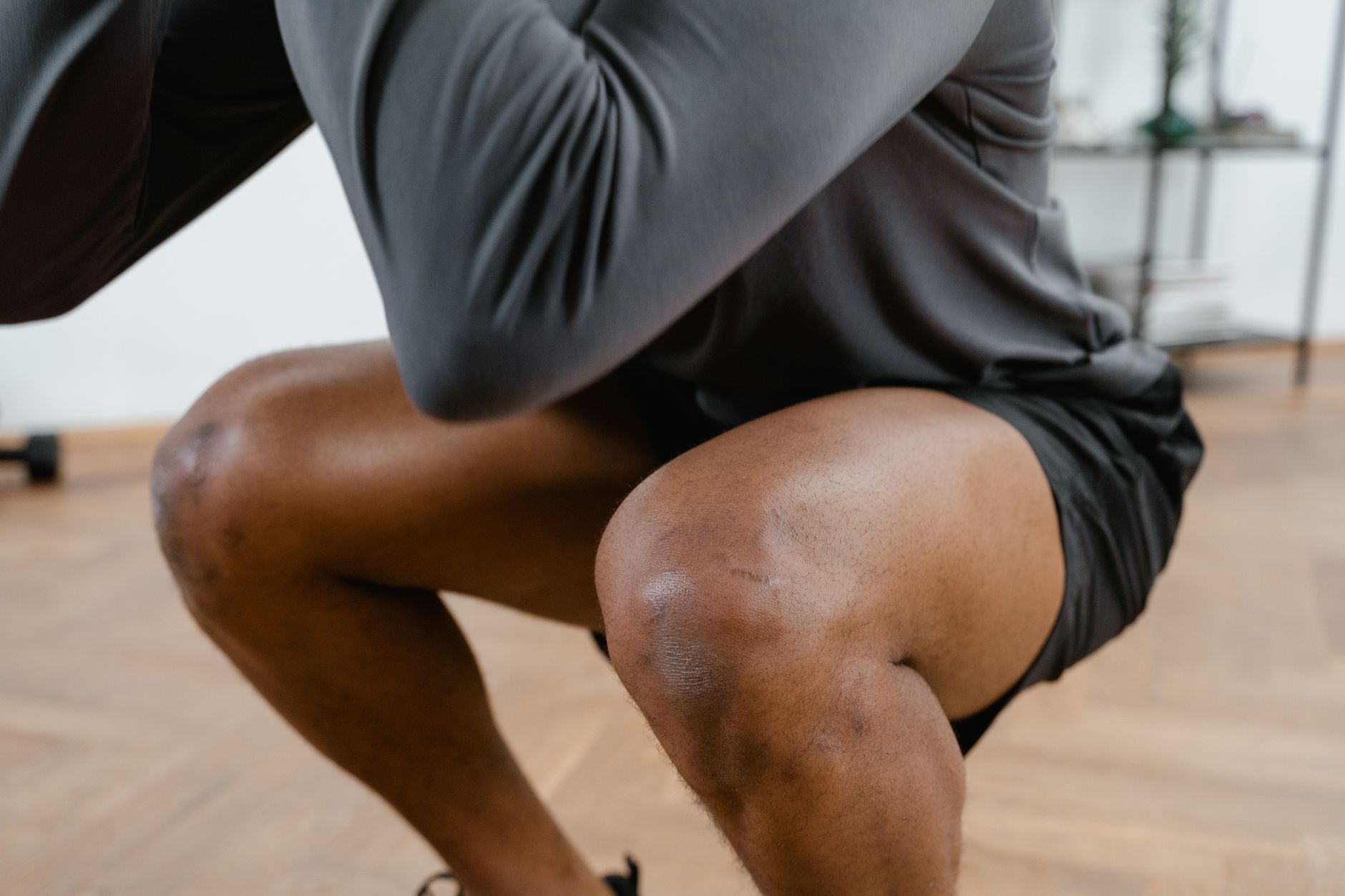
The outside of your knee may hurt downhill because descending changes your knee angle and can irritate tissue beneath the iliotibial band. This pattern often points to iliotibial-band syndrome, or ITB syndrome, a running-related overuse injury. The ITB is a strong band of connective tissue running from the hip down the outer thigh and across the outside of the knee. However, pain in this area is not automatically ITB syndrome.
Medical information disclaimer: This article is for general educational purposes only and does not provide medical advice, diagnosis, or treatment. Always consult a physician or other qualified health professional about symptoms, medications, tests, or treatment decisions.
Table of Contents
- Why Downhills Trigger the Pain
- What Is Actually Becoming Irritated?
- Do Running Mechanics Play a Role?
- What to Do About Downhill Knee Pain
- When It May Be Something Else
Why Downhills Trigger the Pain
running downhill reduces knee flexion—the amount your knee bends—when your foot lands. This can place the knee near the angle at which researchers observed ITB impingement in runners with ITB syndrome, according to an American Journal of Sports Medicine study. The pain commonly feels like a localized stab or sting on the outside of the knee.
It may peak while the knee is slightly bent just before or after foot strike. Walking down stairs may produce a similar sensation. Pain can emerge only on descents at first because downhill running repeatedly loads that sensitive position. Continuing the same route or pace may keep provoking it.
What Is Actually Becoming Irritated?
The condition was traditionally explained as the ITB sliding back and forth across the lateral femoral condyle, the bony prominence outside the knee. That "friction" model is probably incomplete.
A Journal of Anatomy study found that the lower ITB is anchored to the femur rather than freely moving over it. The researchers proposed that bending the knee may compress richly supplied, pain-sensitive fat beneath the band. This distinction matters because the problem may not be a band that simply needs to be "loosened." Training load, running mechanics, strength, flexibility, footwear, and terrain may all deserve attention.
Do Running Mechanics Play a Role?
Some runners who develop ITB syndrome move differently at the hip and knee. In one prospective study of female recreational runners, the 18 participants who developed the condition showed greater inward hip movement and knee rotation than matched controls. Those motions may increase ITB strain and compression near the outer knee.
Weakness, limited mobility, or a recent change in training could also be relevant areas for a clinician to assess. These patterns do not prove the cause in every runner. A 2023 Gait & Posture meta-analysis found limited biomechanical evidence, with findings varying by sex and whether runners were currently injured or had recovered.
What to Do About Downhill Knee Pain
Temporarily reduce the exposure that provokes pain. That might mean avoiding steep descents, choosing a flatter route, shortening the run, or stopping when the familiar outer-knee pain begins.
A physical therapist or other qualified clinician can assess factors that generic exercises may miss: Do not treat pain as proof that you need to push through or stretch one structure aggressively. An assessment can help match the response to the runner rather than to a single theory about the ITB.
- Running gait and lower-limb movement
- Hip, knee, and ankle strength
- Flexibility and joint motion
- Footwear and usual running routes
- Recent changes in distance, intensity, hills, or frequency
When It May Be Something Else
Outer-knee pain can also come from a ligament injury, meniscus tear, or tibial stress fracture. Seek an evaluation if symptoms persist, worsen, interfere with walking, or do not follow the typical activity-linked pattern. According to Hospital for Special Surgery, urgent assessment is warranted for deformity, inability to walk, major swelling, redness or warmth, fever, or severe pain.