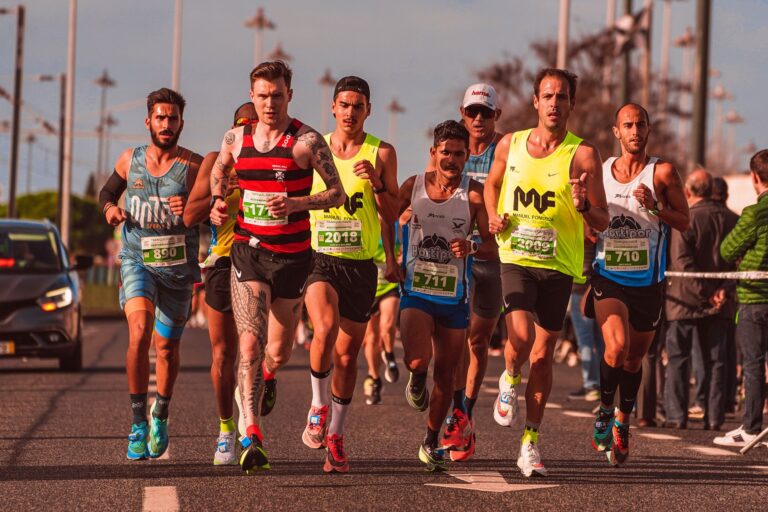
The numbers are unambiguous: marathon success is built on volume. An analysis of 119,452 runners across 151,813 marathons shows that weekly training volume explains more than 90 percent of performance variation. This isn’t speculation or anecdotal advice from running forums—it’s data at scale.
Sub-3-hour marathoners train at three times or more the volume of average finishers, a gap so consistent that it cuts through individual variations in genetics, age, and running economy. But volume alone tells only part of the story. Recent research across multiple datasets has quantified what actually separates competitive finishers from the broader runner population, and the findings challenge some long-held assumptions about marathon training. The numbers reveal which training methods deliver measurable results, which injuries are most likely to derail preparation, and how the sport itself is changing at the recreational level.
Medical information disclaimer: This article is for general educational purposes only and does not provide medical advice, diagnosis, or treatment. Always consult a physician or other qualified health professional about symptoms, medications, tests, or treatment decisions.
Table of Contents
- How Much Volume Do Marathoners Actually Need?
- Quality Sessions and Their Measurable Impact
- Injury Patterns and How to Avoid Them
- Modern Marathon Performance and the Five-Year Trend
- Carbon-Plated Shoes and Technology Adoption
- Record-Breaking Performances in 2026
- Participation Trends and an Aging Marathon Population
How Much Volume Do Marathoners Actually Need?
The scale of the data makes the conclusion hard to dismiss. Among 119,452 runners analyzed, sub-3-hour performance correlates almost entirely with training volume—a relationship so dominant that it accounts for more than 90 percent of the variation in finish times. To put this in practical terms: a runner averaging 30 miles per week faces fundamentally different odds than one averaging 90 miles per week, regardless of other variables. This doesn’t mean every high-volume runner breaks three hours.
It means the odds shift dramatically. Sub-3-hour runners consistently train at triple the volume of the median finisher, suggesting a volume threshold exists—not as a hard line, but as a practical floor beneath which competitive performance becomes unlikely. A runner training 40 miles per week might improve from 4:15 to 4:05 with better pacing strategy or race-day nutrition; a runner training 15 miles per week faces a much steeper climb. The implication for recreational marathoners is straightforward: before optimizing workout intensity, coach selection, or shoe technology, the first question should be whether base volume is adequate. For many runners entering their first marathon, simply accumulating consistent 25–40 weekly miles over 16–20 weeks will produce better results than meticulous interval work on an insufficient foundation.
Quality Sessions and Their Measurable Impact
Beyond volume, the composition of training matters significantly. A Boston Marathon cohort study of 917 runners found that each weekly quality session—a long run, tempo run, or interval workout—predicted a 16.2-minute faster finish time. That’s a quantifiable return on effort. For comparison, runners adding cross-training (cycling or swimming) saw a 6-minute improvement, still meaningful but substantially less than the speed work advantage. This creates a practical hierarchy.
A runner with 10 hours per week to train would produce better results allocating most of that volume to easy aerobic miles, then carving out one high-quality session, rather than spreading effort evenly across the week. The data also shows individual variation: machine learning analysis of training response patterns identified that 68.4 percent of runners benefit from either polarized training (hard/easy separation) or pyramidal methods (gradual intensity buildup). The remaining 31.6 percent either thrive under different approaches or show inconsistent responses, meaning standardized training templates will miss some subset of athletes. One limitation: the Boston Marathon cohort skews toward faster, more disciplined runners. The 16.2-minute advantage from quality sessions may not translate uniformly to slower runners with less developed aerobic capacity or different injury susceptibility. A runner capable of sustaining threshold pace for 40 minutes responds differently to intensity than one doing shorter, slower intervals.
Injury Patterns and How to Avoid Them
The injury rate for marathon training is sobering. A prospective cohort study found that 42 percent of recreational runners sustained at least one injury during marathon training, with historical data suggesting rates as high as 56 to 90 percent. This isn’t rare; it’s the norm. Specific injuries cluster predictably: medial tibial stress syndrome accounts for 24 percent of injuries, iliotibial band syndrome 19 percent, and plantar fasciitis 15 percent. Together, these three injuries affect nearly six of every ten injured runners. Prevention strategies with evidence backing are known and specific.
Structured warm-up protocols reduce injury rates from 60 percent to 28.2 percent—a drop so dramatic it’s almost negligible to skip warming up before a training run. Shoe replacement every 500–700 kilometers, consistent cross-training, and personalized risk assessment also lower incident rates. The puzzle is implementation: runners understand these strategies exist, yet compliance remains inconsistent. A runner increasing mileage by more than 10 percent per week enters a higher-risk zone for tibial stress injuries. A runner with previous IT band issues who skips cross-training or neglects dynamic warm-ups is essentially inviting recurrence. The limitation of the data is that it identifies patterns without fully explaining why individual runners respond differently to the same stimulus—why one athlete tolerates a sudden volume spike while another breaks down.
Modern Marathon Performance and the Five-Year Trend
U.S. marathon times have improved measurably. The average finish time dropped from 4:39 in 2019 to 4:34 in 2024, the first sustained improvement in the metric since the 1990s. Men improved by four minutes over that period; women improved by three minutes. This improvement happened at scale: participation increased 14.6 percent in 2024 alone, with the 2024 New York Marathon drawing 55,646 finishers, the largest field on record.
The median U.S. finish time now sits at 4:25:33, with men averaging 4:10 and women 4:38. That’s meaningful progress, but also context: only 2.65 percent of all marathoners globally break the three-hour barrier. The tradeoff between what’s possible and what’s typical remains vast. A sub-3-hour time places a runner in the top 2-3 percent; a sub-4-hour finish places them in the top 15–20 percent. The gap between competitive and recreational marathoning isn’t narrowing—it’s just that recreational times are trending faster.
Carbon-Plated Shoes and Technology Adoption
Forty-four percent of marathoners now wear carbon-plated shoes, up 14 percentage points from 2023. This rapid adoption coincides with the broader performance improvements seen in average times, though causation is difficult to isolate. A carbon-plated shoe demonstrably improves running economy by 2–4 percent on a treadmill; on race day with fatigue and variable terrain, the advantage is harder to measure precisely. The technology is not a substitute for training, which is critical context. A runner in a $250 carbon-plated shoe but only 25 miles per week will not outrun a well-trained 50-miles-per-week runner in worn-out shoes.
Shoe quality matters most when base preparation is solid. For runners already executing strong training plans, shoe choice becomes a legitimate performance variable worth the cost. For others, better training organization returns more time than better shoes. One nuance worth considering: carbon-plated shoes shift strain patterns, creating new injury risks even while improving efficiency. Runners switching to these shoes after building fitness in traditional trainers sometimes develop different pain patterns. The injury data on carbon shoes remains limited, meaning early adopters are partly conducting an ongoing experiment.
Record-Breaking Performances in 2026
Sebastian Sawe ran 1:59:30 at the 2026 London Marathon, breaking the two-hour barrier in actual race conditions—a milestone distinct from time trials or specially designed efforts. This achievement matters because it happened among competitors, with the variable conditions, pacing decisions, and unpredictability of mass racing. The previous sub-2-hour marathons were either controlled efforts or time trials; Sawe’s performance proved it possible in genuine competitive conditions.
Tigst Assefa set the women’s world record at 2:15:41 at the same race. These performances represent the ceiling of human marathon capacity, but also the data point that informs what elite training looks like. Both runners executed precisely the principles identified in the broader research: high training volume, specific intensity work, and evidence-based pacing. They also benefited from course design, weather conditions, and pacing groups that aren’t available to recreational runners, making direct comparison less useful than noting that the same fundamentals—volume and quality—underpin both elite and age-group marathoning.
Participation Trends and an Aging Marathon Population
Women 70 and older increased marathon participation by 250 percent between 2015 and 2025. Women 60 and older grew by 159 percent over the same period. This demographic shift is rewriting the composition of marathon fields, with older runners now representing a substantial segment of finisher populations.
The New York Marathon’s 2026 drawing had 240,000 applicants for a field that already expanded to 55,646 finishers in 2024, signaling no decline in marathon interest despite saturation in many markets. Age-group marathoning data reveals that older runners often approach training differently—higher respect for recovery, earlier injury intervention, and often more deliberate pacing. The injury rates for runners 60+ differ from those in the 30–40 age range, with some injury patterns becoming more prevalent and others less so. The data doesn’t yet fully stratify injury risk by age within marathon training populations, but the expanding older runner category means future research will likely clarify whether training guidance should diverge more sharply by age than it currently does.