

Running without getting tired comes down to three foundational changes: building aerobic fitness gradually, learning to pace yourself appropriately, and improving your running economy through proper form. Most beginner runners crash into fatigue because they run too fast on easy days, exhaust their glycogen stores, and never develop the aerobic base that allows the body to sustain effort. When you run at conversational pace—where you can speak in short sentences but not full paragraphs—your body learns to burn fat efficiently and spare carbohydrates, delaying the fatigue wall that hits hard runners on longer efforts.
The shift from “getting tired quickly” to “running for extended periods comfortably” typically takes 8 to 12 weeks of consistent training, though individual timelines vary based on starting fitness and training structure. A runner who previously felt exhausted after 20 minutes of continuous effort can often sustain 45 to 60 minutes at an easy pace within three months if they apply the right principles. The changes aren’t mysterious—they’re physiological. Your mitochondria increase in number, your capillary density expands to deliver oxygen more efficiently, and your muscles develop greater oxidative capacity.
Table of Contents
- Why Do You Get Tired While Running?
- Building an Aerobic Base Without Burning Out
- Improving Running Economy and Efficiency
- Pacing Strategy and Effort Distribution
- Nutrition, Hydration, and Energy Management
- The Role of Sleep and Recovery
- Mental Fatigue and Long-Term Progression
- Conclusion
- Frequently Asked Questions
Why Do You Get Tired While Running?
Fatigue while running stems from several intersecting mechanisms, not just a single cause. The primary culprit is anaerobic effort—when you run faster than your aerobic threshold, your muscles produce lactate faster than your body can clear it, triggering that heavy, sluggish feeling in your legs. Most runners aren’t actually in oxygen debt; they’re just running in an Intensity Minutes Improve Real-World Independence”>intensity zone where their system can’t sustain the pace for long. A runner doing an easy 10-minute mile builds aerobic capacity, while that same runner doing a hard 8-minute mile pace burns out quickly because the intensity is unsustainable.
Glycogen depletion is a secondary factor, especially on runs over 90 minutes. Your muscles store enough glycogen for roughly 90 to 120 minutes of continuous effort at moderate intensity, depending on your diet and training status. When glycogen drops below a critical threshold, fatigue becomes severe and performance tanks sharply. This is the “hitting the wall” sensation many endurance runners experience. Dehydration and electrolyte imbalance compound this problem, slowing your metabolism and your body’s ability to regulate temperature.

Building an Aerobic Base Without Burning Out
The biggest mistake runners make is treating every run like it matters, when the truth is that most of your running volume should feel easy—genuinely easy, not “moderate with occasional fast sections.” Research suggests that 80% of your total running time should be at low intensity, with the remaining 20% dedicated to harder efforts like tempo runs and intervals. This distribution allows your body to accumulate aerobic adaptations while recovering adequately between harder sessions. Easy runs should feel sustainable for conversation, typically falling between 60% and 70% of your maximum heart rate. Many runners resist this, believing they’re wasting time, but they’re actually shortchanging their development.
Running too hard too often prevents recovery, suppresses adaptation, and leads to overtraining, where fatigue compounds and performance declines. A limitation to understand: building aerobic capacity takes time. You can’t condense months of adaptation into weeks, no matter how hard you try. The body’s mitochondrial development, capillary expansion, and neuromuscular remodeling follow biological timelines that don’t respond well to shortcuts.
Improving Running Economy and Efficiency
Running economy refers to how much oxygen your muscles demand at a given pace—a more economical runner uses less energy to sustain the same speed. Two runners might run a 9-minute mile at identical intensity, but the more efficient runner does so with lower heart rate and lower perceived effort. Economy improves through strength training, running form refinement, and accumulated aerobic training. A runner who adds two weekly sessions of strength work—focusing on glutes, core stability, and calf strength—typically sees noticeable efficiency gains within 4 to 6 weeks.
Form flaws create energy leaks: excessive vertical oscillation, overstriding, and excessive upper body movement all force your muscles to work harder than necessary. Most runners can improve economy by shortening their stride and increasing cadence to around 170 to 180 steps per minute, a pattern that naturally reduces impact forces and promotes a more efficient gait. A practical example: a runner habitually overstriding at 160 cadence might switch to 175 cadence at the same pace and immediately feel less fatigued, even though nothing about the aerobic demand has changed. The improvement is purely mechanical.
Pacing Strategy and Effort Distribution
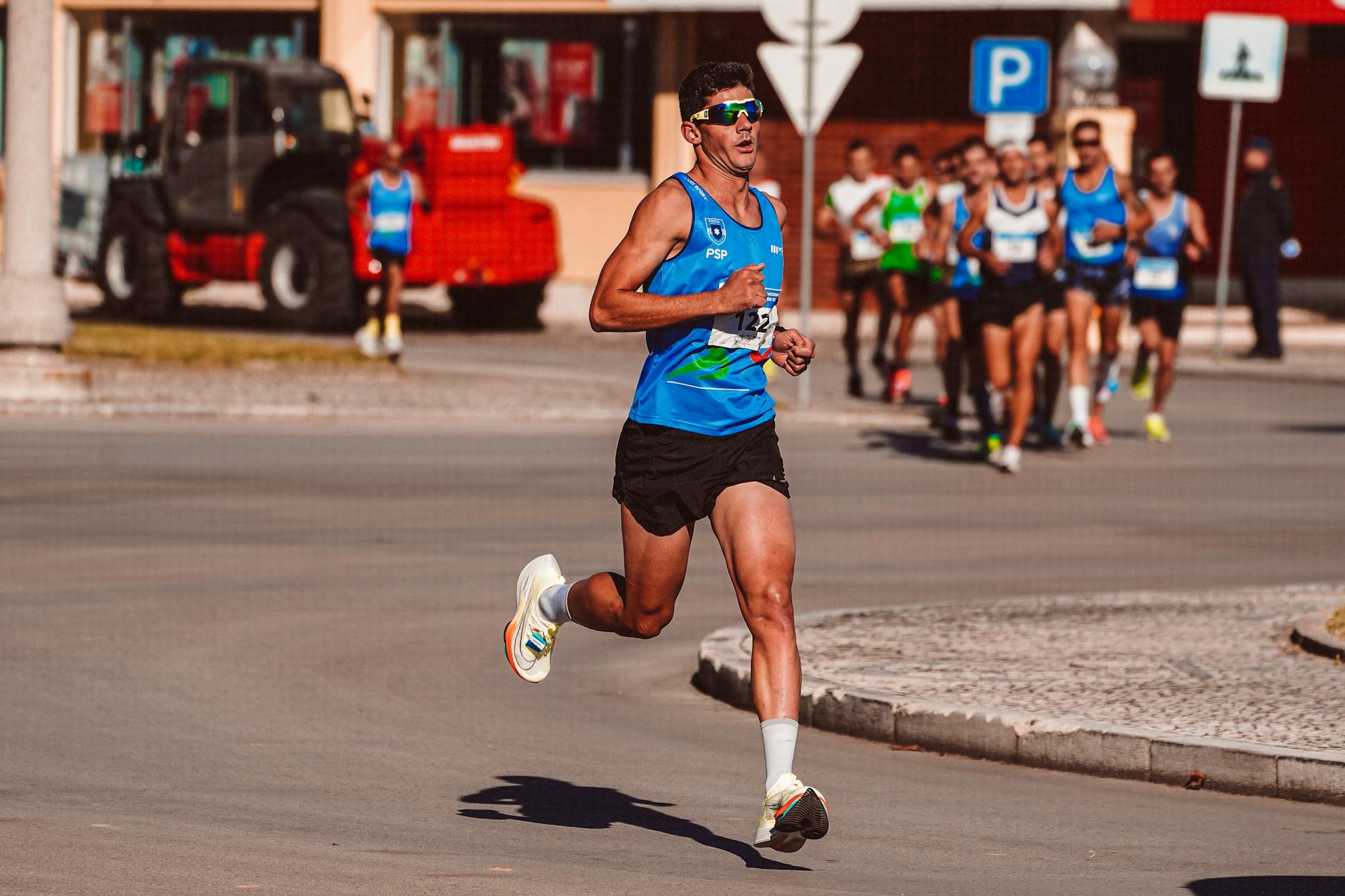
The fundamental tradeoff in distance running is between pace and sustainability. Running faster than your aerobic capacity burns through energy reserves rapidly and creates accumulating fatigue, while running within your aerobic window allows you to continue for extended periods. The sweet spot for building endurance is typically around 65% to 75% of your maximum heart rate, a range where you’re working hard enough to stimulate adaptation but not so hard that you’re triggering anaerobic metabolism. This might translate to a 10-minute mile for one runner and an 8-minute mile for another—the intensity is relative to individual fitness, not the clock.
Negative splits—running the second half of a run faster than the first—create a psychological and physiological advantage. By running the first half conservatively, you preserve energy and glycogen, allowing you to feel stronger as fatigue would normally accumulate. Comparison: a runner who goes out at 8:30 pace and slows to 9:15 will feel progressively more defeated, while a runner who starts at 9:15 and finishes at 8:30 feels strong and capable. The total time might be the same, but the experience and training effect are different. Pacing mastery is ultimately about matching effort to capacity, not about following predetermined splits.
Nutrition, Hydration, and Energy Management
What you consume before, during, and after running directly impacts how quickly fatigue sets in. A runner who starts a long run (90+ minutes) glycogen-depleted hits the wall dramatically harder than one who fueled properly. Eating 50 to 100 grams of carbohydrates 2 to 3 hours before a run ensures your glycogen stores are topped off. For runs exceeding 90 minutes, consuming 30 to 60 grams of carbohydrates per hour during the run—through gels, sports drinks, or chews—maintains blood glucose and delays fatigue.
A warning: fueling improperly during running can actually increase fatigue sensation. Consuming too much simple sugar too quickly can trigger a brief energy spike followed by a crash, or it can cause stomach distress that redirects blood flow from muscles to digestion. Hydration interacts with fueling; dehydration concentrates electrolytes and impairs nutrient absorption, creating a cascading effect where fatigue accelerates. The limitation here is individual variation—what works for one runner’s gut might not work for another’s. Testing nutrition during training, not during important efforts, is non-negotiable.

The Role of Sleep and Recovery
Sleep is where the actual adaptation happens. During deep sleep, your body releases growth hormone, repairs muscle tissue, replenishes glycogen, and consolidates neuromuscular learning. A runner who trains hard but sleeps only 6 hours per night will be significantly more fatigued during runs than one who prioritizes 8 hours of sleep.
The fatigue you feel isn’t just about today’s effort—it’s cumulative fatigue from inadequate recovery across days or weeks. An example: a runner following a challenging training block while managing a new job often reports sudden fatigue spikes during runs that have nothing to do with the workout itself. They’ve simply accumulated a sleep debt, and their aerobic system is operating at diminished capacity. Prioritizing sleep—treating it with the same seriousness as scheduled workouts—is one of the highest-return investments a runner can make.
Mental Fatigue and Long-Term Progression
Physical fatigue is only part of the story. Mental fatigue, driven by monotony or excessive intensity, can make running feel harder than the physiology actually warrants. Varying your routes, running with others occasionally, and mixing paces throughout the week create psychological freshness that makes training sustainable long-term. Runners who follow identical routes at identical paces often report growing fatigue, not because their body has deteriorated but because the repetition creates mental staleness.
Looking forward, the most resilient runners aren’t those who push hardest in the short term—they’re the ones who build fitness gradually, prioritize recovery, and maintain consistency over years. Fatigue resistance compounds over time. A runner with three months of solid aerobic training will naturally tire less quickly than one with three weeks, and a runner with three years of smart training will have adapted profoundly. The goal isn’t to never feel tired; it’s to build the physiological and mental capacity to keep running effectively when fatigue does arrive.
Conclusion
Running without getting tired boils down to training at the right intensity, building aerobic fitness patiently, maintaining proper nutrition and hydration, and respecting recovery. The most common mistake is running too hard too often, which prevents the aerobic adaptations your body needs to sustain longer efforts. By committing to easy paces for most of your volume, adding strength and form work, and prioritizing sleep, you create the conditions for genuine fatigue resistance.
Start where you are, trust the process, and expect progress in 8 to 12 weeks. The runner who struggles to sustain 30 minutes now can almost certainly run for 60 minutes comfortably within that timeframe if they apply these principles consistently. Fatigue isn’t a limit you’re stuck with—it’s a sign your aerobic system needs development, and that’s something training directly addresses.
Frequently Asked Questions
How long does it take to build the aerobic base to run longer distances without getting tired?
Most runners see noticeable improvements within 4 to 6 weeks and significant changes within 8 to 12 weeks. The timeline depends on your starting fitness, training consistency, and how much volume you’re accumulating weekly.
Is it okay to run fast if I’m getting tired during easy runs?
No. If you’re fatiguing quickly on easy runs, you need to slow down further. The goal of easy running is to build aerobic capacity with minimal fatigue, which creates recovery stress that compromises future efforts.
How do I know if I’m running at the right easy pace?
You should be able to speak in short sentences without gasping for breath. If you can only speak a few words at a time, you’re running too hard. If you could give a full speech, you might go slightly harder while staying in the easy zone.
Does strength training help with running endurance?
Yes, significantly. Strength work improves running economy and efficiency, reducing the muscular effort required at a given pace. This reduces fatigue and allows you to sustain efforts longer.
What should I eat before a long run to avoid getting tired?
Eat 50 to 100 grams of carbohydrates 2 to 3 hours before running. For runs over 90 minutes, consume 30 to 60 grams of carbohydrates per hour during the effort through gels, sports drinks, or real food.
Can running too much make me permanently tired?
Yes, overtraining can create chronic fatigue where you feel tired even when resting. The solution is to reduce volume, prioritize recovery, and ensure you’re sleeping adequately.