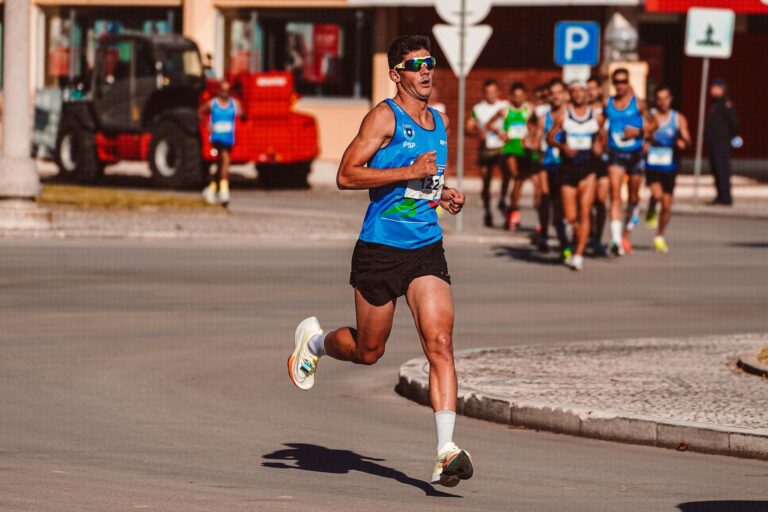
Excessive vertical oscillation—the bouncing motion you feel when running—wastes energy and increases impact stress on your joints. You can reduce this bouncing by focusing on three key areas: increasing your cadence to 170-180 steps per minute, improving your posture to lean from your ankles rather than your hips, and strengthening your core and glutes to stabilize your body during landing. A runner who was bouncing noticeably with a cadence of 155 steps per minute saw a dramatic reduction in vertical movement and felt less tired after runs within two weeks of consciously increasing their cadence to 175 steps per minute.
The amount of energy you waste through excessive bouncing can be significant. Every unnecessary upward movement requires muscular effort that could be directed into forward propulsion instead. Elite distance runners typically exhibit less vertical oscillation than recreational runners because their bodies have adapted through years of running to move more efficiently. The good news is that runners of any level can immediately begin reducing their bounce through focused form work and targeted strength training.
Table of Contents
- What Causes Bouncing When Running and Why It Matters?
- The Role of Cadence in Eliminating Running Bounce
- Postural Alignment and Forward Lean for Efficient Running Form
- Strengthening Your Core and Glutes to Control Bounce
- The Landing Position and Foot Strike Patterns
- Running Surfaces and Their Impact on Vertical Oscillation
- Technology and Feedback Tools for Measuring Improvement
- Conclusion
- Frequently Asked Questions
What Causes Bouncing When Running and Why It Matters?
Vertical oscillation happens when your body absorbs impact poorly at foot strike, then uses excessive muscular effort to propel itself upward. The culprits are usually weak glutes and core muscles, overstriding (landing too far in front of your body’s center of gravity), and too-slow cadence. When you overstride, your leg extends forward before landing, forcing your body to collapse downward at impact rather than smoothly transitioning over your landing foot. running at 160 steps per minute instead of 175 creates longer ground contact times, which typically correlates with larger vertical movements.
Research consistently shows that reducing vertical oscillation improves running economy—the amount of oxygen you need to maintain a given speed. A runner bouncing excessively at a 7-minute-per-mile pace might require 5% more oxygen than a runner with efficient form at the same pace. Over a 5-mile run, that inefficiency adds up significantly, which is why many runners feel exhausted even though they’re not running particularly fast or far. The connection is direct: less bounce equals less effort, which means you can run faster or longer without increasing fatigue.
The Role of Cadence in Eliminating Running Bounce
Your step rate—how many times your feet strike the ground per minute—is one of the most powerful tools for reducing bounce. Most recreational runners naturally fall into a cadence of 155-165 steps per minute, but this slower rate almost inevitably produces more vertical movement. By increasing your cadence to 170-180 steps per minute, you’re forced to take shorter, quicker steps that land closer to your center of gravity, which dramatically reduces bounce.
The mechanics work like this: with a slower cadence, your legs spend more time in the air, which means more time for gravity to pull you downward before the next landing. A faster cadence shortens this flight phase, reducing the distance you fall and therefore the amount of force absorption needed at impact. However, there’s a limitation to simply increasing cadence—if you try to jump from 160 to 185 steps per minute overnight, you’ll likely feel stiff and your muscles will fatigue quickly because they’re not adapted to the faster rhythm. The solution is gradual increases of 5 steps per minute every week or two, combined with listening to a metronome app or music at your target cadence during easy runs.
Postural Alignment and Forward Lean for Efficient Running Form
Your posture during running determines whether your muscular effort goes into forward movement or wasted upward movement. The most common postural mistake is what runners call “sitting back”—where your hips lag behind your torso. This forces you to reach forward with your feet, creates an extended braking phase at landing, and triggers greater vertical oscillation as your body tries to redirect downward momentum into forward progress. The correct posture involves a slight forward lean from your ankles, not your waist, keeping your hips underneath your shoulders and allowing your center of gravity to move directly over your landing foot.
A practical way to feel this is to do what coaches call the “wall drill”: stand with your back against a wall, feet about six inches from the wall, then lean forward at your ankles until you’re just about to fall and have to catch yourself with a step forward. This lean angle is approximately what you should feel during running. Many runners find this feels unnatural at first because years of upright standing have conditioned them differently. One common consequence of forcing a lean without concurrent hip-strengthening work is lower back strain, so always pair postural changes with glute and core exercises. The lean must come from your entire body moving together, not from bending forward at the waist.
Strengthening Your Core and Glutes to Control Bounce
Your glutes are the primary muscles responsible for controlling vertical movement during running. When your glutes are weak, your body cannot control the deceleration of downward movement at impact, and your core cannot maintain spinal stability, forcing your legs to flail and bounce. Specific exercises like single-leg glute bridges, lateral band walks, clamshells, and single-leg balance work directly address the imbalances that cause excessive bounce. One comparison worth noting: a runner doing standard strength training with squats and deadlifts might still bounce excessively if those exercises don’t activate the specific stabilizer muscles needed during running.
Single-leg exercises are far more effective than double-leg exercises for running-specific strength because they force each leg to control its own movement independently. For example, a runner who switched from doing traditional squats twice a week to doing three sessions of single-leg glute bridges and lateral band walks saw noticeable improvement in bounce within three weeks. The tradeoff is that single-leg work is less comfortable and usually allows for less total weight load, but the functional carryover to running is significantly better. These exercises should be done 2-3 times per week, and improvement in bounce usually becomes visible within 4-6 weeks.
The Landing Position and Foot Strike Patterns
Where and how your foot strikes the ground determines how much vertical force your body must absorb. Overstriders land with their foot extended in front of their body, forcing a large braking deceleration that produces upward bounce as compensation. The ideal landing position has your foot striking almost directly underneath your hips, which allows the impact force to travel straight up through your leg rather than requiring redirection. This shift is often the hardest part of changing running form because your body has decades of movement patterns to reprogram.
Many runners who try to change their landing pattern experience shin splints or calf soreness in the first few weeks because these muscles aren’t accustomed to the new demands. This is a warning that you should make landing changes gradually during easy runs only, never during hard workouts or tempo runs where you’re fatigued and likely to revert to old patterns. Additionally, changing your landing pattern without simultaneously increasing your cadence rarely works well because a slower cadence still produces the natural reaching-forward stride that causes overstriding. The two changes—increasing cadence and landing closer to your center of gravity—work synergistically and should be implemented together rather than separately.

Running Surfaces and Their Impact on Vertical Oscillation
The surface you run on affects how much bounce you need to produce. Soft surfaces like trails or grass require more muscular effort to propel yourself forward because the ground absorbs some of your energy. Hard surfaces like concrete or asphalt provide more spring-back, allowing more efficient forward movement but also creating more impact shock that requires better form to manage.
A runner who trains primarily on asphalt and then runs a trail race often notices increased bounce on the uneven terrain because their stabilizer muscles are less developed for that environment. For runners trying to eliminate excessive bounce, road running is actually advantageous because the predictable, firm surface allows your form to stabilize quickly. If you’re dealing with bounce issues, doing your cadence and form work on roads or a treadmill first will show results faster than trying to change form on trails where your nervous system is simultaneously trying to manage irregular footing.
Technology and Feedback Tools for Measuring Improvement
Modern running watches and apps can measure vertical oscillation directly, showing you a number that represents centimeters of upward movement per stride. This objective feedback is invaluable because you cannot always feel your bounce improving—the changes are often small and gradual. Many runners find that having a specific number to track motivates them to maintain their form work and strength training.
GPS watches from brands like Garmin show vertical oscillation during runs, and some provide immediate feedback if you’re bouncing excessively, allowing you to make micro-adjustments in real time. However, technology feedback should complement, not replace, the feel-based awareness you develop through video analysis and coaching cues. Recording yourself running on video allows you to visually see the bounce, which often motivates change more effectively than watching a number on a screen. The most successful runners combine both: they use objective measurement to track progress over weeks, while using video and cadence drills for immediate session-to-session feedback.
Conclusion
Reducing vertical bounce when running is achievable through systematic attention to cadence, posture, landing position, and targeted strength work. The improvements are tangible—you’ll feel less tired, experience less joint impact, and often notice faster race times without running harder. Start by establishing your current cadence with a metronome app, then increase it gradually to 170-180 steps per minute while simultaneously working on glute and core strength 2-3 times per week.
The process typically takes 4-8 weeks before significant improvements appear, and longer-term benefits continue accumulating for months as your strength increases and movement patterns become automatic. Be patient with the process and avoid trying to change everything at once, which usually leads to injury or burnout. Focus on one element—cadence first, then strength, then postural awareness—rather than attempting a complete form overhaul immediately. Your body will adapt, your bounce will diminish, and your running will feel noticeably more efficient.
Frequently Asked Questions
How can I tell if I’m bouncing too much when running?
The most reliable way is to video yourself running from the side or have someone watch you run. Look for excessive vertical head movement or a clear up-and-down motion rather than smooth forward progression. If you have a modern running watch, check the vertical oscillation measurement—most runners fall into a range of 8-12 centimeters, with lower numbers indicating more efficient form. You might also notice excessive tiredness relative to your pace or consistent joint soreness.
Can I fix my bounce in one week?
No. While you might feel immediate differences when focusing on cadence or posture during a single run, actual changes to your neuromuscular patterns and strength take weeks. Most runners see noticeable improvement in 3-4 weeks if they’re consistent with both cadence work and strength training, but continued improvement continues for months. Trying to fix everything immediately often leads to injury because your muscles aren’t ready for the demands.
Should I run on a treadmill to fix my bounce?
Treadmills can be helpful for learning a new cadence because you can match the belt speed and focus purely on form, but they’re not necessary. The advantage is that treadmills provide consistent, predictable ground contact. Most runners do best combining some treadmill work for form practice with road running where they apply the new patterns in a more realistic environment.
Does bouncing slow me down?
Yes. Excessive bounce wastes energy that could be directed into forward movement. Studies show that runners with high vertical oscillation require significantly more oxygen to maintain the same pace as more efficient runners, which translates directly to slower times over any distance. Reducing bounce almost always improves your speed, even if you’re not running harder.
Is my bouncing caused by weak ankles or calves?
More often it’s weak glutes and core muscles rather than ankle or calf weakness. However, calf and ankle strength do matter for landing efficiency. The most common pattern is weak glutes combined with tight hip flexors, which creates the forward-leaning posture that triggers bounce. Address glute strength first with single-leg exercises, and ankle strength will typically improve naturally as your running form improves.
How much improvement can I expect?
Runners who successfully reduce their bounce typically see improvements in running economy of 2-5%, which translates to either running the same pace with noticeably less effort or maintaining effort while running slightly faster. Some runners report feeling 10-15% fresher after runs, even though the actual mechanical efficiency might be lower percentage-wise. These improvements accumulate—after months of consistent work, many runners report personal records despite not training harder.