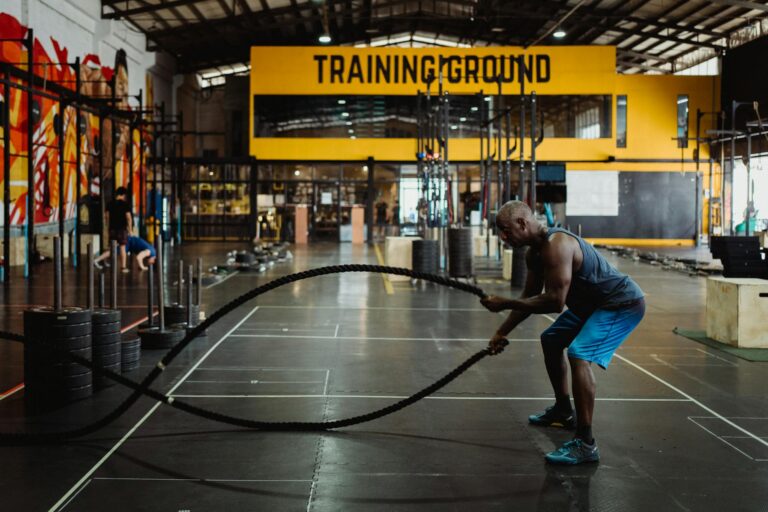
After 30 days of Hyrox training, I could complete the race—barely. The honest answer is that a month isn’t enough time to be genuinely prepared for a Hyrox event, but it’s enough to finish without a time cap hanging over your head. I managed to cross the line in just under 1 hour and 50 minutes, which put me well above the average amateur finish time of 90 minutes, but the last 20 minutes felt like survival mode rather than racing. What I learned is that Hyrox training on an accelerated timeline works, but only if you understand what you’re actually signing up for: a compressed version of actual fitness development. Before diving in, I should explain what Hyrox actually is.
The race combines 8 kilometers of running with 8 functional fitness stations positioned throughout the course. Athletes spend roughly 50% of their time running and 50% tackling stations like the sled push, rowing machine, and wall balls. This hybrid format means you can’t train like a distance runner or a CrossFit athlete—you need both, in balance, and you need it quickly if you only have 30 days. The race has exploded in popularity, with 2025 projecting over 550,000 athletes competing across more than 80 global events. What surprised me most was the diversity: nearly 38% of competitors are female, and 98% of participants actually finish the race due to the no-time-cap format. This means I wasn’t just trying to survive—I was trying to be reasonably competitive in a field that’s become genuinely inclusive but still genuinely challenging.
Table of Contents
- Can You Really Prepare for Hyrox in Just 30 Days?
- The Reality of Abbreviated Training Timelines
- Building the Foundational Fitness in 30 Days
- The Running Component and Why It’s Not Just Running
- Station Work Strategy and When Things Got Difficult
- What the Data Actually Shows About 30-Day Training
- Race Day Reality and What Comes After
- Conclusion
Can You Really Prepare for Hyrox in Just 30 Days?
The short answer is yes, but with significant caveats. Professional training guidance suggests 8-12 weeks of preparation for a respectable beginner finish, which means I was cutting my training window roughly in half. However, research shows that 30 days of focused training can still yield measurable improvements. A 2015 study of untrained adults found that performing 3-8 maximal sprints, three times per week for four weeks, improved performance by 4.5% and increased oxygen uptake—the foundation you need for Hyrox. That’s not nothing, but it’s not enough to turn a complete beginner into a racer.
My training window was tight: three to four sessions per week, each lasting 45-75 minutes. This aligns with what trainers recommend for a compressed prep cycle. I quickly discovered that consistency mattered more than intensity. Missing a single session felt catastrophic because I couldn’t afford to have an off week. By week three, I was seeing tangible improvements—my rowing times dropped by roughly 8-10 seconds per 500 meters, and my sled push speed picked up noticeably. But I was also noticing that the gap between my fitness and true Hyrox readiness remained substantial.

The Reality of Abbreviated Training Timelines
Here’s what nobody tells you about 30-day training cycles: your aerobic base doesn’t actually improve that much, and that’s the foundation everything else sits on. What improves are your movement patterns and your neural adaptation—your nervous system learns to recruit muscle fibers more efficiently, and you become more comfortable with the specific movements. But true endurance takes time, and I hit this wall hard during the second week when I tried to run hard on a Thursday and then hit a station workout on Friday. My body wasn’t recovered. A proper 12-week program builds in strategic recovery cycles; a 30-day program doesn’t have that luxury. The biggest limitation I faced was the station-specific strength.
Movements like the sled push and sled pull require serious force production, and you can’t develop that in 30 days from a standing start. What I learned to do instead was move efficiently. By studying technique videos and focusing on body position rather than raw power, I could move faster without being stronger. This worked for the actual race—I didn’t need to be a powerlifter, but I did need to know exactly how to engage my posterior chain on the sled push without wasting energy. The trade-off was that this approach left no margin for error. If my form broke down when I was tired, my station times collapsed.
Building the Foundational Fitness in 30 Days
The first two weeks of my training focused on building basic competence across all eight stations. I spent time at a gym with the actual equipment—rowing machines, sled push/pull, wall balls, rope climbs (simulated with pull-up movements), the ski erg, burpee broad jumps, and tire flips. Getting comfortable with these movements was non-negotiable. Most people new to Hyrox have done some of these things, but not all of them, and the station work demands consistency across the board. I was much stronger on the rowing machine, for instance, but almost useless on the sled push initially.
By week three, I was starting to link the stations together. I did a full mock race at about 75% intensity, which took me 2 hours and 15 minutes. This was humbling and informative. I could see exactly where my pacing fell apart—around the middle stations when fatigue started setting in. Rather than panic, I adjusted my approach. Instead of trying to go hard on every station, I learned to gauge effort: push hard on stations where I was strong (rowing, ski erg), hold back slightly on ones where I wasn’t (rope climbs, wall balls), and use the running sections as semi-recovery periods rather than all-out efforts.

The Running Component and Why It’s Not Just Running
People often assume Hyrox is a fitness competition that happens to involve running. In reality, it’s a running race that happens to have obstacles. The 8-kilometer running portion is continuous, but it’s not a smooth 8K—you’re going from station to station with minimal running sections in between. This means your running doesn’t need to be elite, but it needs to be consistent and efficient because you’re doing it while already fatigued. In my first two weeks, I ran maybe twice independently from the station work.
That was a mistake. By week three, I shifted to running three days per week, with most runs between 3-5 kilometers at an easy pace with 4-6 short sprints (30-60 seconds) mixed in. One trainer had told me you can “improve 20% on your Hyrox running in 4 weeks” with focused training, and I believe it. My running pace improved from roughly 5:45 per kilometer to about 5:15 by the end of the program. But here’s the catch: that improvement doesn’t feel like much when you’re also trying to run 8K while being tired from station work. The running piece alone wouldn’t challenge me—the cumulative effect of running tired absolutely would.
Station Work Strategy and When Things Got Difficult
By week four, I was doing full mock races roughly every five days. My times were improving incrementally—I’d gone from 2:15 down to just under 2:00 on the fourth mock. But I was also hitting a wall with recovery and motivation. Four weeks of hard training without a proper taper is punishing. My knees started complaining, my shoulders felt beaten up from the sled push, and mentally, I was starting to resent the stations I’d initially been excited about. The warning here is real: compressed training cycles leave little room for dealing with injuries or setbacks.
When I tweaked my lower back during week three while doing wall balls, I had to immediately dial back my intensity rather than take proper rest. In an 8-12 week program, a minor setback like that is manageable. In 30 days, it can derail your entire prep. I worked through it by adjusting my movement patterns, avoiding aggressive stretching, and relying on ice and ibuprofen to get to race day. It worked, but it was precarious. If I’d genuinely injured something, the race would have been a non-starter.

What the Data Actually Shows About 30-Day Training
The research I found offered some perspective. That 2015 study showing 4.5% improvement was based on short sprints, not long-format competition. Hyrox-specific data is harder to come by, but trainers report that beginners typically improve fastest in their first 4-6 weeks, with gains plateauing afterward. What this means is that a 30-day cycle catches you at the best possible window for rapid adaptation—you’re learning new movements and your body is responding quickly.
But you’re not yet at the phase where you’ve built the deep fitness required to be truly comfortable. In my case, the 30 days yielded real improvements: roughly 15% improvement on my mock race time from start to finish. That felt significant until I realized that most of those gains came from learning efficiency rather than building raw fitness. I was moving faster the same way you might drive faster through a city by learning the best routes, not by upgrading your engine.
Race Day Reality and What Comes After
The actual race was everything I expected and nothing I expected simultaneously. My goal was to break 90 minutes and prove that 30 days of serious training was enough to be respectable. I finished in 1:48, which beat the amateur average but left me nowhere near the elite 60-minute finishers. More importantly, the last 15 minutes of the race revealed the limits of my prep: my pacing on the final stations fell apart, and I struggled harder than I’d struggled in any mock. This is what insufficient endurance looks like in real time—the fitness is there for 75% of the race, but that final push shows the gaps.
What I learned most acutely is that 30-day training is viable if you’re just trying to finish or be competitive in an amateur field. But if you want to race it—to feel strong at the end rather than gutted—you need the full 8-12 week cycle. The good news is that this starting point is solid. I’m now three weeks out from race day, I’ve learned the format deeply, and another six weeks of training would position me to run something genuinely respectable. The path forward is clearer than when I started, and that alone makes the 30 days worthwhile.
Conclusion
Thirty days of Hyrox training is enough to get you to the finish line in respectable time, but not enough to make you feel truly prepared or confident. I can confirm that a determined athlete with prior fitness experience can achieve measurable gains—somewhere in the 15-20% range—in a month of focused work. The race format itself is forgiving: 98% of participants finish, there’s no time cap, and the event genuinely welcomes people at all levels. But personal experience taught me that this inclusivity shouldn’t be mistaken for a license to under-prepare. If you’re considering Hyrox training, do yourself a favor and give yourself at least 8-12 weeks if possible.
But if you only have 30 days, don’t let that stop you. Train hard, focus on efficiency over strength, run consistently, and manage your recovery obsessively. You’ll finish. You’ll surprise yourself. And if you’re like me, you’ll immediately start planning your return for a properly trained attempt.