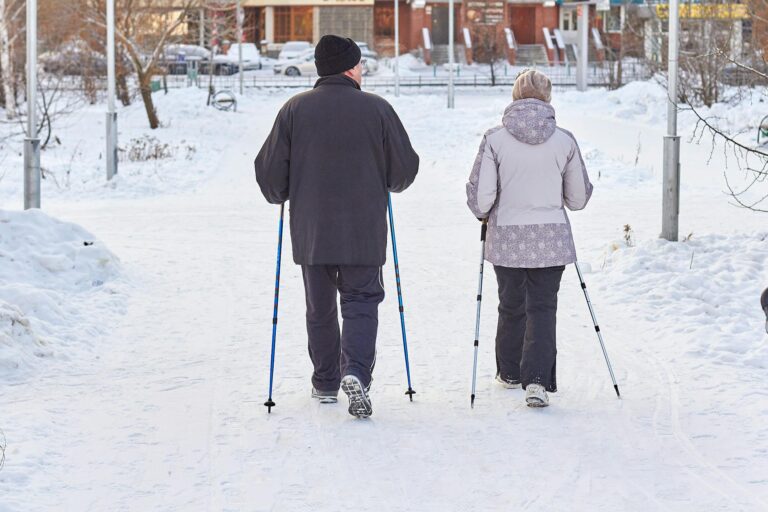
If your fitness tracker shows 8,000 steps but zero intensity minutes, your daily walk probably is not doing what you think it is doing. The distinction matters more than most people realize: slow walking — the kind where you can comfortably sing along to whatever is playing in your earbuds — falls below the moderate-intensity threshold that health guidelines are actually built around. To earn intensity minutes and unlock the bulk of walking’s cardiovascular benefits, you need to hit a brisk pace of at least 3.0 mph, which translates to roughly 100 steps per minute. That is the line where a walk shifts from “better than sitting” to “genuinely protective exercise.” This is not to say a slow stroll is worthless.
Research shows that even 4,000 steps a day at any pace provides measurable health benefits compared to being sedentary. But the gap between slow and brisk is enormous. One large study found that slow walking for three or more hours per day was linked to only about a 4 percent reduction in mortality, while fast walking for just 15 minutes daily was associated with a roughly 20 percent reduction in total mortality. In practical terms, a short brisk walk after dinner does more for your longevity than a long, leisurely afternoon meander through the neighborhood. This article breaks down exactly what qualifies as brisk walking, why pace matters so much for health outcomes, how fitness trackers decide whether your walk counts, what recent research from 2025 and 2026 reveals about walking duration and speed, and how to realistically upgrade your walking habit without turning every outing into a workout.
Table of Contents
- What Pace Separates a Slow Walk From a Brisk Walk That Earns Intensity Minutes?
- Why Slow Walks Still Matter — and Where Their Benefits Hit a Ceiling
- What the Latest Research Says About Walking Speed and Duration
- How to Make Your Walks Actually Count on a Fitness Tracker
- When Brisk Walking Is Not the Right Answer
- The Interval Walking Approach for People Stuck in the Middle
- Where Walking Research Is Headed
- Conclusion
What Pace Separates a Slow Walk From a Brisk Walk That Earns Intensity Minutes?
The CDC recommends 150 minutes of moderate-intensity aerobic activity per week, and brisk walking is the most commonly cited way to meet that target. But “brisk” has a specific definition most people get wrong. It is not just walking with purpose or feeling slightly winded. Brisk walking falls in the range of 3.0 to 4.0 mph, which registers at approximately 3.3 METs (metabolic equivalents) at the lower end — the threshold where an activity officially crosses into moderate intensity. In cadence terms, research has established that roughly 100 steps per minute corresponds to moderate intensity, while around 130 steps per minute enters vigorous territory, where each minute counts double toward your weekly goal. The simplest field test requires no gadget at all. The CDC’s “talk test” says that at moderate intensity, you should be able to carry on a conversation but not sing comfortably. If you can belt out a full chorus without any breathlessness, you are strolling, not exercising.
For most adults, the difference between a stroll and a brisk walk is surprisingly small — often just an extra half mile per hour — but that small gap is where the health returns multiply. Consider two neighbors who both walk for 30 minutes each morning. One covers about 1.2 miles at a comfortable 2.4 mph pace and earns zero intensity minutes on her Fitbit. The other covers 1.7 miles at 3.4 mph and banks 30 active zone minutes. Over a five-day week, the second walker meets the full CDC recommendation. The first does not register at all. Walking at 80 or more steps per minute does reduce the risk of serious illness compared to walking at 40 steps per minute, so there is a gradient rather than a hard cliff. But the research is clear that pace matters for health outcomes, and the returns accelerate meaningfully once you cross that 100-step-per-minute line.

Why Slow Walks Still Matter — and Where Their Benefits Hit a Ceiling
Dismissing slow walking entirely would be a mistake. For people who are currently sedentary, injured, recovering from surgery, or managing chronic pain, a gentle daily walk is a significant and legitimate upgrade. The baseline comparison matters: going from zero movement to 4,000 slow steps a day delivers real, measurable improvements in blood sugar regulation, mood, joint mobility, and cardiovascular risk markers. Walking slowly also serves important purposes that have nothing to do with exercise physiology — decompression, social connection, creative thinking, and simply being outdoors. However, if your goal is to improve cardiovascular fitness, reduce your risk of heart disease, or meet the activity guidelines your doctor references at your annual physical, slow walking runs into a hard ceiling. That study linking three-plus hours of daily slow walking to only a 4 percent mortality reduction is worth sitting with.
Three hours is a massive time investment for a 4 percent return. Meanwhile, 15 minutes of fast walking — a fraction of the time — was associated with a five-times-greater mortality reduction at roughly 20 percent. The efficiency gap is staggering. There is also a common trap for people who track steps religiously. Hitting 10,000 steps feels like an accomplishment, and it is, but if all 10,000 came at a leisurely pace spread across the entire day, your tracker likely recorded zero intensity minutes. The steps count for general movement, which is good, but they did not stress your cardiovascular system enough to trigger adaptation. If you are walking for health and you have limited time — which most people do — pace is the single biggest lever you can pull.
What the Latest Research Says About Walking Speed and Duration
A December 2025 study added an important wrinkle to the walking conversation: it is not just about pace but also about how your walking time is structured. Researchers found that longer continuous walking bouts of 15 minutes or more outperformed several short walks for reducing heart disease and death risk, even when total step counts were identical. In other words, three 10-minute walks scattered across the day may not deliver the same cardiovascular benefit as one sustained 30-minute walk, despite adding up to the same number. This challenges the popular advice that breaking exercise into small chunks throughout the day is just as good as a single session. A Vanderbilt University study published in 2025 reinforced the speed argument from a different angle. Researchers found that faster habitual walking speed was independently associated with lower all-cause mortality — meaning that people who naturally walk faster tend to live longer, even after controlling for other fitness and health variables.
The UChicago Medicine group reported similar findings, noting that walking just slightly faster — even a modest bump in pace — helped older adults maintain their fitness levels over time. You do not need to power-walk like a mall-walking retiree in racing shorts. A small, sustainable increase in your default pace appears to be enough to shift outcomes. One of the more interesting developments in the walking world is the Japanese interval walking method, which gained significant traction through 2025 and into 2026. The protocol alternates three minutes of brisk walking with three minutes of slow walking, repeated for a total of 30 minutes. Research shows this approach improves cardiovascular fitness and burns more calories than steady-pace walking at the same duration. It is especially useful for people who find 30 straight minutes of brisk walking too demanding — the built-in recovery periods make higher-intensity efforts more sustainable.

How to Make Your Walks Actually Count on a Fitness Tracker
If you wear a Garmin, Fitbit, or Apple Watch, understanding how each device scores your walks can help you stop wasting time on effort that does not register. Garmin awards “intensity minutes” by comparing your heart rate to your resting heart rate or by tracking cadence. A brisk walk or faster pace will register moderate intensity minutes, and vigorous minutes count double toward the 150-minute weekly goal. Fitbit uses a similar system called “Active Zone Minutes,” which kicks in at the 3-MET level — roughly a brisk walking pace of about 100 steps per minute. A slow stroll does not register at all. Apple Watch tracks “Exercise Minutes” with comparable logic: a leisurely walk typically will not count unless your heart rate is elevated enough above your baseline.
The tradeoff to understand here is that tracker accuracy depends heavily on your personal fitness level. A sedentary person who is new to walking may see their heart rate climb into the moderate zone at 2.8 mph, meaning their tracker gives them credit for a pace that would not register for a more fit individual walking at the same speed. This is actually by design — the intensity is relative to your body, not to an absolute standard. But it also means that as you get fitter, you will need to walk faster or add hills to keep earning the same intensity minutes. What counted as brisk in month one may register as a stroll by month six. For people whose walks consistently show zero intensity minutes, the fix is straightforward: pick up the pace until you can talk but not sing, aim for 100 steps per minute as a floor, and try to sustain that pace for at least 15 consecutive minutes rather than spreading it across short bursts. If you have a heart rate monitor, target roughly 50 to 70 percent of your maximum heart rate for the moderate zone.
When Brisk Walking Is Not the Right Answer
There are legitimate situations where pushing for brisk walking is counterproductive or even risky. People recovering from joint replacement, managing severe arthritis, or dealing with balance disorders may not be able to safely sustain 3.0 mph, and pressuring them to hit an intensity target can lead to falls or flare-ups. For these individuals, slow walking is the appropriate exercise, and the modest but real benefits of gentle movement should not be minimized just because they do not meet a tracker’s threshold. Similarly, the 2025 research on continuous walking bouts has a limitation worth noting. The finding that 15-plus-minute sustained walks outperform shorter walks assumes you can physically manage that duration. For older adults with fatigue-related conditions, people returning to activity after prolonged illness, or those managing chronic fatigue syndrome, multiple short walks may be the only realistic option — and that option is still vastly better than inactivity.
The study compared continuous versus fragmented walking in populations that could do either. It did not conclude that short walks are ineffective, only that longer bouts appear to offer additional cardiovascular protection when both options are available to you. There is also a psychological dimension. Some people who are told their daily walk “does not count” because it was too slow simply stop walking altogether. If tracking intensity minutes makes you feel defeated rather than motivated, it may be worth ignoring the metric entirely and focusing on consistency. A person who walks slowly every single day for years will almost certainly outlive a person who does intense brisk walks for two months and then quits.

The Interval Walking Approach for People Stuck in the Middle
If you currently walk at around 2.5 mph and find the jump to 3.5 mph unsustainable for a full 30 minutes, the Japanese interval walking method offers a practical bridge. The structure is simple: walk briskly for three minutes, then slow down to a comfortable pace for three minutes, and repeat for a total of five cycles. That gives you 15 minutes of brisk effort woven into a 30-minute walk, which is enough to register meaningful intensity minutes on most trackers while keeping the session manageable.
Research from Brown University Health and other institutions confirms that this alternating approach improves cardiovascular fitness and calorie burn compared to walking at a single moderate pace for the same duration. It works particularly well for people who are building up their fitness base, because the recovery intervals prevent the accumulated fatigue that causes many walkers to cut their sessions short. Over weeks, you can gradually extend the brisk intervals and shorten the recovery periods until you are comfortably walking briskly for 20 or 25 continuous minutes.
Where Walking Research Is Headed
The trend in exercise science is moving away from step-count fixation and toward pace-and-duration metrics as the more meaningful indicators of health benefit. The December 2025 findings on continuous walking bouts are likely just the beginning of a deeper investigation into how walking structure — not just total volume — affects cardiovascular outcomes.
Expect future studies to examine whether the timing of walks (morning versus evening), terrain (flat versus hilly), and environmental context (treadmill versus outdoor) modify the intensity-minute equation. Meanwhile, wearable technology is getting better at distinguishing between movement that is merely activity and movement that is actual exercise. As trackers incorporate more granular cadence data and better heart rate algorithms, the gap between “steps” and “intensity minutes” will become more visible to everyday users — which should help more people understand that not all walking is created equal, and that a small increase in pace can produce an outsized return on their time investment.
Conclusion
The core message is simple: all walking is good, but brisk walking is substantially better for your heart, your longevity, and your fitness. To meet the CDC’s recommendation of 150 minutes of moderate-intensity activity per week, you need to walk at roughly 3.0 mph or faster — about 100 steps per minute — at a pace where you can talk but not sing. A 30-minute brisk walk five days per week checks that box entirely. Recent research adds that sustaining that pace for 15 or more continuous minutes appears to outperform fragmented short walks, and even a slight increase in your habitual walking speed is associated with meaningful mortality reduction.
If you are currently a slow walker, you do not need to overhaul everything overnight. Start by picking up the pace for just three-minute intervals within your existing walks, using the Japanese interval method as a scaffold. Track your cadence or heart rate to confirm you are crossing the moderate-intensity threshold. Over time, extend those brisk intervals until they become your default. The difference between a walk that registers on your tracker and one that does not is often just a half mile per hour — a small change with an unreasonably large payoff.