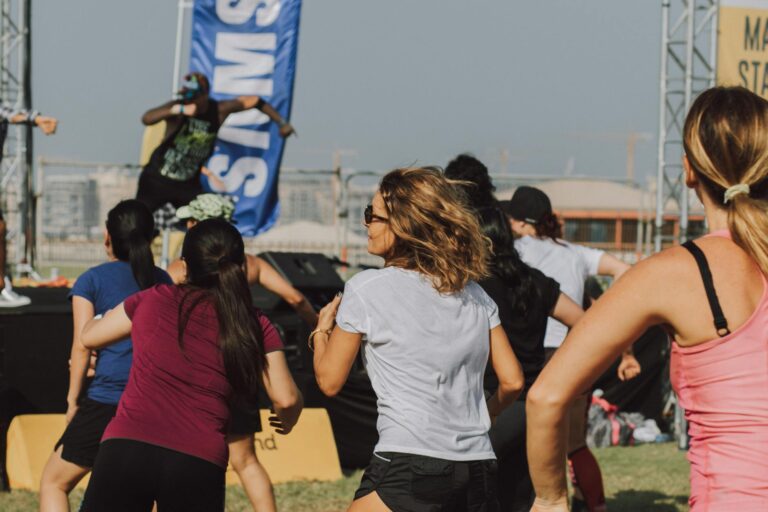
Heart rate is the single most reliable real-time indicator of how many calories you burn during a Zumba class, and research confirms the connection is significant. According to an ACE-funded study conducted at the University of Wisconsin-La Crosse, participants in Zumba classes reached an average heart rate of 154 bpm — roughly 80% of their maximum heart rate — and burned an average of 369 calories per session, or approximately 9.5 kcal per minute. That rate of burn exceeds what researchers have measured in power yoga, cardio kickboxing, step aerobics, and advanced Pilates group classes. The reason is straightforward: heart rate serves as a direct proxy for exercise intensity and metabolic demand. The harder your cardiovascular system works, the more energy your body expends, and Zumba’s dance-based format pushes most people into a heart rate zone where calorie burn is substantial.
For a practical example, consider two people in the same Zumba class. One weighs 140 pounds and sustains an average heart rate around 145 bpm; the other weighs 180 pounds and averages 160 bpm. The second person will burn meaningfully more calories — not just because of body weight, but because their heart rate reflects a higher metabolic workload. The exact calories burned during Zumba are influenced by body weight, heart rate, height, and age, but heart rate is the variable that changes most dynamically during a session and gives you the clearest picture of effort in the moment. This article breaks down the specific relationship between heart rate zones and calorie expenditure in Zumba, explains why the format mimics interval training, identifies who benefits most, and offers practical guidance on using a heart rate monitor to get the most out of every class.
Table of Contents
- Why Does Heart Rate Determine How Many Calories You Burn in Zumba?
- The Interval Training Effect — How Zumba’s Heart Rate Pattern Burns More Calories
- Optimal Heart Rate Zones for Maximizing Fat Burn During Zumba
- How to Use a Heart Rate Monitor to Get More From Your Zumba Class
- Why Heart Rate Response Varies Widely Between Individuals in the Same Class
- Zumba Gold and Heart Rate Response in Older Adults
- The Future of Heart Rate–Based Calorie Tracking in Group Fitness
- Conclusion
Why Does Heart Rate Determine How Many Calories You Burn in Zumba?
Your heart rate during exercise reflects how much oxygen your body is consuming, which directly correlates with how much energy — measured in calories — you are burning. When you dance through a zumba routine and your heart rate climbs to 154 bpm, your cardiovascular system is working to deliver oxygen to large muscle groups in your legs, core, and arms. That oxygen fuels aerobic metabolism, the process by which your body converts stored glycogen and fat into usable energy. The ACE study found that Zumba participants averaged 64% of VO2max during sessions, which falls within the recommended range of 40–85% of VO2max for improving cardio endurance. VO2max is the maximum rate at which your body can use oxygen, so working at 64% of that ceiling means the metabolic engine is running at a meaningful clip. The comparison with other group fitness formats is instructive. Step aerobics and Pilates tend to produce lower sustained heart rates because their movement patterns are more controlled and repetitive.
Cardio kickboxing can spike heart rate during combinations but often includes longer recovery periods. Zumba, by contrast, layers continuous footwork with arm movements and directional changes across a full hour, which keeps heart rate elevated without the rigid structure that causes people to pace themselves too conservatively. The result — 9.5 kcal per minute on average — reflects sustained cardiovascular demand rather than brief spikes. It is worth noting that heart rate is not a perfect calorie-counting tool. Factors like caffeine intake, stress, dehydration, and certain medications can elevate heart rate without a corresponding increase in calorie burn. A person who drank two cups of coffee before class might see a heart rate reading five to ten beats higher than their actual exercise effort warrants. This is why heart rate is best understood as a strong proxy for intensity, not an exact calorie meter, and why combining it with perceived exertion gives a more complete picture.

The Interval Training Effect — How Zumba’s Heart Rate Pattern Burns More Calories
One of the most interesting findings from heart rate monitor data collected during Zumba sessions is that the heart rate pattern closely resembles interval training. Rather than maintaining a flat, steady-state heart rate like you might see during a 45-minute jog, Zumba alternates between high-intensity peaks — during fast-tempo salsa or reggaeton tracks — and lower-intensity recovery periods during slower merengue or cumbia segments. This fluctuation between effort levels is precisely what makes interval training so effective for calorie burn, and Zumba achieves it almost accidentally through its musical structure. Interval-style exercise burns more calories than steady-state cardio for two reasons. First, the high-intensity bursts push your heart rate into the upper portion of your aerobic zone, demanding more immediate energy. Second, the recovery periods are active rather than passive — you are still moving, just at a lower intensity — which keeps your metabolic rate elevated.
Over the course of a 60-minute class, these accumulated intervals result in a higher total calorie expenditure than if you had simply maintained a moderate, unchanging pace. The ACE study’s finding of 80% of maximum heart rate as an average during Zumba reflects this: participants were frequently exceeding that mark during intense segments and dipping below it during transitions. However, this interval effect depends on the instructor and the specific class format. A Zumba class with poor song sequencing — where every track is the same tempo — will flatten your heart rate curve and reduce the interval benefit. Similarly, if you already know every routine and can execute the choreography on autopilot, your heart rate may not climb as high during peak segments. The novelty and complexity of movements matters. If you have been attending the same class with the same instructor for a year, your body has adapted, and your heart rate response will be blunted compared to your first month.
Optimal Heart Rate Zones for Maximizing Fat Burn During Zumba
To maximize fat oxidation specifically — not just total calories, but the proportion coming from fat stores — research points to a target of approximately 70% of maximum heart rate. This sits in the middle of the broader 55–85% of maximum heart rate zone recommended for Zumba. At this moderate intensity, your body preferentially uses fat as fuel because the energy demand is high enough to require significant calorie burn but not so high that your body shifts entirely to glycogen, which it prefers during very intense efforts. For a 35-year-old with an estimated maximum heart rate of 185 bpm (using the standard 220 minus age formula), 70% would be about 130 bpm. At 80% — closer to the 154 bpm average observed in the ACE study — total calorie burn is higher, but a greater proportion of those calories come from carbohydrate stores rather than fat. This is not necessarily a disadvantage for weight loss, since total calorie deficit is what ultimately matters, but it does explain why some fitness professionals recommend occasionally dialing back intensity during certain Zumba tracks to stay in the fat-burning sweet spot.
A specific example helps clarify the tradeoff. If you sustain 130 bpm for 60 minutes, you might burn 300 calories with roughly 50% coming from fat — 150 fat calories. If you push to 160 bpm for the same duration, you might burn 420 calories but with only 35% from fat — 147 fat calories. The total calorie burn is much higher at the elevated heart rate, even though the absolute fat calories are nearly identical. For most people focused on general fitness and weight management, the higher heart rate and higher total burn is the better target. The fat-burning zone matters most for endurance athletes managing fuel sources during long efforts.

How to Use a Heart Rate Monitor to Get More From Your Zumba Class
Wearing a chest strap or optical wrist-based heart rate monitor during Zumba gives you real-time feedback that can meaningfully change your workout. The most practical approach is to glance at your monitor between songs — not during choreography, where distraction could cost you the routine — and check whether you are in your target zone. If you are consistently below 55% of your max, you need to exaggerate your movements: deeper squats, higher arm reaches, more explosive directional changes. If you are consistently above 85%, you may be overexerting, particularly if you are new to exercise or returning after a layoff. Chest strap monitors like the Polar H10 remain the gold standard for accuracy during dance-based exercise. Wrist-based optical sensors can struggle with the rapid arm movements in Zumba because the sensor loses consistent skin contact.
If your wrist monitor frequently shows implausible readings — a sudden jump from 140 to 190 bpm and back — the data is unreliable. This is a genuine limitation for the growing number of people who rely on smartwatches for fitness tracking. The tradeoff is comfort versus accuracy: chest straps are less convenient but produce cleaner data, while wrist monitors are easier to wear but may misrepresent your actual heart rate during high-movement activities like Zumba. One useful strategy is to record your heart rate data over several classes and review the trends rather than fixating on a single session. If your average heart rate during Zumba is steadily declining over weeks while your perceived effort stays the same, your cardiovascular fitness is improving — your heart is doing the same work with fewer beats. That is a meaningful fitness gain, even if it means your estimated calorie burn per session drops slightly.
Why Heart Rate Response Varies Widely Between Individuals in the Same Class
A common frustration among Zumba participants is seeing wildly different calorie estimates from their trackers compared to someone standing next to them in class. This is not a flaw in the tracking — it reflects genuine physiological differences. Body weight is the most obvious factor: a 200-pound person doing the same movements as a 130-pound person is moving significantly more mass against gravity, requiring more energy and driving a higher heart rate. Age also matters because maximum heart rate declines with age, so a 25-year-old and a 55-year-old at the same absolute heart rate of 150 bpm are at very different percentages of their respective maximums. Height plays a less intuitive role. Taller individuals have longer limbs, which means their arm and leg movements cover more distance and require more energy, but they also tend to have larger hearts with greater stroke volume, meaning each heartbeat pumps more blood.
The net effect varies. Fitness level itself is a major variable — a highly conditioned person’s heart rate may peak at 140 bpm during an intense Zumba track while a deconditioned person hits 175 bpm during the same routine. Both are getting a valid workout, but the calorie burn differs substantially. The important takeaway is that comparing your heart rate or calorie data to someone else’s is almost meaningless without accounting for these variables. A more productive approach is to compare your data against your own baseline over time. If your heart rate during the same class format is lower than it was two months ago but you feel like you are working just as hard, your cardiovascular system has adapted and become more efficient. That is the fitness improvement you are training for.

Zumba Gold and Heart Rate Response in Older Adults
Zumba is not limited to young, highly fit populations, and the heart rate research reflects this. A study published in PMC examined Zumba Gold — a modified format designed for middle-aged and older adults — and found that the physiological responses, including heart rate elevation, were sufficient to improve fitness in this demographic. The movements are lower impact, the tempo is slightly reduced, and the choreography avoids the rapid directional changes that could cause balance issues, but the cardiovascular stimulus remains meaningful.
This matters because older adults often struggle to find group exercise formats that elevate heart rate into a beneficial zone without creating joint stress or injury risk. Zumba Gold fills that gap. Participants in the study achieved heart rates consistent with the recommended range for cardiovascular improvement, confirming that you do not need to be in your twenties or already fit to get a legitimate heart rate–driven calorie burn from Zumba. The universal effectiveness of the format — the finding that participants across all fitness levels tend to work out in the heart rate zone recommended for improving cardiovascular health — is one of its most notable characteristics.
The Future of Heart Rate–Based Calorie Tracking in Group Fitness
The integration of heart rate monitoring into group fitness is accelerating. Many Zumba studios now offer sessions where participants wear heart rate monitors that display their data on a shared screen, creating a real-time visual of the class’s collective effort. This technology allows instructors to see whether the group is hitting target zones and adjust the playlist or choreography intensity accordingly — a feedback loop that was impossible even five years ago.
As wearable accuracy improves and algorithms get better at accounting for individual variables like body composition and fitness history, heart rate–based calorie estimates during Zumba will become more precise. The fundamental relationship will not change — higher sustained heart rate means more calories burned — but our ability to quantify it for each individual will sharpen. For anyone serious about using Zumba as a cardiovascular and calorie-burning tool, investing in a reliable heart rate monitor and learning to interpret the data is one of the highest-return decisions you can make.
Conclusion
Heart rate is the most actionable metric for understanding and maximizing calorie burn during Zumba. The ACE-funded research makes the case clearly: an average heart rate of 154 bpm, representing 80% of maximum heart rate, drives an average burn of 369 calories per class — outpacing several other popular group fitness formats. The interval training pattern inherent in Zumba’s musical structure amplifies this effect, and the format is accessible enough that people across all fitness levels and age groups tend to reach heart rate zones associated with genuine cardiovascular improvement.
If you are currently doing Zumba without monitoring your heart rate, you are leaving insight on the table. A heart rate monitor — ideally a chest strap for accuracy during dance movements — will show you exactly how hard you are working, whether you are in the optimal zone for fat burn or total calorie burn, and how your fitness is progressing over weeks and months. Pair that data with attention to the factors you can control — movement intensity, consistency of attendance, and progressive challenge through new routines or instructors — and Zumba becomes not just a fun class but a quantifiable cardiovascular training tool.