The most reliable way to avoid hip pain while running is to combine a targeted hip-strengthening routine with gradual training progression and proper warm-up habits. That sounds simple on paper, but the execution matters. Up to 11 percent of runners experience hip pain at some point during their training, and the majority of these injuries trace back to preventable training errors rather than some unavoidable structural flaw. If you run three or four times a week and skip strengthening work entirely, you are asking a joint that absorbs up to three times your body weight per stride to perform without adequate muscular support.
Consider a runner who increases weekly mileage from 20 to 30 miles in a single week because a race is approaching. Within days, a dull ache settles into the outer hip. That ache is often the gluteus medius or the iliotibial band protesting a workload spike they were not prepared for. This scenario plays out constantly — roughly 50 percent of runners deal with a running-related injury each year, and about 25 percent are nursing one at any given time. This article covers why hip pain develops in runners, which strengthening exercises actually prevent it, how to structure warm-ups and cooldowns, what role running form and footwear play, and when hip pain crosses from manageable discomfort into something that requires medical attention.
Table of Contents
- Why Do Runners Get Hip Pain in the First Place?
- The Strength Exercises That Actually Protect Your Hips
- How to Warm Up Without Wasting Time or Risking Injury
- Training Smarter — The 10 Percent Rule and Recovery That Works
- Running Form and Footwear — What Helps and What Gets Overhyped
- Cooling Down and What Happens When You Skip It
- When Hip Pain Means It Is Time to See a Professional
- Conclusion
- Frequently Asked Questions
Why Do Runners Get Hip Pain in the First Place?
The hip joint is a workhorse during running, and the muscles surrounding it — glutes, hip flexors, adductors, abductors — coordinate in rapid sequence with every stride. When any link in that chain is weak or tight, the joint compensates. The most frequent culprits are muscle strains and tendonitis, which typically result from sudden acceleration, deceleration, or eccentric contractions that overload tissue faster than it can adapt. IT band syndrome ranks close behind, producing a sharp or burning sensation along the lateral hip or knee that worsens with continued activity. Bursitis — inflammation of the fluid-filled sacs around the hip, whether trochanteric, ischial, or iliopectineal — develops from repetitive motion or sometimes from a single acute incident like a fall. Less common but more serious causes include labral tears, sports hernias, and nerve entrapment.
These tend to produce pain that does not respond to rest the way a simple strain does. Stress fractures of the hip are another concern, and they affect women more frequently than men, likely due to differences in bone density and hormonal factors. What ties most of these injuries together is a pattern: the runner did too much, too fast, with too little preparation. Most running-related lower-extremity injuries are attributed to preventable training errors, meaning the problem is rarely the act of running itself but rather how the training was managed. The distinction matters because it shifts the focus from fear of injury to management of load. A runner doing 25 miles a week with a solid strength routine and sensible progression faces far less hip risk than a runner doing 15 miles a week with zero cross-training and erratic scheduling.
The Strength Exercises That Actually Protect Your Hips
Building strength in the adductors, abductors, glutes, and core is the single most impactful thing a runner can do to prevent hip pain. The American Academy of Orthopaedic Surgeons recommends a hip conditioning program maintained for four to six weeks before expecting meaningful results, which means a handful of clamshells the night before a long run will not cut it. This needs to be a sustained, scheduled effort. Single-leg exercises deserve particular emphasis. running is essentially a series of single-leg hops, so training both legs simultaneously with squats or deadlifts alone leaves a gap.
Single-leg Romanian deadlifts, Bulgarian split squats, and single-leg glute bridges force each hip to stabilize independently, which mirrors what actually happens at mile six of a tempo run. Mass General Brigham recommends performing hip-specific strength work two to three times per week, which is achievable even on a busy training schedule if you treat it as non-negotiable rather than optional. However, if you already have sharp or persistent hip pain, jumping straight into heavy single-leg work can aggravate the problem. Strength training is preventive medicine, not acute treatment. A runner with active IT band syndrome, for instance, needs to reduce irritating load first — often by cutting mileage and addressing tissue tightness — before layering on strengthening. Starting a conditioning program when things feel good is the entire point.
How to Warm Up Without Wasting Time or Risking Injury
Dynamic stretching before running is preferred over static stretching, and this is not just a trend. According to Yale Medicine, static stretching prior to activity can actually decrease speed and power output, which is the opposite of what a warm-up should accomplish. Dynamic movements — leg swings, walking lunges, high knees, lateral shuffles — raise tissue temperature and take the hip through its full range of motion under light load. A practical warm-up takes about 10 minutes and should target the legs, hips, and core. This might include two minutes of brisk walking, followed by dynamic leg swings in both the sagittal and frontal planes, then a set of bodyweight squats and some light foam rolling on the quads and IT band.
Orthopedic surgeon Benjamin Domb recommends light hip flexor stretches with three-to-five-second holds for three to four repetitions before and after running. These brief holds are not the long static stretches that compromise power — they are short enough to increase range of motion without dulling the muscles’ ability to fire. For example, a runner who previously dealt with recurring hip flexor tightness might add 90/90 hip switches and a short couch stretch to the pre-run routine. Within a few weeks, the tightness at mile two that used to force a walking break is gone. The warm-up did not need to be elaborate — it just needed to be consistent and targeted at the right structures.

Training Smarter — The 10 Percent Rule and Recovery That Works
The 10 percent rule is the most widely cited guideline for safe mileage increases: do not raise your weekly running volume by more than 10 percent from one week to the next. It is a blunt instrument — it does not account for individual fitness, terrain changes, or intensity shifts — but it works as a guardrail against the kind of sudden spikes that trigger hip injuries. A runner doing 20 miles per week should cap the following week at 22 miles, not leap to 28 because the weather was nice and motivation was high. Recovery is the other half of the equation, and it gets less attention than it deserves. Taking two to three rest days per week focused on light, low-impact activity or stretching gives tissues time to repair.
This does not mean sitting on the couch — walking, swimming, or cycling at easy effort all count. Post-run cooldowns also matter: a five-to-ten-minute brisk walk or light jog after a hard session helps flush lactic acid and returns the hips to a neutral state. Skipping the cooldown after an interval workout and immediately sitting in a car for 30 minutes is a reliable recipe for hip stiffness. The tradeoff runners face is between short-term progress and long-term durability. Adding a fourth running day per week might boost fitness faster, but if it eliminates a rest day and the hip muscles never fully recover, the net result is an injury that costs three weeks of zero running. The conservative path almost always wins over a full season.
Running Form and Footwear — What Helps and What Gets Overhyped
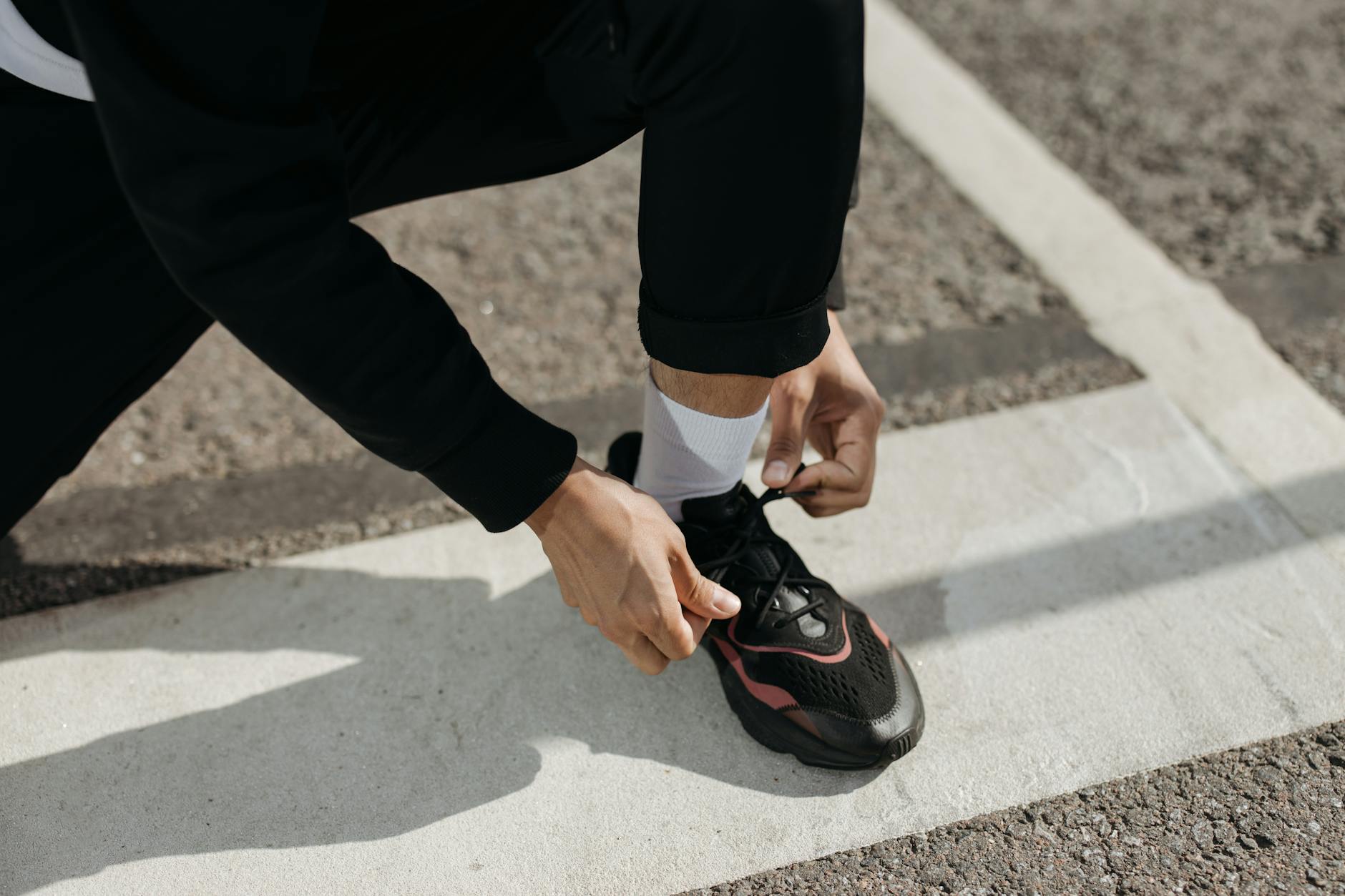
Poor running form is one of the most commonly cited causes of hip pain, and the basics are straightforward: maintain alignment of the hips, pelvis, and spine; land softly rather than heel-striking with a locked knee; and keep the core engaged so the pelvis does not drop excessively with each step. A slight forward lean from the ankles, a cadence around 170 to 180 steps per minute, and avoiding overstriding address the majority of form-related hip stress. Footwear matters, but within limits. Running shoes should provide adequate support and cushioning matched to your foot type — a heavy overpronator in a minimalist flat is asking for trouble, and a neutral runner in a heavy motion-control shoe is wasting energy and potentially altering mechanics in unhelpful ways. Getting fitted at a running-specific store where someone watches you walk or jog remains the most practical approach.
Running on softer surfaces like grass or trails instead of concrete also reduces impact on the hips, though trail running introduces uneven terrain that demands more lateral hip stability. A runner with weak abductors might actually find trails harder on the hips than a flat road, which is worth knowing before assuming softer automatically means safer. The warning here is against over-optimizing. Spending hundreds of dollars on carbon-plated shoes or obsessing over foot-strike patterns while ignoring the fundamentals — strength work, gradual progression, adequate rest — is solving the wrong problem. Form and gear are supporting factors, not substitutes for a well-managed training plan.

Cooling Down and What Happens When You Skip It
A proper cooldown after running is one of those habits that feels unnecessary until you stop doing it. A five-to-ten-minute walk or easy jog immediately after finishing a run helps the cardiovascular system return to baseline gradually and keeps blood flowing through muscles that just did significant work.
For the hips specifically, this means the hip flexors, which have been contracting repeatedly for however many miles you ran, get a chance to lengthen gently before you sit down and lock them in a shortened position. A runner who finishes a hard 8-mile run on a Saturday morning and immediately drives to a breakfast spot, sitting in the car and then a booth for 90 minutes, often stands up feeling like their hips belong to someone 30 years older. Adding a walk around the block and a few minutes of hip flexor and glute stretching before getting in the car costs almost nothing in time but dramatically reduces post-run stiffness and the cumulative tightness that leads to overuse injuries.
When Hip Pain Means It Is Time to See a Professional
Not all hip pain responds to foam rolling and rest days. If pain persists despite self-care — meaning it has not improved after a week or two of reduced activity, icing, and home exercises — a physical therapist can assess your running form and prescribe targeted exercises for the core, glutes, and leg muscles that address your specific imbalances. This is not a failure of your training plan; it is an acknowledgment that some problems need an outside eye and a structured rehab protocol.
Injuries like labral tears or stress fractures may require medical evaluation, imaging, and in some cases a significant reduction in training or a temporary halt to running altogether. Stress fractures in particular are not something to push through — continuing to run on a hip stress fracture risks converting a hairline crack into a complete fracture, which turns a six-week recovery into a six-month one. The runners who stay healthy over years and decades are not the ones who never get hurt. They are the ones who recognize the difference between soreness that resolves with a warm-up and pain that signals structural damage, and who act on that distinction early rather than late.
Conclusion
Avoiding hip pain while running comes down to a handful of non-negotiable habits: strengthen the muscles that stabilize the hip joint at least two to three times per week, warm up with dynamic stretches rather than static holds, follow the 10 percent rule for mileage increases, take adequate rest days, and pay attention to running form and footwear. None of these strategies are complicated. The challenge is consistency, because the consequences of skipping them do not show up immediately — they accumulate over weeks and months until a single run tips the balance from healthy adaptation to injury.
If you are currently pain-free, now is the best time to start a hip conditioning program. Four to six weeks of targeted work builds a buffer of strength and resilience that pays dividends during race training, mileage peaks, and the inevitable weeks when life gets busy and recovery gets short-changed. If you are already dealing with hip pain that is not resolving, get evaluated by a physical therapist sooner rather than later. Early intervention almost always means a shorter, less frustrating path back to running without pain.
Frequently Asked Questions
How long does it take for hip strengthening exercises to reduce pain risk?
The American Academy of Orthopaedic Surgeons recommends maintaining a hip conditioning program for four to six weeks to see meaningful results. Consistency matters more than intensity — two to three sessions per week of targeted exercises is sufficient for most runners.
Should I stretch before or after running to prevent hip pain?
Both, but differently. Before running, use dynamic stretches like leg swings and walking lunges. Static stretching before a run can decrease speed and power output. After running, static stretches and longer holds are appropriate because the muscles are warm and you are no longer asking them to produce force.
Can I run through mild hip pain?
It depends on the type. Dull muscle soreness that fades within the first mile and does not worsen during or after the run is generally manageable. Sharp pain, pain that changes your gait, or pain that increases as you run warrants stopping and reassessing. Continuing to run with significant pain risks turning a minor issue into a serious injury.
Is hip pain more common in new runners or experienced runners?
Both groups are vulnerable but for different reasons. New runners often lack the hip and glute strength to handle impact forces, while experienced runners are more likely to encounter overuse injuries from accumulated mileage and insufficient recovery. About 50 percent of all runners experience some running-related injury each year regardless of experience level.
Do I need special shoes to prevent hip pain?
You need shoes that match your foot type and provide adequate cushioning, but there is no single shoe that prevents hip pain. The right shoe supports good mechanics; it does not replace strength work or smart training. Getting fitted at a specialty running store is the most practical way to find an appropriate option.
Does running surface affect hip pain?
Yes. Running on softer surfaces like grass or trails reduces impact compared to concrete or asphalt. However, trails with uneven terrain require more lateral hip stability, so a runner with weak hip abductors might actually experience more hip stress on trails than on a flat road.