The best jump rope workouts for beginners are simple interval routines that alternate between 30 seconds of jumping and 30 seconds of rest, repeated for five to ten minutes total. That basic structure, endorsed by coaches and fitness platforms like Crossrope and Jump Rope Dudes, gives new jumpers enough stimulus to build coordination and cardiovascular endurance without the burnout and injury risk that come from doing too much too soon. A runner who spends 10 minutes with a rope can get cardiovascular benefits equivalent to 30 minutes of jogging, according to research cited by the American Council on Exercise, which makes jump rope one of the most time-efficient cross-training tools available.
But choosing the right workout is only part of the equation. Rope selection, proper form, and a realistic progression plan all determine whether you stick with jumping or abandon it after a week of sore calves and tangled rope. This article covers the specific beginner workouts worth trying, the technique fundamentals that prevent injury, how to pick the right rope without overspending, and the real fitness benefits that make jump rope worth adding to your routine, whether you are a distance runner looking for variety or someone who just wants a quick cardio option at home.
Table of Contents
- What Makes Jump Rope One of the Best Cardio Workouts for Beginners?
- The Best Beginner Jump Rope Workouts to Start With
- How Proper Jump Rope Form Prevents Injury and Improves Results
- How to Choose the Right Jump Rope Without Overspending
- Common Mistakes That Stall Beginner Progress
- How to Combine Jump Rope with a Running Program
- What to Expect in Your First Month of Jump Rope Training
- Conclusion
- Frequently Asked Questions
What Makes Jump Rope One of the Best Cardio Workouts for Beginners?
jump rope stands out from other beginner cardio options because of its calorie-to-time ratio. At a moderate pace, jumping rope burns approximately 14 to 16 calories per minute, which translates to roughly 600 to 1,000 calories per hour depending on body weight and intensity. That is up to 25 percent more calories per minute than running, according to data compiled by Elite Jumps. For a beginner who only has 15 or 20 minutes to train, that efficiency matters. You can get a legitimate workout in a fraction of the time it takes to lace up your shoes and run a few miles. Beyond raw calorie burn, jump rope is a genuine full-body workout.
Unlike running, which primarily targets the lower body, jumping rope engages your calves, quads, glutes, abdominals, lower back, shoulders, forearms, and upper back, as noted by the Cleveland Clinic. That makes it a particularly smart complement to a running program, since it strengthens the stabilizing muscles that distance running tends to neglect. The repeated low-level impact also increases bone density over time, which helps prevent osteoporosis, a benefit that matters more than most beginners realize, especially for women over 30. There is also the afterburn effect to consider. Jump rope sessions trigger what exercise physiologists call EPOC, or excess post-exercise oxygen consumption, which keeps your metabolism elevated for hours after you finish training. That metabolic boost means your body continues burning calories well after you have put the rope away. Combine that with improved coordination, balance, and cardiovascular health, and it becomes clear why jump rope has earned a reputation as one of the best bang-for-your-buck exercises available.

The Best Beginner Jump Rope Workouts to Start With
The simplest and most widely recommended beginner workout follows a 30-on, 30-off interval format. You jump at a comfortable pace for 30 seconds, rest for 30 seconds, and repeat until you accumulate five minutes of total jumping time. That might sound easy on paper, but most first-timers are surprised by how quickly their calves fatigue and their breathing ramps up. Crossrope recommends this as a starting point and suggests progressing to 10 minutes, then 15 to 20 minutes of total jump time over the course of several weeks. For those who want a bit more structure, a 10-minute HIIT-style jump rope workout works well. This format uses 30-second exercise intervals with 10 seconds of rest between exercises and one minute of rest between circuits, completed two to four times through, as outlined by TODAY.com.
You can vary the jump style within each interval, alternating between basic two-foot bounces, single-leg hops, and high knees as your skill improves. The short rest periods keep your heart rate elevated, which drives cardiovascular adaptation faster than steady-state jumping. However, if you have not exercised regularly in the past six months, even these beginner-friendly protocols might be too aggressive on day one. The number one beginner mistake, according to Nerd Fitness, is going too hard too fast. Shin splints and calf strains are the most common overuse injuries in new jumpers. A smarter starting point for truly deconditioned beginners is two minutes of jumping broken into 15-second intervals with 30 to 45 seconds of rest, done three times a week. Let your tendons and connective tissue catch up to your ambition before you push the volume.
How Proper Jump Rope Form Prevents Injury and Improves Results
The difference between a productive jump rope session and a frustrating one almost always comes down to form. The most important cue is to jump on the midsoles and balls of your feet, landing softly with a slight bend in the knees. Flat-footed jumping sends excessive impact through the shins and lower back, which is where many beginners develop pain. Your feet should barely leave the ground, roughly one to two inches of clearance is all you need to let the rope pass underneath. Hand position is the other critical piece that beginners consistently get wrong. Your hands should sit about 9 to 12 inches from your hips, positioned along the midline of your body, and the rotation should come entirely from your wrists.
When beginners use their elbows or shoulders to swing the rope, they waste energy, the rope path becomes erratic, and trips happen constantly. Think of it this way: your arms are quiet and still, and your wrists do all the work. Jump Rope Dudes emphasize this wrist-only rotation as the single most important technique correction for new jumpers. A proper warm-up also matters more than most people expect. Five minutes of light movement, such as marching in place, arm circles, and calf raises, prepares the muscles and tendons for the repetitive impact of jumping. Skipping the warm-up does not save time; it just accelerates the onset of shin splints. Likewise, a brief cool-down with calf stretches and ankle circles after your session helps manage the soreness that is inevitable during your first few weeks.
How to Choose the Right Jump Rope Without Overspending
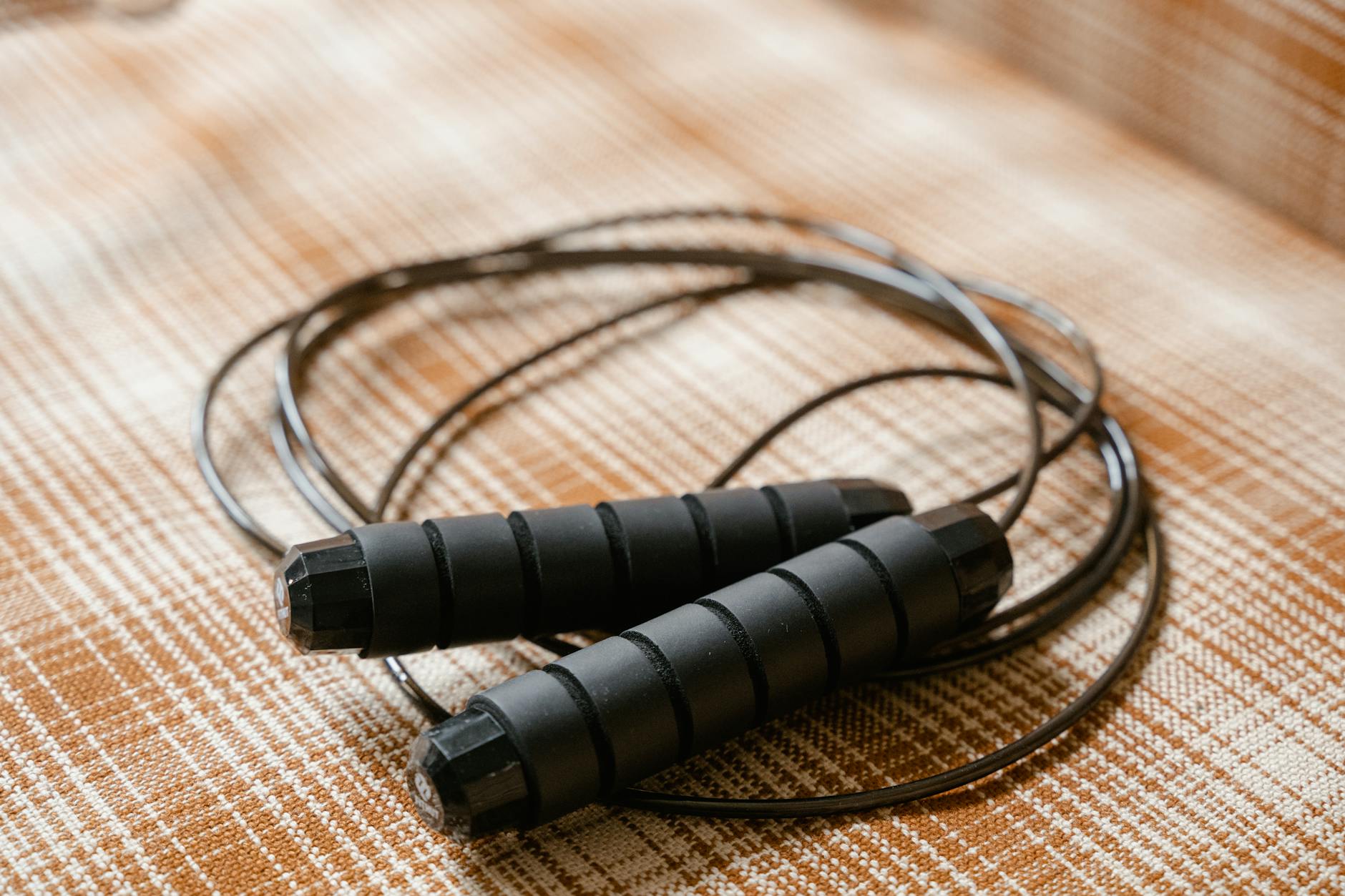
Rope selection is one of the most consequential decisions a beginner makes, and the instinct to grab whatever is cheapest at the store is often counterproductive. Multiple coaches and equipment reviewers recommend starting with a weighted rope, specifically one in the half-pound range. A weighted rope provides tactile feedback that helps beginners learn timing, rhythm, and coordination significantly faster than a lightweight speed rope, which can feel invisible in the hands and leads to more frequent trips. The Crossrope Get Lean Set, priced at roughly $69 to $99, is one of the most frequently recommended options for beginners who are willing to invest. It includes interchangeable weighted ropes and a handle system designed for long-term progression. On the more affordable end, Elite Jumps offers beginner-friendly PVC and beaded ropes in the $20 to $45 range, which work perfectly well for learning the basics.
Basic speed ropes can be found for as little as $5 to $15 at general retailers, but the tradeoff is that ultralight ropes offer minimal feedback, making the learning curve steeper rather than shorter. Rope sizing is the other detail that trips people up. The standard beginner sizing method is to stand on the center of the rope with one foot and pull the handles upward. For beginners, the handles should reach approximately to your armpits, according to Crossrope. As you gain skill and want faster rotations, you can gradually shorten the rope. Starting too short is a recipe for constant trips; starting too long means the rope drags on the ground and disrupts your rhythm. Get the length right before your first session and you will save yourself significant frustration.
Common Mistakes That Stall Beginner Progress
The most pervasive mistake among new jumpers is treating jump rope like an endurance test from day one. Beginners who try to jump for 10 or 15 straight minutes in their first session almost always end up too sore to train again for a week. Progressive overload applies to jump rope just as it does to running or weightlifting. Start with intervals, build total jump time by no more than a minute or two per week, and give your body at least one full rest day between sessions during the first month. Another common error is jumping on the wrong surface. Concrete is the default for most people, but it is also the hardest surface on your joints. Rubber gym flooring, a wooden floor, or even a thin exercise mat on a hard surface can reduce impact and lower injury risk.
Avoid carpet and thick mats, though, as the rope catches and bounces unpredictably on soft surfaces. If you only have access to concrete, invest in a good pair of cross-training shoes with adequate cushioning and accept that your sessions should be shorter until your body adapts. Finally, many beginners underestimate the importance of rest. Jump rope creates a significant eccentric load on the calves and Achilles tendons, structures that take longer to adapt than muscles. If you feel persistent tightness or sharp pain in the lower legs, back off the volume rather than pushing through. The military-style beginner plan featured on Military.com wisely pairs jump rope intervals with bodyweight exercises like push-ups and squats, giving the calves periodic breaks while keeping the workout moving. That kind of intelligent programming prevents overuse injuries far more effectively than rest-day ice baths after the damage is already done.

How to Combine Jump Rope with a Running Program
For runners looking to add jump rope as cross-training, the best approach is to use it on easy days or as a warm-up before runs. A five-minute jump rope warm-up before an easy run activates the calves, ankles, and hip stabilizers in a way that dynamic stretching alone does not. The coordination demand also sharpens neuromuscular responsiveness, which can translate to better running economy over time.
On non-running days, a 10 to 15 minute jump rope HIIT session provides cardiovascular maintenance without the ground-contact stress of additional miles. This is particularly useful during high-mileage training blocks when your legs need a break from running but your aerobic system can handle more work. The roughly 140 to 190 calories burned per 1,000 skips at a moderate pace, as calculated by Omnicalculator, means even a short session adds meaningful training volume without meaningful injury risk, provided your form is sound and you have built up to that duration progressively.
What to Expect in Your First Month of Jump Rope Training
The first two weeks will be humbling. Tripping is normal, your calves will burn after 60 seconds, and you will wonder how boxers do this for 30 minutes straight. That is the reality of learning a new motor pattern, and it is no different from the first time you tried to maintain a running pace.
By week three, most beginners notice that they can string together longer intervals without tripping, and the calf soreness transitions from debilitating to manageable. By the end of the first month, most consistent beginners can handle 10 to 15 minutes of interval-style jumping and have begun to develop the rhythm that makes the exercise feel less like coordination torture and more like actual cardio training. From there, the progression options open up considerably: single-leg jumps, double-unders, crossovers, and more complex footwork patterns all become accessible. The key to reaching that point is simply showing up three to four times a week, keeping sessions short, and resisting the urge to do more than your body is ready for.
Conclusion
Jump rope is one of the most efficient and accessible cardio tools available to beginners, burning up to 25 percent more calories per minute than running while engaging the entire body from calves to shoulders. The best approach for someone just starting out is a simple interval format, 30 seconds of jumping followed by 30 seconds of rest, building from five minutes of total work toward 15 or 20 minutes over the course of a month. A half-pound weighted rope, proper wrist-driven technique, and a forgiving surface make the learning curve far less steep than most people expect.
The biggest risk is not that jump rope is too difficult. It is that eager beginners push too hard, too fast, and end up sidelined by shin splints or calf strains before they ever experience the benefits. Start conservatively, prioritize form over speed, and treat the first month as skill acquisition rather than fitness testing. If you do that, you will have a cardio tool that fits in a bag, costs less than a single month of gym membership, and delivers a workout that rivals anything you can do on a treadmill.
Frequently Asked Questions
How long should a beginner jump rope each session?
Start with five minutes of total jumping time using 30-second intervals separated by 30 seconds of rest. Most beginners can progress to 10 minutes within two to three weeks and 15 to 20 minutes within a month, provided they train three to four times per week.
Is jump rope bad for your knees?
Jump rope is generally easier on the knees than running because the jumps are low-impact and you land on the balls of your feet. However, jumping on hard surfaces like concrete increases joint stress. Use a rubber mat or wooden floor when possible, and stop if you experience sharp or persistent knee pain.
What type of jump rope is best for beginners?
A half-pound weighted rope is widely recommended by coaches because it provides tactile feedback that helps you learn timing and rhythm faster. Beaded ropes in the $20 to $45 range from brands like Elite Jumps are a solid budget option. Ultralight speed ropes, while cheap, tend to make learning harder because they are difficult to feel in your hands.
How many calories does jumping rope burn?
At a moderate pace, jump rope burns approximately 14 to 16 calories per minute, or roughly 600 to 1,000 calories per hour depending on body weight and intensity. For context, approximately 140 to 190 calories are burned per 1,000 skips.
Can I jump rope every day as a beginner?
It is not recommended during the first month. Your calves, Achilles tendons, and shins need time to adapt to the repetitive impact. Three to four sessions per week with at least one rest day between sessions is a safer starting frequency that still allows steady progress.
Is jump rope better than running for weight loss?
Jump rope burns more calories per minute than running and creates a stronger afterburn effect due to EPOC. However, running allows for longer sessions at lower intensity, which some people find more sustainable. The best choice depends on your schedule, preferences, and joint tolerance. Many people benefit from combining both.