

Most runners and cardio enthusiasts think of kickboxing as a fighting discipline, something for people who want to step into a ring. But the benefits that fly under the radar have little to do with combat. Kickboxing is one of the most efficient cardiovascular workouts available, burning approximately 372 calories in just 30 minutes for a 155-pound person and up to 600–900 calories in a full hour-long session, according to Healthline and sports research outlets. Beyond the calorie torch, it builds anaerobic power, sharpens cognitive function, and improves balance in populations you might not expect, including people managing multiple sclerosis.
What makes kickboxing genuinely interesting for anyone already invested in running or aerobic fitness is how it fills gaps that steady-state cardio leaves wide open. A 2014 study published in Muscles, Ligaments and Tendons Journal found that kickboxing just three days per week for five weeks significantly increased VO2max, a metric every serious runner tracks. That same structured training produced a 42.4% increase in upper-body peak anaerobic power and a 10.2% boost in lower-body mean power. Those are numbers that translate directly to hill sprints, finishing kicks, and overall athletic resilience. This article covers the cardiovascular and metabolic advantages most people overlook, the mental health research that goes beyond vague claims about stress relief, how kickboxing stacks up as cross-training for runners, and the injury considerations you need to weigh before adding it to your routine.
Table of Contents
- What Hidden Kickboxing Benefits Actually Improve Your Cardio Fitness?
- The Mental Health Benefits of Kickboxing That Research Actually Supports
- How Kickboxing Builds Balance and Coordination That Runners Need
- Should Runners Use Kickboxing as Cross-Training or a Standalone Workout?
- Kickboxing Injury Risks and How to Train Around Them
- Kickboxing, Sleep, and the Recovery Equation
- What the Future of Cross-Training Looks Like for Endurance Athletes
- Conclusion
- Frequently Asked Questions
What Hidden Kickboxing Benefits Actually Improve Your Cardio Fitness?
The obvious selling point of kickboxing is that it gets your heart rate up. But the mechanisms behind that elevated heart rate matter more than the sensation itself. Unlike running, which primarily loads the lower body in a repetitive sagittal plane, kickboxing demands rapid engagement across all four limbs — punches, kicks, knees, and elbows — in multiple planes of motion. This recruits a broader base of muscle tissue per minute of work, which drives oxygen demand higher and forces cardiovascular adaptation in ways that a treadmill session simply cannot replicate. The afterburn effect is where kickboxing separates itself from most traditional cardio.
Because of the high-intensity intervals inherent in combination work and bag rounds, the body continues to burn calories for up to 24 hours after a kickboxing workout due to excess post-exercise oxygen consumption, or EPOC. For runners who already log plenty of moderate-intensity miles, this kind of metabolic disruption is exactly the stimulus their bodies are no longer getting from familiar training. A 185-pound person can burn roughly 444 calories in a half-hour kickboxing session — comparable to running at a seven-minute-mile pace, but with far less repetitive joint loading. However, kickboxing is not a direct replacement for running-specific aerobic base work. The intervals are shorter, the rest periods break up sustained effort, and the movement patterns do not build the same muscular endurance in the calves, hip flexors, and glutes that long-distance running requires. Think of it as a high-octane supplement, not a substitute.

The Mental Health Benefits of Kickboxing That Research Actually Supports
Plenty of workouts claim to reduce stress. Kickboxing has clinical backing that goes further than most. A study published in the Journal of Sport Behavior found that participants who engaged in kickboxing reported lower stress levels and higher self-esteem compared to non-participants. More compelling, a 2021 study demonstrated that kickboxing training can improve cognitive function in young adults, including measurable gains in attention, memory, and processing speed. For runners who already rely on their sport for mental clarity, this adds a different dimension — the focus required to learn and execute striking combinations functions as a form of active mindfulness. The neurochemistry is straightforward but worth stating plainly. Kickboxing releases endorphins and decreases cortisol levels, which is true of most vigorous exercise.
What distinguishes it is the technical concentration involved. You cannot throw a proper roundhouse kick while mentally replaying your work inbox. The cognitive demand forces a disconnect from rumination that a familiar running route does not always provide, especially for experienced runners whose bodies have automated the movement. Research has even explored kickboxing as a treatment strategy for psychotic disorders, with participants showing improvements in assertiveness, self-esteem, aggression regulation, and reduced feelings of victimization. That is a niche application, but it speaks to the depth of psychological engagement this training modality creates. A limitation worth noting: most mental health studies on kickboxing involve structured, coached sessions. Solo bag work at home, without instruction or progressive skill development, is unlikely to produce the same cognitive and emotional benefits.
How Kickboxing Builds Balance and Coordination That Runners Need
Runners are notoriously poor at lateral movement. The sport is linear by nature, and years of forward-only training create predictable imbalances — weak hip abductors, limited rotational core strength, and underdeveloped proprioception outside the sagittal plane. Kickboxing addresses all three simultaneously. A study on people with multiple sclerosis found that kickboxing three days per week improved coordination and balance, which is significant because MS-related balance deficits are far more severe than the subtle imbalances most healthy runners carry. If kickboxing can move the needle for that population, the transfer to a healthy athlete dealing with minor stability issues is even more direct.
Research published in the PMC shows that elite and amateur kickboxers carry more muscle mass and lower body fat percentages than average. For runners concerned about body composition — particularly those trying to maintain lean mass while training at high mileage — kickboxing offers resistance-style muscular engagement without requiring a separate weight room session. The kicking mechanics alone demand significant hip flexor, glute, and quadricep activation through full ranges of motion that running never touches. A specific example: trail runners who add kickboxing to their weekly rotation often report better footing on technical terrain. The proprioceptive challenge of shifting weight during combinations, pivoting on the ball of the foot while throwing a hook, and recovering balance after a high kick trains the same stabilizer muscles that keep you upright on a root-covered singletrack.

Should Runners Use Kickboxing as Cross-Training or a Standalone Workout?
The answer depends on your weekly mileage and goals. For runners logging 20 to 35 miles per week, replacing one or two easy runs with kickboxing sessions can improve overall athletic capacity without adding more impact to already-loaded joints. The calorie expenditure is comparable — a 155-pound runner burns roughly 335 to 400 calories in a 30-minute moderate run, while the same person burns approximately 372 calories in 30 minutes of kickboxing. The trade-off is that kickboxing builds upper-body and rotational strength that running ignores entirely, while running maintains the aerobic base and muscular endurance specific to race performance. For higher-mileage runners training for marathons or ultras, kickboxing works best as a short supplemental session rather than a run replacement.
Twenty to thirty minutes of bag work or pad work after a shorter run can serve as both a core workout and an anaerobic stimulus without compromising the long-run recovery that dominates a marathon training block. The key is intensity management — a full-effort kickboxing class the day before a tempo run is a recipe for flat legs. The comparison to other popular cross-training options is worth making. Cycling is joint-friendly but does nothing for upper-body strength or rotational power. Swimming is excellent for recovery but has minimal carryover to land-based proprioception. Kickboxing occupies a middle ground: high intensity, full-body engagement, and genuine skill development that keeps the training mentally fresh in a way that an elliptical machine never will.
Kickboxing Injury Risks and How to Train Around Them
No honest discussion of kickboxing benefits should skip the injury profile. A 2003 study found that the most common kickboxing-related fitness injuries are strains of the shoulders, back, hips, knees, and ankles. For runners, the shoulder and back strains are unfamiliar territory — these joints are not conditioned for the sudden deceleration forces of punching, and beginners frequently overextend their elbows or hyperrotate their lumbar spine when throwing hooks and uppercuts. The knees and ankles present a different concern. Runners already carry cumulative load in these joints, and adding the rotational torque of roundhouse kicks or the lateral shear of pivot footwork can aggravate existing issues.
If you have a history of IT band syndrome, patellar tendinitis, or chronic ankle instability, start with boxing-only classes that keep your feet planted and eliminate the kicking component until your joints adapt to the new movement patterns. Proper warm-up and attention to form are the primary defenses — most kickboxing injuries in fitness settings come from poor technique under fatigue, not from the movements themselves. A warning for runners specifically: the delayed-onset muscle soreness from your first few kickboxing sessions will show up in muscles you forgot you had. Your obliques, hip adductors, rear deltoids, and intercostals will all announce themselves. Plan your first kickboxing session at least 48 hours before any important run, and scale your intensity to about 60 to 70 percent effort for the first two to three weeks.
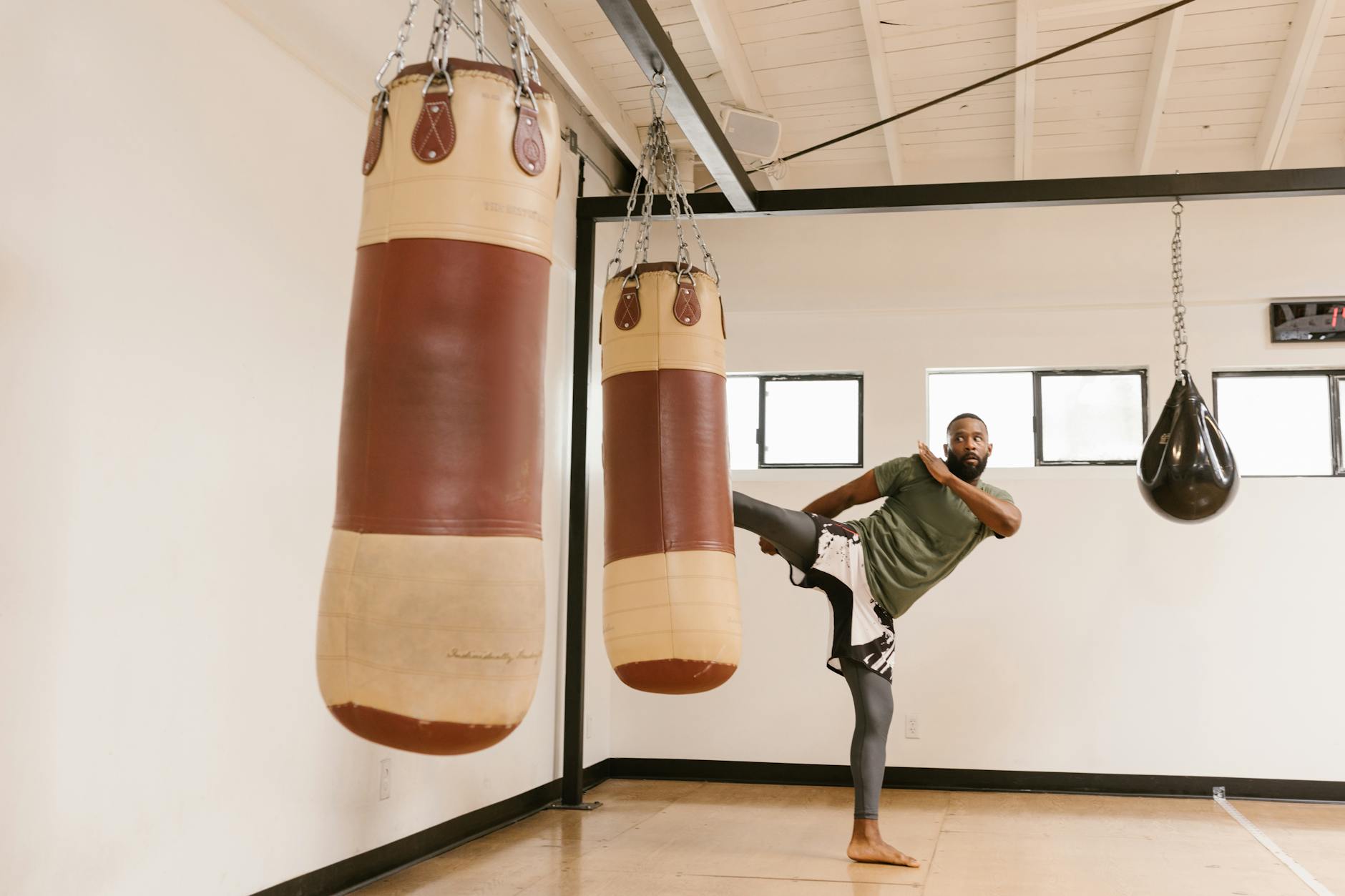
Kickboxing, Sleep, and the Recovery Equation
One benefit that rarely gets attention in fitness marketing is sleep quality. Physical activity from martial arts like kickboxing has significant evidence linking it to improved sleep quality and duration, including in people with sleep disorders. For runners who already struggle with disrupted sleep during heavy training blocks — a common complaint during peak mileage weeks — the addition of a vigorous, skill-based workout earlier in the day can reset the body’s fatigue signals and promote deeper overnight recovery.
The mechanism is likely a combination of physical exhaustion and mental discharge. Kickboxing demands enough cognitive focus that it creates genuine neurological fatigue, the kind that makes your brain ready for sleep in a way that a monotonous tempo run sometimes does not. If you train kickboxing in the morning or early afternoon, the EPOC-driven metabolic activity gradually tapers through the evening, aligning well with natural circadian downregulation.
What the Future of Cross-Training Looks Like for Endurance Athletes
The old model of cross-training for runners — cycling, swimming, maybe some yoga — is giving way to a broader understanding of what athletic development actually requires. Kickboxing fits into a growing trend of endurance athletes adopting combat sports not for self-defense, but for the neurological complexity, full-body power output, and metabolic variety they provide.
Regular sparring practice sharpens reaction time by training practitioners to read body language and anticipate movements, a skill set that has surprising carryover to pack racing, technical trail navigation, and the split-second decisions that determine whether you roll an ankle on a descent. As more research emerges on the cognitive benefits of complex motor learning for aging athletes, expect kickboxing and similar disciplines to become standard recommendations alongside traditional strength training. The combination of cardiovascular demand, neuromuscular coordination, and psychological engagement makes it one of the most complete single-session workouts available — and for runners willing to step outside their comfort zone, it might be the missing piece that makes everything else work better.
Conclusion
Kickboxing delivers a range of benefits that most runners and cardio athletes never consider. It burns 600 to 900 calories per hour with sustained afterburn effects, increases VO2max in as few as five weeks of regular training, builds upper-body anaerobic power by over 40 percent, and improves balance, coordination, and cognitive function with clinical evidence to back each claim. It also addresses the rotational strength deficits, proprioceptive gaps, and mental staleness that accumulate in any single-sport training program. The practical next step is simple.
Find a reputable kickboxing gym or class that emphasizes technique instruction over just intensity, schedule one or two sessions per week in place of easy runs or supplemental training, and give your body three weeks to adapt before judging the results. Start at moderate intensity, prioritize form over power, and pay attention to how your running feels after your joints and stabilizers catch up to the new demands. The worst-case scenario is a broader fitness base and some sore muscles you did not know you had. The best case is a genuine shift in your overall athletic capacity.
Frequently Asked Questions
How many calories does kickboxing actually burn compared to running?
A 155-pound person burns approximately 372 calories in 30 minutes of kickboxing. The same person burns roughly 335 to 400 calories running at a moderate pace for the same duration. At higher intensities, a full hour of kickboxing can reach 600 to 900 calories depending on body weight and effort level.
Can kickboxing improve my VO2max the way running does?
Yes. A 2014 study in Muscles, Ligaments and Tendons Journal showed that kickboxing three days per week for five weeks significantly increased VO2max. It will not replace high-mileage aerobic base building, but it provides a meaningful cardiovascular stimulus, particularly for runners who have plateaued with running alone.
Is kickboxing safe if I already have knee or ankle problems from running?
It depends on severity. The kicking and pivoting components place rotational stress on knees and ankles that running does not. If you have active injuries, start with boxing-only formats that keep your feet grounded. A 2003 study identified strains of the knees, ankles, shoulders, hips, and back as the most common kickboxing fitness injuries, most of which stem from poor form rather than inherent danger.
Will kickboxing help me sleep better during heavy training blocks?
Evidence supports this. Research on martial arts training shows significant links to improved sleep quality and duration, including in people with sleep disorders. The combination of physical and cognitive fatigue from kickboxing sessions tends to promote deeper recovery sleep when training is done earlier in the day.
How often should a runner do kickboxing per week?
One to two sessions per week is the sweet spot for most runners. This provides the cross-training benefits — upper-body strength, rotational power, balance, and metabolic variety — without compromising running-specific recovery or mileage targets. Place sessions at least 48 hours before key workouts during the adaptation period.
3 thoughts on “The Benefits of Kickboxing You Didn’t Know”
Comments are closed.