Jump rope delivers more high-intensity cardiovascular minutes per session than almost any other exercise you can do at home. A 10-minute jump rope workout can burn roughly 100-150 calories and elevate your heart rate into the vigorous zone within the first 30 seconds, making it one of the most time-efficient conditioning tools available for runners and fitness enthusiasts. For comparison, you would need to run at a 6-minute mile pace to match the caloric expenditure of moderate-intensity rope jumping, and most recreational runners cannot sustain that speed.
The efficiency comes from the full-body coordination required. Your calves, quadriceps, shoulders, and core all engage simultaneously while your cardiovascular system works to supply oxygen to multiple muscle groups. A runner training for a half marathon might incorporate two 15-minute jump rope sessions per week during taper periods when reducing mileage but wanting to maintain cardiovascular conditioning without the impact stress of additional running miles. This article explores why jump rope accumulates high-intensity minutes so quickly, how to structure sessions for maximum cardiovascular benefit, which rope types suit different training goals, common technique errors that limit effectiveness, and how to integrate rope work into an existing running program without overtraining.
Table of Contents
- How Does Jump Rope Accumulate High Intensity Minutes So Quickly?
- The Cardiovascular Benefits of Short Jump Rope Sessions
- Selecting the Right Jump Rope for Intense Workouts
- Common Mistakes That Reduce Jump Rope Intensity and Effectiveness
- Integrating Jump Rope with Running Programs
- How to Prepare
- How to Apply This
- Expert Tips
- Conclusion
- Frequently Asked Questions
How Does Jump Rope Accumulate High Intensity Minutes So Quickly?
The metabolic demand of jump rope stems from its continuous nature and the requirement to leave the ground repeatedly. Unlike cycling or swimming, where momentum can provide brief recovery moments, each jump requires a muscular contraction to lift your body weight. At a moderate pace of 100 jumps per minute, you perform 1,000 ground contacts in a 10-minute session, with each contact requiring force production from your lower body. Heart rate data from trained athletes shows that jump rope typically elevates heart rate to 75-85% of maximum within two minutes of starting, placing it firmly in the vigorous intensity zone defined by exercise physiology guidelines. This compares favorably to running, where reaching similar heart rate percentages often requires 4-6 minutes of building pace.
The difference matters for time-constrained training: a 20-minute jump rope session might yield 16-18 minutes in the target heart rate zone, while a 20-minute run might only produce 12-14 minutes at equivalent intensity after accounting for warm-up pacing. However, this intensity comes with a limitation. The continuous calf engagement causes significant local muscular fatigue before cardiovascular limits are reached in many beginners. Someone new to jumping might find their calves burning and forcing rest intervals after just 2-3 minutes, even though their breathing would allow them to continue. This local fatigue issue typically resolves after 3-4 weeks of consistent practice as calf endurance develops.
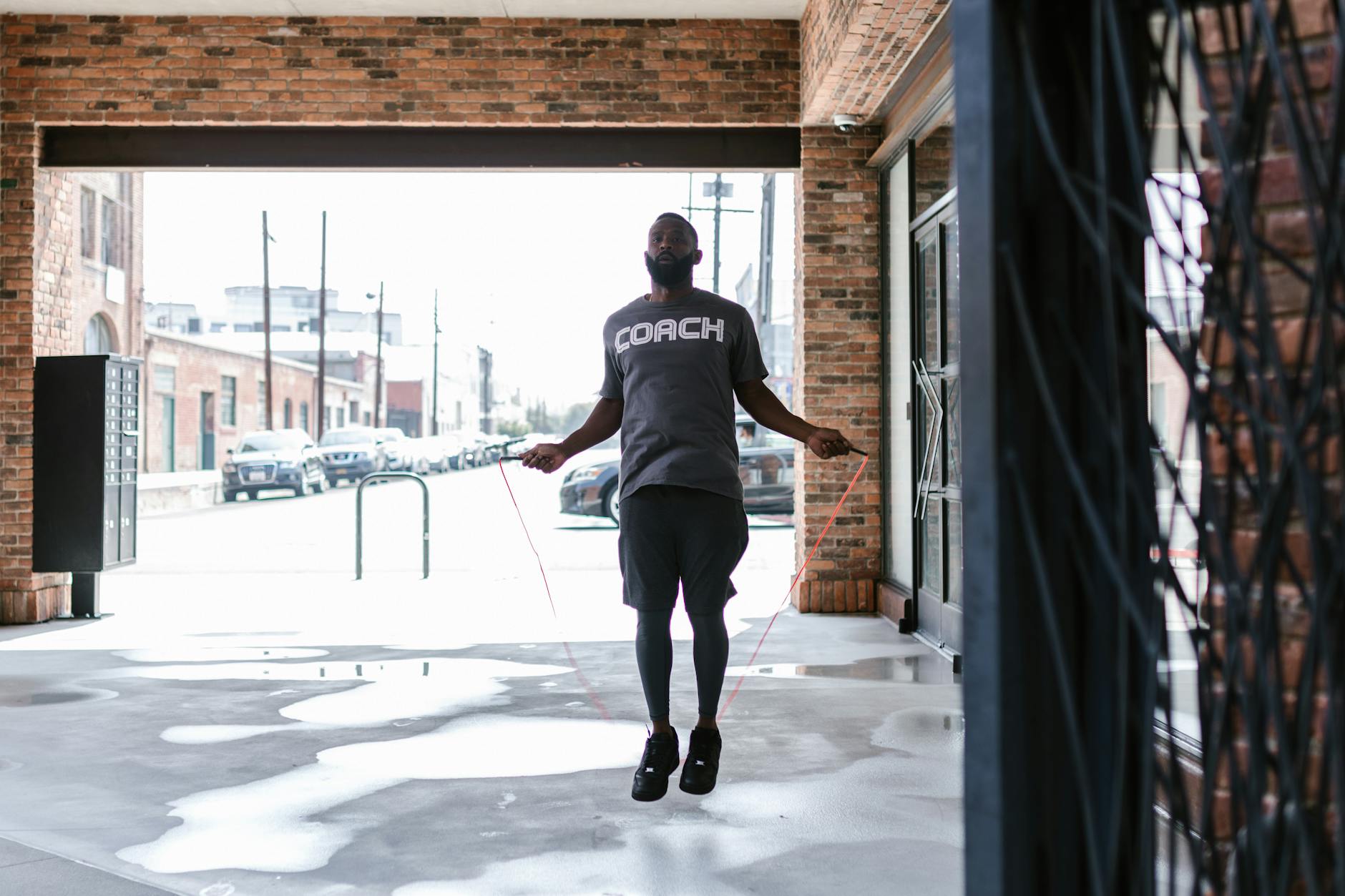
The Cardiovascular Benefits of Short Jump Rope Sessions
Research published in the European Journal of Applied Physiology found that 10 minutes of daily jump rope training improved VO2 max by 7-8% over 12 weeks in previously sedentary adults. This improvement rate matches what longer-duration moderate-intensity exercise programs typically achieve, suggesting that jump rope’s high metabolic demand compensates for shorter session lengths. The key mechanism is time spent above the lactate threshold, which stimulates cardiovascular adaptations more efficiently than time spent at lower intensities. For runners specifically, jump rope provides cardiovascular stress without the eccentric loading that causes muscle damage during running. Each running stride involves absorbing 2-3 times body weight in impact force through a lengthening quadriceps contraction, which creates the soreness and recovery needs associated with running volume.
Jump rope contacts are shorter and more elastic, involving primarily concentric (shortening) contractions and generating less muscle damage per minute of exercise. This allows athletes to accumulate additional cardiovascular training stimulus during heavy running blocks without extending recovery timelines. The limitation here applies to bone health. If bone density improvement is a training goal, running provides superior stimulus compared to jump rope. The higher impact forces and varied loading angles of running create stronger osteogenic effects. Athletes using jump rope as a running substitute during injury periods should consider supplementing with other weight-bearing activities if the substitute period extends beyond 4-6 weeks.
Selecting the Right Jump Rope for Intense Workouts
Rope selection significantly affects workout quality and the ability to sustain high-intensity efforts. Speed ropes made from thin PVC or coated cable rotate faster with less effort, allowing higher jump frequencies and reduced shoulder fatigue. Beaded ropes offer better feedback and maintain their arc in wind but require more energy per rotation. Weighted ropes add upper body training but reduce sustainable session length. A practical example illustrates the difference: a conditioned jumper using a speed rope might maintain 140 jumps per minute for 10 minutes, accumulating approximately 1,400 jumps. The same jumper using a 1-pound weighted rope might only sustain 90 jumps per minute before shoulder fatigue forces rest intervals, accumulating perhaps 700-800 jumps in the same time frame. The weighted rope session provides more shoulder and forearm conditioning, but the speed rope session delivers superior cardiovascular stimulus. For runners prioritizing cardiovascular efficiency, a basic speed rope with ball-bearing handles represents the best value. These range from $8-25 and last several years with normal use. Ropes without bearing systems create friction at the handle junction, slowing rotation and increasing the energy cost of each jump in a way that causes premature arm fatigue without proportionally increasing cardiovascular benefit.
## How to Structure Jump Rope Intervals for Maximum Conditioning Interval structures optimize jump rope training by matching work periods to fitness levels and goals. Beginners benefit from short work periods of 30-45 seconds followed by equal rest, allowing calf recovery while keeping total session time reasonable. As conditioning improves, extending work periods to 2-3 minutes with shorter rest intervals increases time in higher heart rate zones. A direct comparison: continuous jumping for 10 minutes might average 78% of maximum heart rate across the session. Interval jumping with 2 minutes on and 30 seconds off for the same total work time might average 82% of maximum heart rate because each work interval can be performed at higher intensity. However, continuous jumping builds more specific endurance for activities requiring sustained output, while interval training creates greater peak cardiovascular stress. The tradeoff for runners involves specificity. Continuous jumping mimics the sustained nature of distance running and may transfer better to race performance. Interval jumping produces more potent cardiovascular adaptations per minute but trains a different energy system profile. Most runners benefit from including both approaches, using continuous jumping in base-building phases and interval jumping during speed development phases.

Common Mistakes That Reduce Jump Rope Intensity and Effectiveness
The most frequent error involves jumping too high. Each unnecessary inch of vertical displacement wastes energy, increases ground contact time, and reduces sustainable jump frequency. Efficient jumpers clear the rope by 1-2 inches maximum, keeping ground contact brief and elastic. Beginners often jump 4-6 inches high, which cuts sustainable pace by 30-40% and shifts stress toward the quadriceps rather than maintaining the calf-dominant pattern that makes jump rope efficient. Arm position errors compound jumping inefficiency.
Swinging from the shoulders rather than rotating from the wrists requires dramatically more energy and slows rope speed. Proper technique uses minimal arm movement, with rotation occurring almost entirely at the wrist joint. Elbows stay close to the body at roughly hip height, and the hands remain positioned slightly forward of the hips. A critical warning: jumping on concrete or other hard surfaces significantly increases injury risk and may cause shin splints, stress reactions, or plantar fascia irritation. Runners are particularly susceptible because their lower legs are already handling substantial training load. Jumping on rubber mats, wooden floors, or rubberized track surfaces reduces impact force by 20-30% and should be considered mandatory for sessions exceeding 5 minutes.
Integrating Jump Rope with Running Programs
Jump rope functions best as a supplement rather than a replacement within running programs. Placing jump rope sessions on easy running days adds cardiovascular stimulus without the muscular damage of additional running miles. A runner doing 40 miles per week might add two 15-minute jump rope sessions, gaining cardiovascular benefits equivalent to 5-8 additional running miles without the recovery cost.
During injury periods when running is restricted, jump rope can maintain fitness more effectively than most alternatives. A runner sidelined with a tibial stress reaction, for example, might be cleared for low-impact activities while avoiding running. Three 20-minute jump rope sessions per week, performed on a cushioned surface, can prevent significant cardiovascular detraining over a 4-6 week recovery period. Upon returning to running, these athletes typically regain race fitness faster than those who substituted with cycling or swimming, possibly because jump rope maintains more similar neuromuscular patterns.

How to Prepare
- **Measure and adjust rope length** by standing on the center of the rope and raising the handles. They should reach your armpits for beginners or chest level for experienced jumpers. Ropes that are too long cause timing issues and trip-ups; ropes that are too short force excessive jumping height.
- **Select an appropriate surface** that provides some cushioning. Gym floors, rubber mats, tennis courts, and rubberized tracks work well. Avoid concrete, asphalt, and thick carpet, which either transmit too much impact or grab rope material unpredictably.
- **Verify adequate ceiling clearance** of at least 10 inches above your head plus the rope arc, typically requiring 9-10 feet minimum for most adults.
- **Warm up dynamically** with leg swings, calf raises, and light hopping for 3-5 minutes. Cold muscles and tendons are more susceptible to strain during the repeated calf contractions of jump rope.
- **Start with a timer visible** rather than counting jumps. Time-based sessions provide more consistent training stimulus than jump counts, which vary with fatigue and technique.
How to Apply This
- **Begin with the basic bounce** using a two-foot takeoff and landing, focusing on minimal jump height and wrist-driven rotation. Maintain this until you can complete 2 minutes continuously without misses.
- **Progress to the alternate-foot step**, which mimics running cadence and distributes calf fatigue more evenly between legs. This pattern also allows slightly higher sustainable heart rates because each calf gets brief recovery during the opposite-leg contact.
- **Structure initial sessions as intervals**, using 1-2 minutes of work followed by 30-60 seconds of rest, repeated for 10-15 minutes total. Track heart rate if possible to confirm you are reaching target intensity zones.
- **Increase density progressively** by reducing rest intervals before extending work intervals. Once you can complete 5 continuous minutes at target heart rate, begin adding work interval duration in 30-second increments.
Expert Tips
- Use a metronome or music at 140-160 BPM to establish consistent rhythm and prevent the gradual pace decline that occurs when jumping without external timing cues.
- Focus on keeping shoulders relaxed and elbows stationary; arm fatigue usually indicates technique problems rather than genuine upper-body training benefit.
- Practice double-unders (two rope rotations per jump) only after establishing consistent single-under technique for at least 4 weeks, as premature double-under attempts often create poor habits that persist in basic jumping.
- Do not jump rope within 24 hours before key running workouts or races; the calf fatigue can subtly alter running mechanics and reduce performance.
- Time jump rope sessions by heart rate recovery rather than fixed rest periods as fitness improves; resume jumping when heart rate drops to 120-130 BPM to ensure consistent intensity across the workout.
Conclusion
Jump rope earns its reputation as a time-efficient cardiovascular tool through the combination of continuous muscular demand, rapid heart rate elevation, and low equipment requirements. Runners and general fitness enthusiasts can accumulate meaningful high-intensity minutes in sessions as brief as 10-15 minutes, making jump rope practical for busy schedules and effective as a supplemental training modality alongside running programs.
The keys to success involve proper technique fundamentals, appropriate surface selection, gradual volume progression, and strategic placement within weekly training schedules. Athletes who rush the learning process or add too much volume too quickly often encounter calf injuries or technique plateaus that limit long-term benefit. Those who approach jump rope as a skill requiring patient development typically find it becomes a sustainable and valuable component of their fitness toolkit.
Frequently Asked Questions
How long does it typically take to see results?
Results vary depending on individual circumstances, but most people begin to see meaningful progress within 4-8 weeks of consistent effort. Patience and persistence are key factors in achieving lasting outcomes.
Is this approach suitable for beginners?
Yes, this approach works well for beginners when implemented gradually. Starting with the fundamentals and building up over time leads to better long-term results than trying to do everything at once.
What are the most common mistakes to avoid?
The most common mistakes include rushing the process, skipping foundational steps, and failing to track progress. Taking a methodical approach and learning from both successes and setbacks leads to better outcomes.
How can I measure my progress effectively?
Set specific, measurable goals at the outset and track relevant metrics regularly. Keep a journal or log to document your journey, and periodically review your progress against your initial objectives.
When should I seek professional help?
Consider consulting a professional if you encounter persistent challenges, need specialized expertise, or want to accelerate your progress. Professional guidance can provide valuable insights and help you avoid costly mistakes.
What resources do you recommend for further learning?
Look for reputable sources in the field, including industry publications, expert blogs, and educational courses. Joining communities of practitioners can also provide valuable peer support and knowledge sharing.