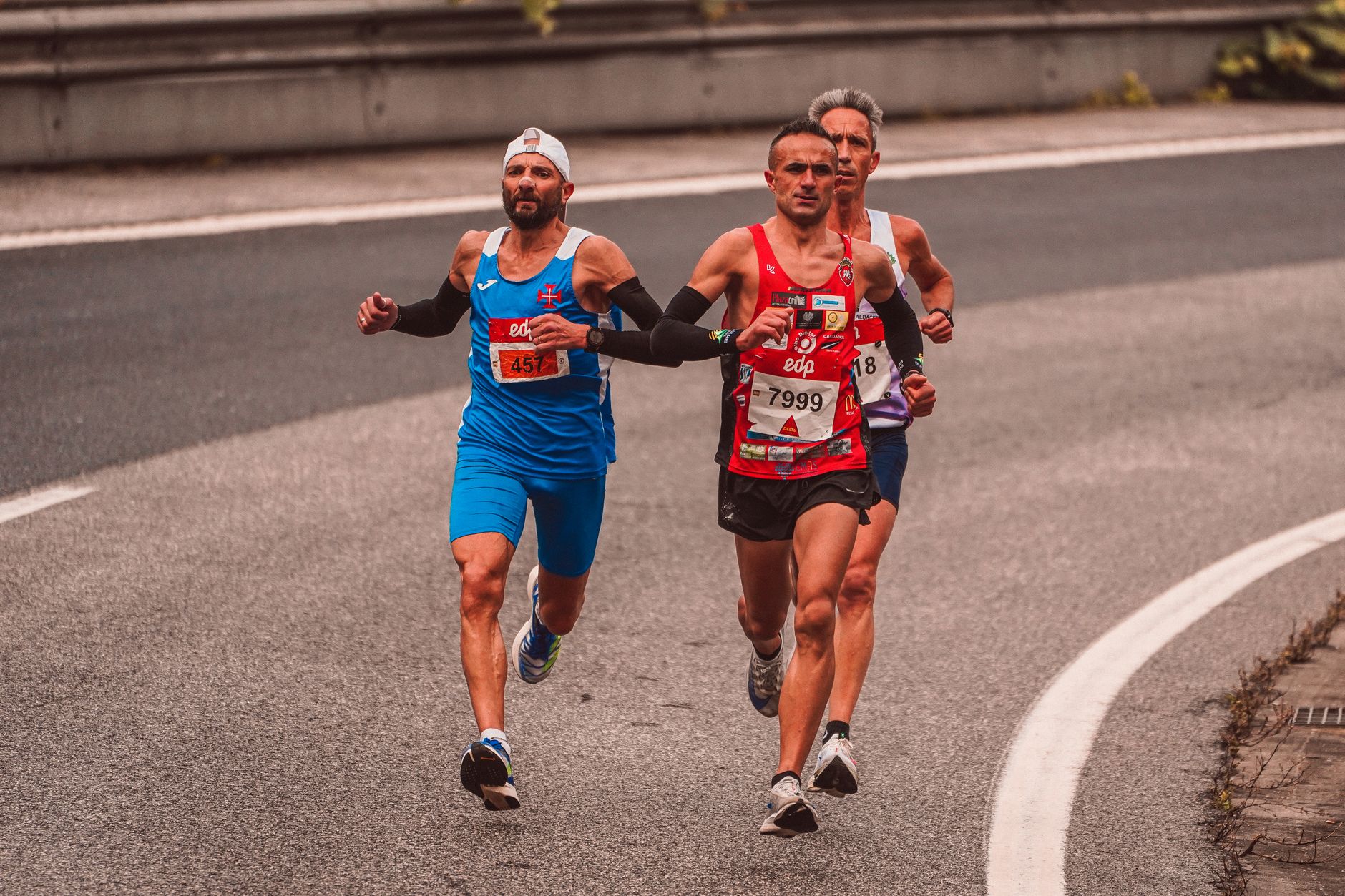
Runners slow down with age mainly because VO2 max falls and fast-twitch muscle power fades, while running economy often holds up. VO2 max, the maximum rate your body can use oxygen during hard exercise, peaks in the 20s and then declines each decade.
Georgia State University analysis in PLOS ONE finds marathon times are fastest at ages 25-34, then slow from about age 35 PLOS ONE analysis. Top men slow about 2 min per year and top women about 2.5 min per year, in elite and recreational runners. Training slows the VO2 max loss but does not stop it.
Medical information disclaimer: This article is for general educational purposes only and does not provide medical advice, diagnosis, or treatment. Always consult a physician or other qualified health professional about symptoms, medications, tests, or treatment decisions.
Table of Contents
- How fast does VO2 max fall?
- Why does the heart set the limit?
- What happens to muscle power?
- Does running economy stay young?
- What training best slows the slowdown?
How fast does VO2 max fall?
A Human Kinetics excerpt reports VO2 max falls about 10% per decade in sedentary adults Human Kinetics excerpt. Continued vigorous training slows the loss to about 5-7% per decade, with exceptional elites near 2%.
The drop is steady, not sudden. A runner who trains hard at 50 still loses aerobic ceiling, just more slowly than a sedentary peer.
Why does the heart set the limit?
An R Discovery summary of a long-distance runners study points to central factors. Max heart rate falls 3.2% per decade and cardiac output 5.8% per decade, with no significant change in arteriovenous oxygen difference. That difference measures how much oxygen muscles pull from blood.
A Tanaka, Monahan and Seals analysis in the Journal of the American College of Cardiology studied maximum heart rate and aging. It finds a fall of about 0.7 beats per year and predicts max as 208 minus 0.7 times age. The result came from a meta-analysis of 351 studies with 18,712 subjects plus 514-person lab validation.
What happens to muscle power?
A National Institute on Aging and NIH Cold Spring Harbor review describes sarcopenia, age-related muscle loss. Loss centers on fast-twitch type II fibers, which shrink and drop out first.
Those fibers drive sprint, surge, and climb. The same review finds strength drops significantly after 50-60 at roughly 2-4% per year, faster in legs. That loss cuts power, turnover and hill running.
Does running economy stay young?
Humboldt State University researchers reporting via ScienceDaily found runners over 65 retain youthful running economy ScienceDaily summary. They used similar or 2-9% less metabolic energy than runners in their 20s across 2.01-2.91 m/s, despite lower leg stiffness and altered mechanics.
Running economy means the energy cost to hold a steady pace. A Sports Medicine systematic review notes this preservation applies to runners training at least 3x/week for 30 min, not sedentary adults. Habit keeps stride efficient even as stiffness and mechanics shift.
What training best slows the slowdown?
A Sports Medicine systematic review via NIH PMC found adding lower-limb strength plus plyometrics improves running economy, muscle power and 1,500-10,000 m performance NIH PMC review. Plyometrics means quick jumping and bounding drills that train snap. For healthy runners, the practical pattern is simple: Pick one fast stride or hill session and one leg-strength session this week to protect turnover and climbing.
- Keep vigorous aerobic running across the week to slow VO2 max loss.
- Add leg strength plus jumps and bounds for power and economy.
- Hold a base of 3 sessions per week for 30 minutes or more.
2 thoughts on “Why Runners Slow Down With Age: VO2 Max, Muscle Power, and Running Economy”
Comments are closed.